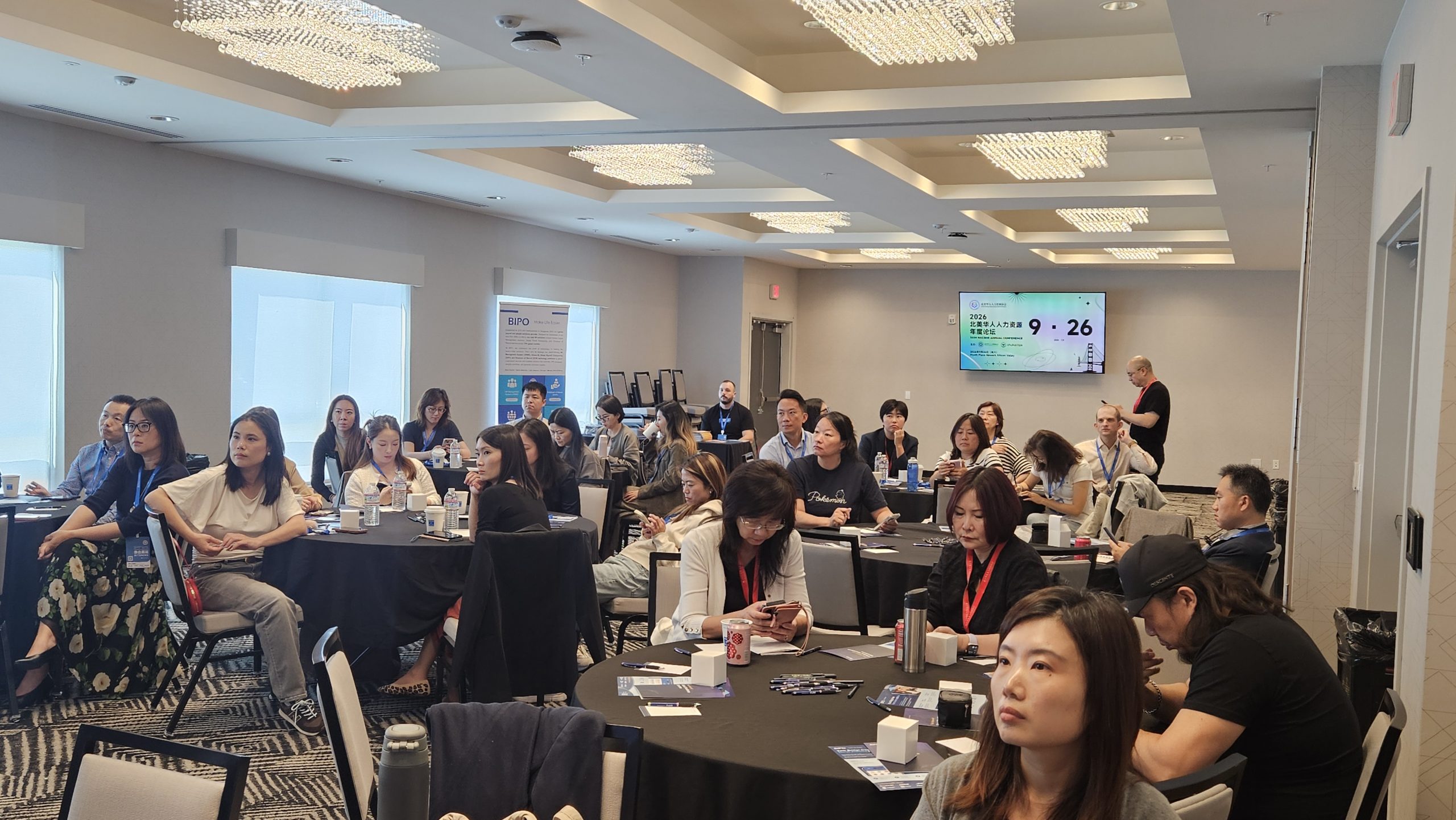
SILICON VALLEY, September 26, 2026 — The 2026 NACSHR Annual Conference convened in Silicon Valley, bringing together more than 50 HR leaders, business executives, technology professionals, and professional-services experts from Silicon Valley, Toronto, Chicago, Houston, Los Angeles, and the U.S. East Coast. Over a full day of discussion, participants examined organizational transformation in the AI era, new ways of working and evolving talent profiles, the changing role of the HRBP, globalization and cross-cultural management, career development for Chinese-American HR professionals in North America, immigration policy, and employee benefits and enterprise risk. The conference was supported by sponsors BIPO and Ji Mobility Law, whose partnership played an important role in advancing professional exchange, industry connection, and knowledge sharing within the North American Chinese HR community.
In a single sentence, the core message of this year's conference:
In an era of hyper-accelerated AI, what is changing is not merely tools and skills. Work, roles, organizations, the division of labor between humans and machines, the HRBP role, talent standards, global management, and incentive systems are all being redefined. As more and more execution is handed to AI, the scarcest and most valuable human capability is becoming judgment.
Two themes ran through the entire day: Redesign and Human Judgment.
From HR Tech Upgrades to the Redesign of Work and Organizations
The conference opened by looking across a longer industry cycle at the changes AI is bringing to HR and to organizations.
Gawain, a longtime observer of the HR technology sector, spoke on “A Decade of Global HR Tech Trends and the HR Challenges of the AI Era.” Drawing on more than ten years of HR Tech industry data, funding and M&A activity, and technological evolution, he noted that earlier generations of software mainly helped HR digitize processes such as recruiting, performance management, and compensation, whereas generative AI and agents have now begun to participate directly in, and even execute, work tasks.
This means the question facing companies is no longer simply “How do we use AI?” Instead, they must answer anew: which work should remain with people, which tasks can be handed to AI, and which judgments must be owned by humans. He also observed that while AI’s gains in individual capability and productivity are already evident, using AI to improve organizations and redesign work and processes remains the core challenge companies worldwide are still working through. And the pace is accelerating: the Copilot model long championed by Microsoft has now given way to Autopilot, and AI’s shift from assisting to delivering outcomes has happened within roughly the past 180 days. HR must therefore extend its focus beyond individual AI skills to the redesign of work and the organization itself, a point that prompted deep reflection among the HR professionals in the room.
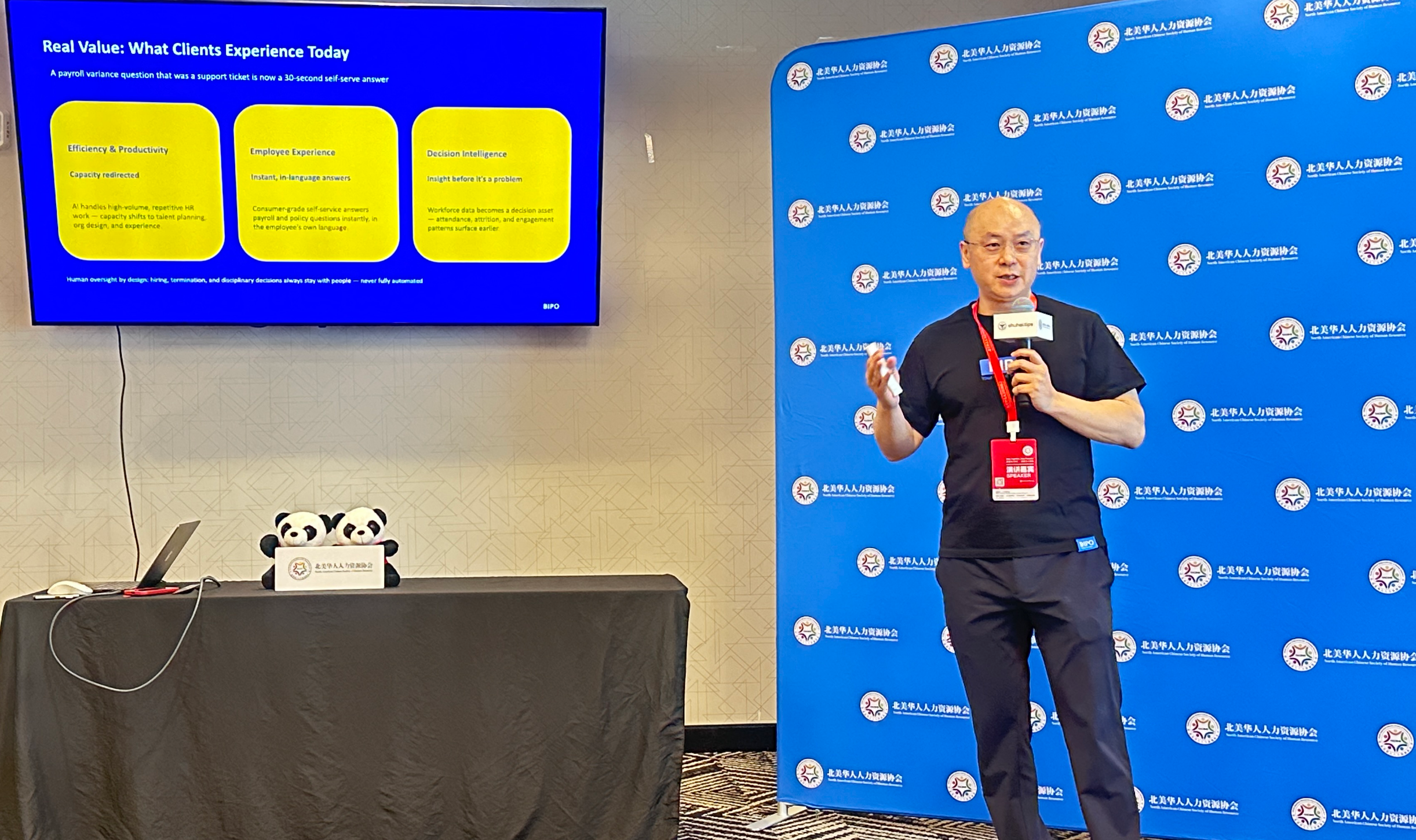
2026 NACSHR Conference Chair Bijun Zhang followed with a talk titled “When Code Gets Cheap, the Org Chart Breaks.” Using Anthropic as a case study, she examined how AI-native companies are redesigning the division of labor, and extended that shift to the HR function. She argued that as AI dramatically lowers the cost of producing code, content, and execution, the real organizational bottleneck is moving from “getting things done” to Judgment: verification, review, trade-offs, taste, safety, and accountability. The new Human + AI division of labor can be summarized as: Humans hold judgment, AI holds throughput.
This shift will not stay within technical teams. Bijun further proposed that as much transactional HR work is automated or augmented, HR’s time will move from transactional delivery toward strategic judgment, and the traditional Three-Pillar Model of COEs, HRBPs, and Shared Services may itself be redesigned. HR may evolve toward a new model built on a unified People Data and AI Platform, organized into Product Pods and Flow-to-Work Teams, with new roles such as People Strategist, People Scientist, and People Technologist. The CHRO role may likewise evolve into that of an Enterprise Workforce Architect, responsible for designing how humans and AI together make up the company’s future workforce.
This set a central proposition for the day: the more AI can execute, the more people need to exercise judgment. What must change is not just the tools, but work and the organization themselves.

Global Competition Accelerates: Technology Platforms and Local Capabilities Are Both Essential
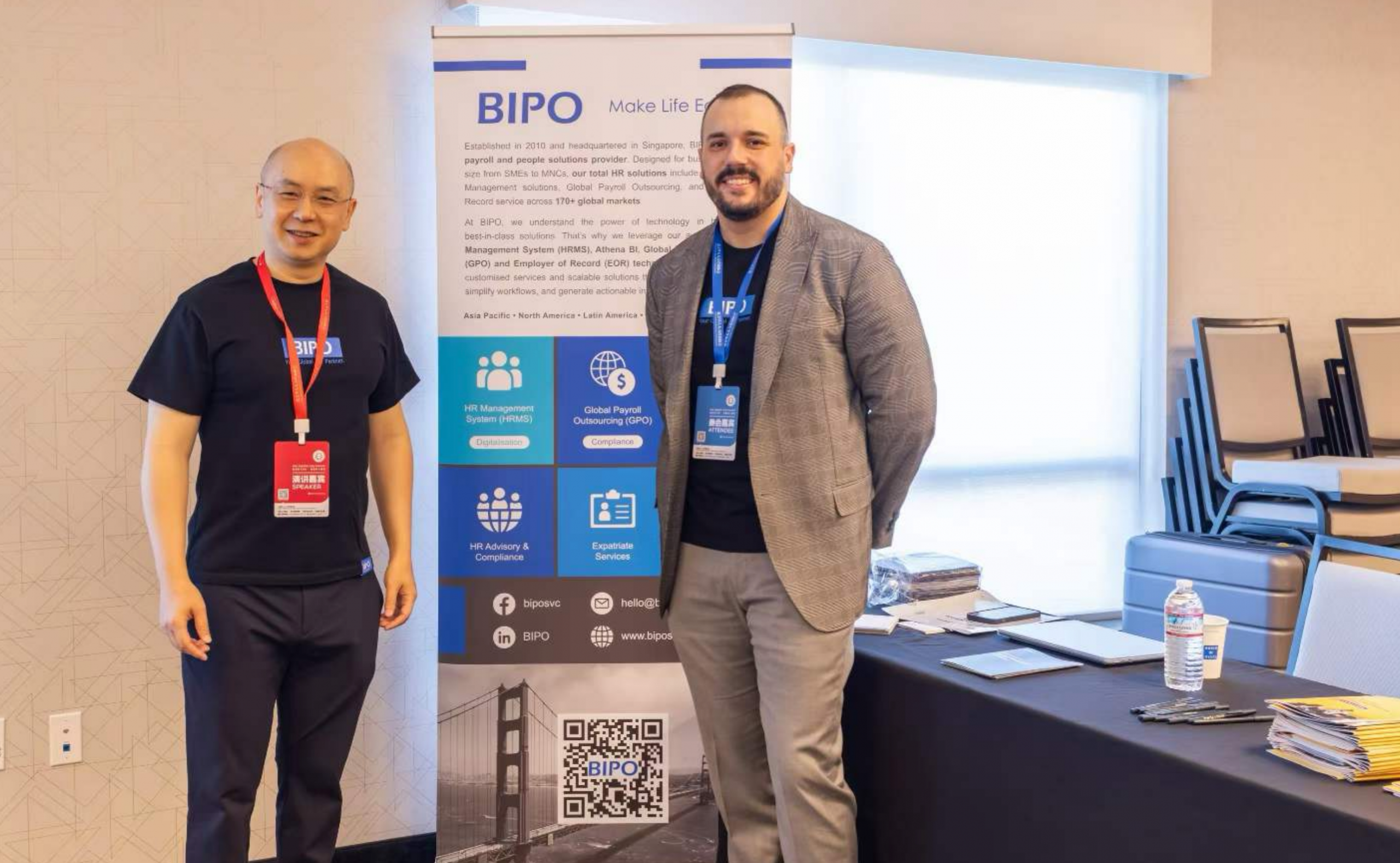
David Tan, North America Account Director and Canada Country Manager at BIPO, spoke on “From Local to Global: How BIPO's AI Powers North American Companies Abroad,” addressing the talent, payroll, compliance, and localization challenges companies face as they enter global markets.
As a sponsor of this year’s conference, BIPO noted that growth pressure, global competition for talent, customer demand for localization, and faster competitive cycles are pushing companies to accelerate global expansion. At the same time, worker classification, payroll, taxation, benefits, labor regulations, and cultural differences are rapidly increasing the complexity of global HR management.
David Tan argued that combining a unified technology platform and AI capabilities with local expert teams can help companies reduce operational and compliance complexity as they enter new countries and regions.
This reflects a broader shift: for global HR, AI is not only an efficiency tool but is gradually becoming organizational infrastructure that spans countries, systems, and regulatory environments.
Organizational Transformation in the AI Era: Judgment, Human Nature, and Incentives Return to the Core
The morning roundtable on “Organizational Transformation in the AI Era” was moderated by Tina, HRBP at Meta AI Labs. Panelists included Yang Chen, former VP of Engineering at Paraform and former product and engineering lead at TikTok; Chunxia, Founding Partner of NextCurve Intelligence; and Jian Qiao, Member of Technical Staff at Fireworks.
In their opening remarks, the three panelists summed up the AI era as Reset, Reboot, and “human nature and incentives.” Those three ideas effectively set the tone for the discussion: the change AI brings is not only technological; ultimately it comes back to human capability, organizational structure, and incentive design.
Yang Chen observed that AI is sharply compressing development time, while the share of effort devoted to design, QA, and judgment is actually rising. What will truly set talent apart may no longer be execution speed alone, but the ability to think independently, make sound judgments, and bring “taste” to the quality of outcomes.
This led to one of the most representative ideas of the day:
Judgment is the new output.
The panel went on to argue that the capabilities worth sustained investment over the next three years are not any single AI skill, but judgment, together with the courage to solve problems across traditional professional boundaries. As role boundaries loosen, talent will increasingly organize its work around problems rather than strictly around job descriptions.
Jian Qiao suggested that instead of dwelling on whether AI will replace them, people facing AI anxiety should make the question concrete by starting to use AI on one real piece of work.
At the same time, he cautioned that while AI productivity can rise quickly, human cognitive capacity, attention, and psychological bandwidth do not grow at the same pace. Mental health, human touch, a sense of meaning, and organizational rhythm may therefore rise from traditional employee-experience topics to major organizational issues in the AI era.
Chunxia, speaking from the perspective of organizational leaps and incentive design, argued that real organizational change still rests on three foundations: the mindset of the top leader, the codification of workflows, and incentive systems aligned with human nature.
As agents enter the workplace, the next generation of organizations may gradually shift from purely “people managing people” to hybrid Humans + Agents organizations. How work is divided between people and agents, how agents are evaluated, and how the people who design and manage agents are assessed will all become new questions of organizational design and incentives.

From Annual Renewals to Continuous Benefits and Risk Management
Cost and risk management were also key themes of the conference.
Annie Huang, California Licensed Insurance Broker with NACSHR, spoke on “The 2027 U.S. Business Insurance Cycle: How HR Should Plan Ahead, from Employee Health Benefits to Enterprise Risk Protection,” outlining the changes underway in the U.S. employee benefits and commercial insurance markets.
She noted that as medical costs continue to rise, small and mid-sized businesses can no longer manage employee benefits the traditional way, comparing prices in the final few weeks before renewal. Instead, they need to start 90 to 120 days in advance: updating employee enrollment data, comparing the insurance market, planning employer contribution strategies, and communicating with employees early.
The discussion extended from medical benefits to enterprise risk areas including Workers’ Compensation, EPLI, Cyber Insurance, E&O, and General Liability. For HR, employee benefits, employment risk, and business insurance are becoming increasingly intertwined, and benefits management is shifting from a once-a-year purchase to ongoing planning and management.
As U.S. Immigration Policy Shifts Frequently, HR Must Learn to Manage Uncertainty
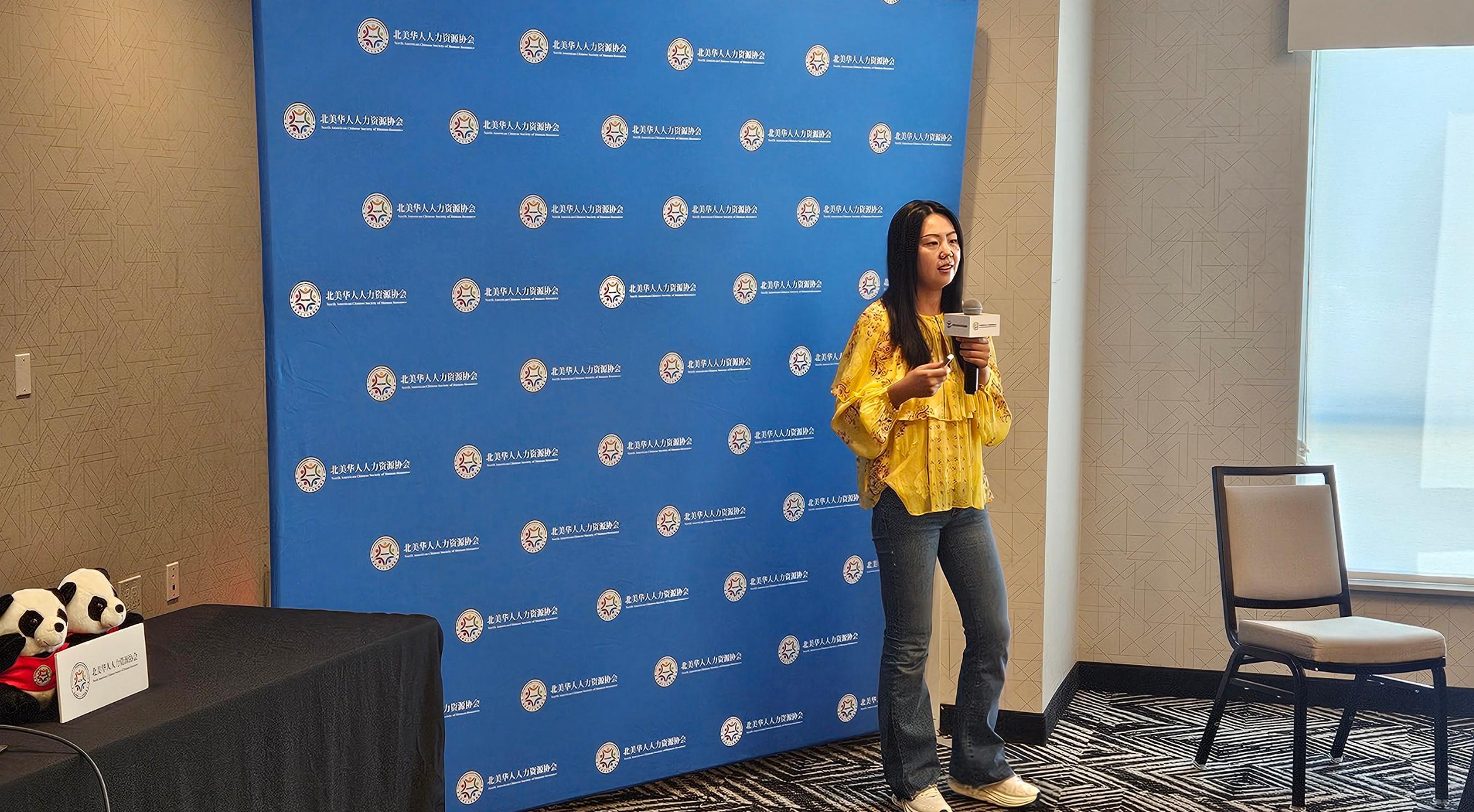
Jacky (Jiaqi) Ji, Partner at Ji Mobility Law, spoke on “Adjusting Expectations as Immigration Policy Keeps Changing,” reviewing a range of recent developments affecting the employment of highly skilled talent and international employees in the U.S., including H-1B, F-1, CPT, OPT, PERM, and H-4 EAD, as well as a potential new link between corporate layoffs and H-1B review.
Jacky emphasized one point in particular: amid frequent policy changes, HR must first distinguish among rules already in effect, policies restricted by the courts, and changes still in rulemaking or litigation, rather than treating every policy headline as a settled rule.
Take the closely watched $100,000 H-1B fee. The White House extended the relevant proclamation on September 18, 2026. However, a federal district court had previously ruled the fee unlawful, and in July the First Circuit Court of Appeals declined to stay that ruling. As of the conference date, the fee requirement therefore remained constrained by court rulings, and the legal dispute was ongoing.
Jacky also addressed changes to the F-1 Duration of Status (D/S) rule. The new rule, originally scheduled to take effect on September 15, was stayed by a federal court the day before and, as of the conference, had not formally taken effect.
For corporate HR, a more significant development is the growing intersection between immigration policy and workforce planning. The H-1B Executive Order issued on September 18 expressly directs the relevant agencies to consider, in their review, whether an employer has conducted layoffs in the past year or plans to lay off U.S. workers in positions similar to the H-1B roles.
This means collaboration among HR, hiring managers, and immigration counsel needs to move further upstream. Immigration issues can no longer be handled only when an offer goes out or a visa is about to expire; they need to enter headcount planning, layoff planning, talent retention, and role design much earlier.
Drawing on everyday business scenarios, Jacky also discussed how to explain the H-1B lottery policy to employees, how to assess CPT employment, employer obligations and the agent model under O-1, and whether L-1 can, in some cases, serve as a talent mobility pathway beyond H-1B.
The session underscored that in a highly uncertain policy environment, HR’s professional value lies not in giving employees a seemingly certain answer, but in understanding what stage a rule is in, assessing the risk, and helping both the company and its employees form reasonable expectations.

China–U.S. Global Expansion: Local HR Is Shifting from Executor to Strategic Bridge
Alice Tian, VP of HR & Admin at Freewind Technology Corporation, spoke on “Going Global Between China and the U.S.: Challenges for Local HR and Cross-Cultural Management,” discussing the management tensions global companies frequently encounter when operating in North America.
Alice Tian noted that headquarters often wants to replicate management practices already proven at home, yet local laws, labor relations, compensation and benefits systems, work culture, and employee expectations may be entirely different. Local HR is therefore often caught between communication pressures from headquarters on one side and local employees on the other.
In her view, local HR should not be merely an enforcer of policy, but a Strategic Bridge and Cross-Cultural Interpreter within the company.
With headquarters, HR must learn to explain local realities in the language of cost, risk, data, and business, offering workable alternatives even while saying “no.” With local employees, HR must build trust through transparent communication, clear boundaries, and respect for local culture.
She further proposed a Glocal (Globalization + Localization) management approach: headquarters should set clear “red lines” on strategy, compliance, and core budgets, while giving local teams sufficient authority and flexibility over day-to-day management and local policies.

Ways of Working and Talent Profiles in the AI Era: Talent Standards Are Being Redefined
The afternoon roundtable on “Ways of Working and Talent Profiles in the AI Era” was moderated by Linna Dai, HRBP & Recruiting Lead at Luma Research Lab.
Panelists included Felicity Yang, HR Director at Weee; Ying Lu, Data Scientist at Zoom (ex-Google); and Ethan Guo, TPM at Databricks (formerly Director of Infra TPM at GitLab).
The discussion covered ways of working in the AI era, talent profiles, changing roles, talent standards, recruiting and selection, and models of human–AI collaboration.
As information search, content generation, coding, analysis, and parts of process execution become ever easier for AI to perform, the talent question facing companies is changing. Where employers once asked mainly whether a person has a particular skill, they now need to ask whether that person can define problems, evaluate outcomes, learn quickly, and use AI effectively to get work done.
As a result, talent standards in the AI era increasingly point to judgment, learning agility, complex problem-solving, cross-functional collaboration, and Human + AI Collaboration.
Traditional selection methods centered on fixed experience, skill checklists, and standard job descriptions also need to be re-examined.

The HRBP’s First Transformation Begins with the HRBP
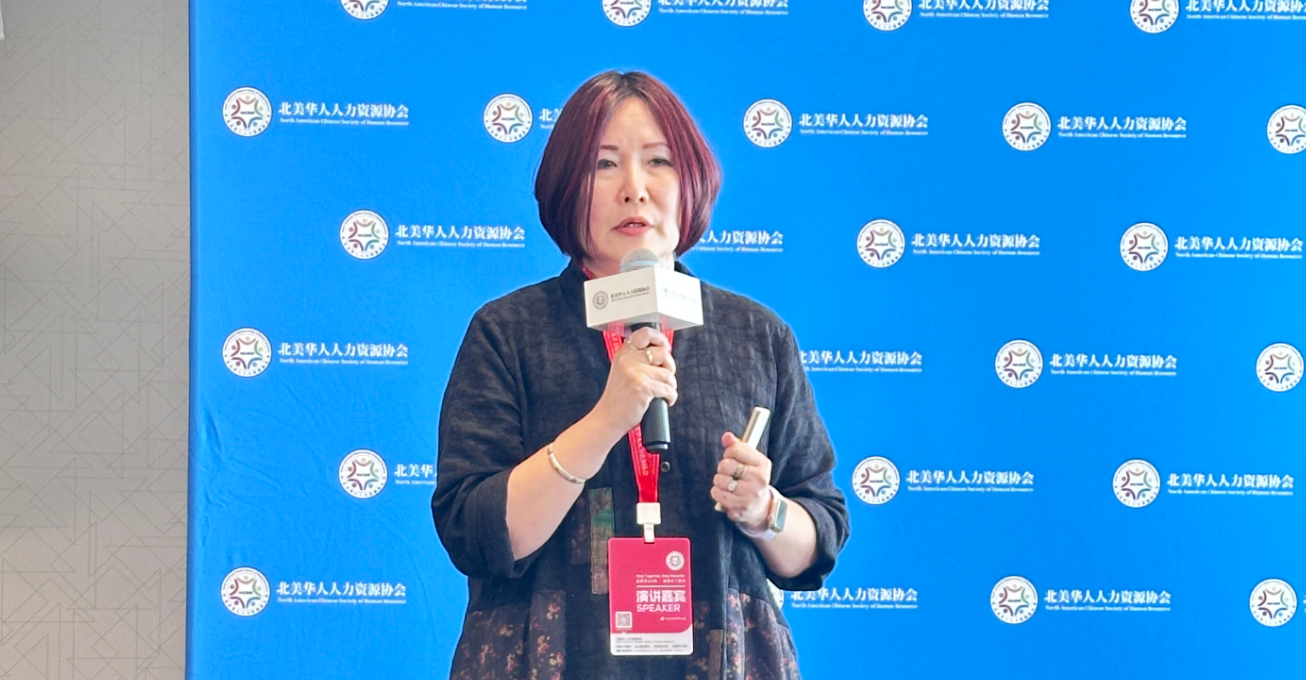
Cynthia Gao, Head of Global HR for the BL Apps Division at ASML, spoke on “The HRBP in the AI Era: From Detoxifier to Midwife,” examining how the HRBP role is changing.
She argued that HRBP transformation must begin with HRBPs themselves.
In the past, HRBPs often stayed in a mode of observing issues, waiting for requests, relying on fragmented experience, and maintaining existing processes. The new way of working should use AI to widen the field of view, turning surveys, cases, workflows, talent data, and employee feedback into shared evidence that can be validated and discussed.
She summarized this transformation path as: See Earlier. Solve Faster. Prove More Value.
In other words: identify problems earlier, drive solutions faster, and demonstrate HR’s business value through results.
Cynthia Gao closed with a concrete 30-day action framework: Detox One Barrier. Illuminate One Roadblock. Deliver One Visible Impact.
AI’s greatest value to HRBPs is not simply adding another tool, but moving HRBPs from passively receiving problems to proactively diagnosing them, driving solutions, and proving business impact.
Career Development for Chinese-American HR Professionals: From Expertise to Leadership and Influence
The closing roundtable, “Career Development for Chinese-American HR Professionals in North America,” brought the conversation back from AI, organizations, and talent to HR professionals’ own growth.
The roundtable was moderated by Mindy Gao, HR Director at Silergy, with Jane Liang, Head of HR; Tan Huangfu, Head of HR - US at Avia Games; Alice Tian; and Cynthia Gao.
Panelists discussed career growth, leadership, career breakthroughs, building influence, cross-cultural management, and future opportunities for Chinese-American HR professionals in North America.
For Chinese-American HR professionals, professional expertise remains the foundation of career development. At more senior stages, however, what often determines whether one can break through is the ability to understand the business, build trust in cross-cultural settings, voice professional judgment with confidence, and move from “completing one’s own work” to “helping the organization make better decisions.”
AI has only made these capabilities more important. As more execution is accelerated by technology, the importance of leadership, influence, communication, judgment, and cross-cultural understanding will not decline; it will continue to rise.

The Final Guest: AI
The conference closed with a special segment: “Today’s Final Guest Is AI.”
Rather than ending with a moderator’s summary, as most forums do, NACSHR invited AI to join a live conversation as the day’s final “guest.” Drawing on the speakers’ slides, the day’s topics, and professional context in HR Tech, organizations, and talent management, the AI responded to the moderator’s live questions and summarized the full day of discussion.
In that final exchange, the keyword that had run through the entire day surfaced once again:
Judgment.
As more information gathering, content generation, and execution can be handled by AI, what ultimately determines the quality of outcomes is whether people can ask the right questions, discern good answers, understand complex situations, and take responsibility for final decisions.
From Redesign to Judgment: The Core Proposition of the 2026 NACSHR Annual Conference
Looking back across the day, from HR Tech, AI-native organizations, and the Human + AI workforce to globalization, local HR, talent profiles, the HRBP, career development, immigration policy, and employee benefits, the different topics all pointed to the same shift:
AI is moving from “a new tool for work” into the underlying structure of work and organizations.
The questions HR faces are no longer just which software to buy or which AI skills employees should learn. HR must now answer: which work should still be done by people, which tasks should go to AI, how people and AI should divide the work, who should be hired and promoted, and how organizations should redefine performance, incentives, and accountability.
In this round of redesign, as execution becomes ever easier to replicate and scale, Human Judgment is becoming an increasingly scarce capability.