背调巨头First Advantage以22亿美元完成对Sterling Check的收购,
2024年10月31日,美国亚特兰大 — 作为全球就业背景筛查、身份和验证解决方案的领先供应商,First Advantage Corporation(纳斯达克代码:FA)今天宣布,公司已经成功完成对Sterling Check Corp的收购。此次交易的总价值达到了惊人的22亿美元,包括承担Sterling现有的债务。这一战略性收购不仅显著扩大了First Advantage的服务范围,也增强了其在全球背景筛查和身份验证市场的竞争力。
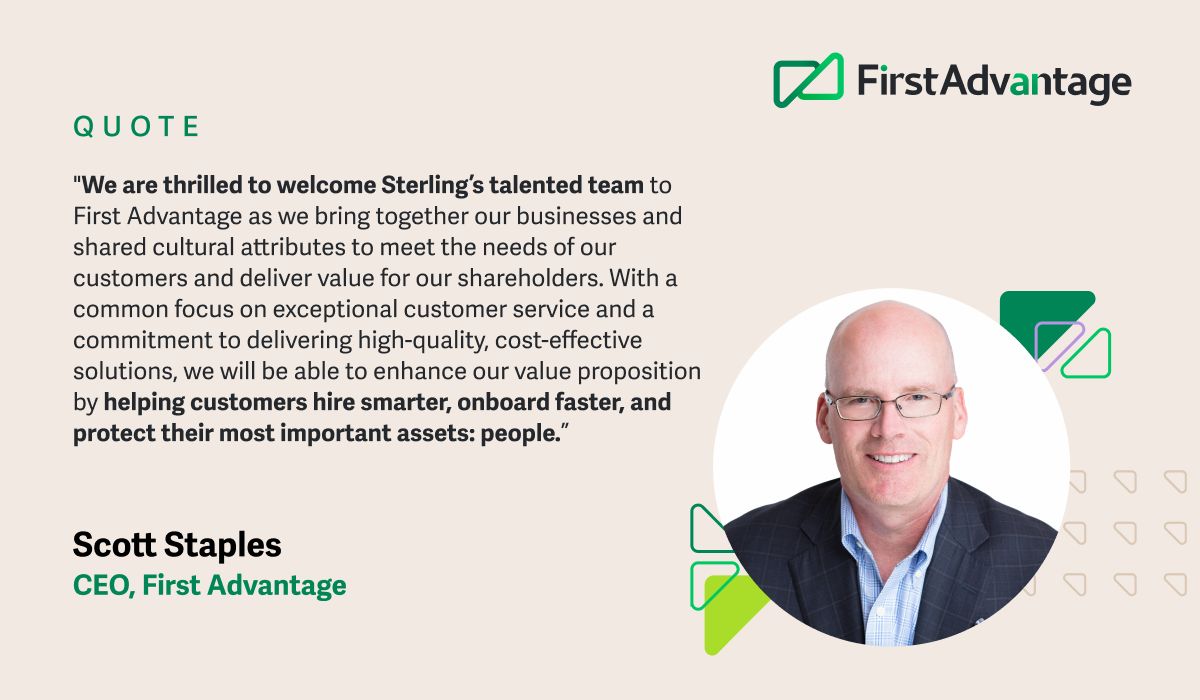
First Advantage的总裁兼首席执行官斯科特·斯台普斯(Scott Staples)在宣布收购完成时表示:“我们非常高兴能欢迎Sterling的才华横溢的团队加入First Advantage。通过整合双方的业务和共享文化属性,我们将更好地满足客户需求,并为我们的股东创造价值。这次合并将使我们能够通过提供高质量、成本效益的解决方案,增强我们的价值主张,帮助客户更智能地招聘,更快地入职,并保护他们最重要的资产:人才。”
此次合并将结合两家公司在背景筛查和身份验证领域的领先技术平台和创新解决方案,以交付更优的客户体验,并扩展及多元化First Advantage的垂直和地理市场覆盖,创造一个更加平衡的业务组合。并且,该交易预计将实现50至70百万美元的常年协同效应,立即对每股收益产生双位数的增长。
Sterling的加入,增强了First Advantage在提供移动优先、高度直观且数据驱动的客户和申请人体验方面的专业能力。这一优势将通过加速创新投资进一步发挥,客户将获得更广泛的产品和解决方案套件以满足其需求,这将推动合并公司的增长。合并后的公司预计在客户细分、行业和地理多样性方面拥有更大的收入分布,减少季节性波动,并提高资源规划和运营效率。
斯台普斯继续指出:“Sterling的收购定位First Advantage于长期价值创造,解锁效率并为额外增长和新技术解决方案的投资提供机会,包括AI驱动的自动化,同时进一步多样化我们的业务以增强韧性。展望未来,我们致力于促进企业文化的无缝整合,继续向我们的客户提供世界级的解决方案,快速有效地执行我们的协同计划,并去杠杆化我们的资产负债表。我们期待在即将到来的2024年第三季度财报电话会议中分享关于我们未来组织结构和战略的更多细节。”
此外,为完成这项交易,First Advantage获得了J.P. Morgan Securities LLC的领导财务顾问服务。Barclays Bank PLC、BofA Securities, Inc.、BMO Capital Markets Corp.、Jefferies Finance LLC、RBC Capital Markets、Citizens Capital Markets、HSBC、KKR Capital Markets LLC、Stifel和Wells Fargo Securities, LLC也为First Advantage提供了财务咨询服务。Simpson Thacher & Bartlett LLP担任交易的法律顾问。
对于Sterling,Goldman Sachs & Co. LLC和Citi提供了财务顾问服务,而Fried, Frank, Harris, Shriver & Jacobson LLP则担任其法律顾问。此次合并强化了First Advantage作为行业领导者的地位,使其在全球范围内提供更为高效和全面的就业背景筛查与身份验证服务的能力进一步提升。
随着市场对背景筛查服务的需求持续增长,First Advantage通过这次战略性收购,不仅能够扩大其市场份额,还能通过引入更先进的技术解决方案来提升服务质量和效率,满足客户的需求,并进一步巩固其在全球背景筛查市场的领导地位。
收购
2024年10月31日
收购
Cornerstone Galaxy: Acquisition Of SkyHive Could Pay OffCornerstone在人力资源技术领域长期以来一直是学习管理系统(LMS)的领导者。公司最近推出了Galaxy,这是一个集成了人工智能的全新人才管理平台。这一重大进展是在一系列收购之后实现的,尤其是最近收购了SkyHive,显著增强了公司的数据处理能力。Galaxy平台通过提供全面的技能发展、绩效管理和员工晋升系统,为HR技术空间树立了新标准。
Galaxy区别于市场上其他基于技能的或智能平台,例如Eightfold主要从人才获取开始,而Gloat着眼于人才流动性。Galaxy则从另一个角度出发,即员工发展,这是由Cornerstone在学习与发展(L&D)领域深厚的背景所支撑的。Galaxy系统内置了完整的用户界面,能够推断技能,让员工标记和评估自己的技能,帮助员工找到并完成各种学习形式,管理合规性和认证程序,通过任务、评估或管理辅导提升技能。
通过整合性能管理、发展计划、继任计划,以及招聘过程,Galaxy使公司能够通过绩效管理推动技能发展。在收购SkyHive之前,Cornerstone试图仅使用其LMS信息的数据集来实现这一目标,但这些数据并不足以构建完整的人工智能语料库。通过这次收购,Cornerstone获得了一个完整的劳动力市场数据系统、一个公司中立的职位架构以及大量行业技能,使Galaxy能够与其他主要的人才智能和人才市场供应商直接竞争。
Cornerstone spent the last decade acquiring LMS and talent software companies, all in a goal to build an integrated skills platform. Finally, after years of hard work and integration, the company introduces Galaxy, an advanced offering in the world of AI-powered HR systems.
Before I explain Galaxy, the history is important. Founded in 1999, Cornerstone started as an e-learning platform company (CyberU). The company established a foothold in the emerging LMS market and grew through strong marketing, sales, and product innovation. Since then the company has gone public, reached a $5.2 billion valuation, and was then acquired by a private equity firm (Aug. 2021, three years ago).
The new management team continued to acquire companies (EdCast, SumTotal, Talespin, and most recently SkyHive) and has now stitched these systems together into a unified platform called Galaxy. Galaxy, as I show below, is a skills-powered integrated talent management platform, built around the core of learning management. And this is what makes it unique.
The other talent intelligence or skills-based platforms started elsewhere. Eightfold started in talent acquisition; Gloat started in talent mobility; SeekOut started in recruiting; Beamery started in CRM; and players like Retrain.ai and NeoBrain started in more vertical domains. Each of these companies use large-scale profile data to infer skills, give companies tools to find and match candidates, and eventually to deliver learning.
Cornerstone, with deep background in L&D, is coming at this from another direction: employee development. The Galaxy system, which is built into a complete user interface, infers skills, lets employees tag and assess their skills, helps employees find and complete many forms of learning, manage compliance and certification programs, and advance skills through gigs, assignments, assessments, or management coaching. And since Cornerstone is an integrated talent suite, the system lets companies drive skills through performance management, development planning, succession planning, and also recruiting.
Before the acquisition of SkyHive, Cornerstone was trying to do this with its own data set of LMS information. This data, which includes billions of learning records, was simply not sufficient to build out the entire AI corpus. By acquiring SkyHive, Cornerstone gained an entire labor market system of data, a company-neutral job architecture, and lots of industry skills. This brings Galaxy into direct competition with the other major talent intelligence and talent marketplace vendors.
I have not yet talked with Galaxy customers, but the user experience is integrated and shows the sophistication of thinking under the covers. Remember that Cornerstone acquired Evolv, Clustree, and EdCast before acquiring SkyHive, so the team has been building AI capabilities and use-cases for several years. And now that Cornerstone has a VR platform for learning, more use-cases are coming.
While I don’t know Cornerstone’s revenues, the leadership team assures me that the company is growing and the profitability is high. This means the company has long-term sustainability and despite its many acquisitions, is likely to evolve to “Oracle-like” status. (Oracle has acquired hundreds of companies over the years and now looks at M&A as one of its core strengths).
Here’s the major play in the market. With 7,000+ customers, Cornerstone has many customers shopping for new tools. If Galaxy is as solid as it looked in the demos, some percentage of these buyers could upgrade to Galaxy and avoid the purchase of Gloat, Eightfold, or another LMS. While we cannot be sure where Galaxy will play, for companies that want to deploy a skills architecture across all talent practices, it looks like a solid option.
Cornerstone Vision:
Cornerstone User Experience
Cornerstone Career and Talent Marketplace
Cornerstone Performance Management
Skills in Goal Management
Why Cornerstone Still Matters
Cornerstone has a massive customer base. The users of Cornerstone, Saba, SumTotal, Lumesse, and Halogen include many of the world’s largest companies and thousands of mid-market organizations as well. These organizations have invested billions of dollars into learning infrastructure, content, and user portals to reach employees. If Cornerstone Galaxy delivers on its promise, the company can help many of these organizations avoid buying lots of standalone new tools. And given Cornerstone’s size, the company could become, as I mentioned above, the “Oracle” of the space.
And note, by the way, that a recent survey by HR.com found that the top rated HR tech issue to address is L&D infrastructure, so this issue is on everyone’s mind.
While the market is highly competitive and there are many skills-based tools in the market, Cornerstone’s focus on L&D is unique. None of the other major LMS vendors have the skills infrastructure of Cornerstone today.
If your skills strategy is focused on building skills, Galaxy may be the answer.
More to come as we talk with more Galaxy customers.
Additional Information
收购
2024年09月03日
收购
Workday收购HiredScore的意义,这可能颠覆人力资源科技领域Workday计划收购HiredScore,这是人力资源技术领域的一次重大变革。HiredScore是一家领先的基于AI的招聘匹配工具提供商,此举将大大增强Workday在人才智能和招聘方面的能力。这次收购预计将整合HiredScore的专长到Workday的系统中,显著改善其应聘者追踪系统(ATS)、技能云和整体人才智能产品。此战略性收购可能会重塑人力资源软件市场,迫使其他供应商加速他们的AI计划,可能激发一轮新的收购热潮。
以下是原文:
This week Workday announced intent to acquire HiredScore, a leading provider of AI-based matching tools for recruiting (called “talent orchestration”). While it wasn’t discussed much in the earnings call, this deal is a big positive for Workday and could have many implications for the HR Tech market.
Let me explain. (I have not been briefed by Workday yet, so more information will come as I learn more.)
Right now there is a massive marketplace war for high-powered AI-based recruiting tools (estimated at $30.1 billion). Historically dominated by applicant tracking systems (ATS), this market provides essential technology to help every company grow.
The ATS market, which is more than 25 years old, has been rapidly transformed with high-powered AI tools that help with candidate matching, search, skills inference, and sourcing. And now that AI tools are readily available, these systems are becoming big data platforms loaded with billions of employee profiles, running complex AI models to help match people to jobs, projects, and gigs.
Most ATS vendors (including Workday) have slowly extended into this space through matching. The original idea of a resume parser (software that reads a resume and scores it against a job description) has evolved into complex text analysis and AI-powered inference technology, forcing ATS vendors to invest.
As the ATS vendors enhance their AI capabilities, a parallel universe of AI-first Talent Intelligence vendors emerged. These vendors, like Eightfold, Gloat, Beamery, Phenom, Seekout, Skyhive, Retrain, and Techwolf are building skills-centric big data platforms to match people to jobs, gigs, and mentors. These systems do much more than rate matches: they identify skills, find adjacent skills, match people to careers, find mentors, and more. They are essentially open big-data AI platforms built on vector databases that can be used for many enterprise apps (job architecture design, skills planning, internal mobility, pay equity analysis, etc.). In many ways they represent the future of HR Tech.
(Read our Talent Intelligence Primer for more.)
As the Talent Intelligence vendors grow, they start to deliver “HCM-threatening” platforms that impinge on the HCM “System of Record” idea. If you have all your employees, candidates, alumni, and prospects in Eightfold, Phenom, Seekout, or Gloat, for example, Workday or SAP look like a tactical payroll and workflow management system. (ServiceNow also understands this, and is building talent intelligence into its workflow platform.)
Up until now the big HCM vendors like Workday, Oracle, and SAP have struggled to build these new systems, largely because their original architectures were not AI-based. So they’ve attracted customers with offerings like the Workday Skills Cloud or SAP Opportunity Marketplace that aren’t fully completed yet. We have talked with dozens of Workday Skills Cloud customers, for example, and they see it as an important “skills system of record,” but its real AI matching and inference capabilities have been limited.
Along comes HiredScore, a well respected AI-based matching system with 150 employees and 40+ seasoned AI engineers in Israel. These folks are experts at candidate matching (quite a complex problem), and they’ve built a very innovative “orchestration” system to help line managers coordinate activities with HR business partners and recruiters (more on this later). While I’m sure they’ll continue to build out HiredScore, they can also contribute to Workday’s overall talent intelligence offering, improving the entire system – including the Skills Cloud, Workday Learning, Workday’s Talent Marketplace.
As large as the recruiting software market is, the market for internal career tools, talent mobility, skills inference, and corporate learning is five times bigger. This acquisition gives Workday a shot in the arm to accelerate its entire AI platform strategy. (As the Identified acquisition did back in 2014. Identified was the roots of the Workday Skills Cloud.)
Market Implications Of This Move
This move could change the market for HR software in a few significant ways.
First, Workday Recruiting customers will be thrilled. Workday’s ATS now benefits from a first class matching and candidate scoring solution. This helps Workday compete with the bigger ATS players and gives Workday a new revenue source as they sell HiredScore to the existing 4,000+ Workday ATS customers. (Similar to the Peakon acquisition in Employee Experience.) And the talent orchestration features (kind of like a “staffing copilot”) gives Workday a very unique feature set.
Second, this forces Workday’s talent intelligence partners to step up their game. Remember when Apple acquired Dark Sky, the most compelling micro-weather app on the market? Once they integrated it into Apple’s other apps, the market for third party weather apps went away. Workday could limit its partner network to avoid letting HiredScore competitors into the ecosystem.
Third, this forces HCM vendors to accelerate their AI. Since HiredScore is such a well-respected product (every client we talk with adores it), it will become part of Workday demos and sales proposals quickly. Workday’s HCM competitors will start scratching around to find a similarly mature AI vendor to acquire. And that could kick off another round of acquisitions, similar to the frenzy that took place in the mid 2010s.
Finally, there’s one more scenario, and I give this good odds. Not to be outdone by Workday, the Talent Intelligence vendors may just expand their ATS capability and decide to go “full stack.” I wouldn’t be surprised to see this happen.
Why Is AI-Based Candidate Matching So Important
Why is this technology so important? Well if you’ve ever tried to recruit on Indeed or LinkedIn, you know why. The quality and reliability of “candidate matching technology” is a lynchpin of a talent platform. Just as Google Search crushed Yahoo, Excite, and Inktomi, a powerful next-gen matching tool adds an enormous amount of value. Not only does it speed talent acquisition, it fuels all the internal mobility, career portals, skills, and eventually learning and pay systems.
Why do I say this? A “match” is a sophisticated problem. Unlike a Google search which looks at text and traffic, when you search for a person to fill a role you have to think about dozens of complex relationships. What are this person’s skills and capabilities? What are their credentials or certifications? Who else are they connected with? How likely will they fit into the job, role, and company? What is the impact of their industry experience? What tools and technologies do they understand?
And it gets much more complex. The Heidrick Navigator platform (built on Eightfold), uses AI to assess functional skills for management and leadership, identifies a person’s “ability to drive results,” and more. This important application of AI powers many of the most important decisions we make in business.
That’s why the Talent Intelligence space is growing so fast. As of this week there are more than 1,800 Director or VPs of “Talent Intelligence” in LinkedIn, and that number is up almost six-fold from one year ago.
Can Workday take the lead in this emerging space? It’s impossible to tell at this point, but the horses have left the gate and the race is on. This deal sets the players in the right lanes and feels like the earthquake to shake things up.

 收购
收购
 收购
收购
 收购
收购
 收购
收购





 扫一扫
添加客服
扫一扫
添加客服


