12 Opportunities for HR in 2024: From Support Function to Strategic Partner
This decade has been uniquely challenging to business with economic uncertainty, geopolitical tension, and the aftermath of the largest global pandemic for a century. But in the coming years, disruptions are likely to increase in frequency and severity (1). The business environment is increasingly volatile, uncertain, complex, and often ambiguous (2). Coupled with rapid advances in technology, organisations are transforming at an unprecedented pace and frequency – from ‘episodic transformation’ toward ‘continuous transformation’ (3).
At the same time, companies are confronted with a series of organisational shifts that have significant implications for structures, processes, and people. These include complex questions around finding the optimal balance between in-person and remote work, building new organisational capabilities in the face of challenging workforce demographics and talent gaps, and focusing on developing a healthy, inclusive, and thriving company culture (4).
HR is the CEO's right-hand in enlightened organisations.
(Barbara Lavernos , Deputy CEO at L'Oreal (5)
HR’s journey from support function to strategic partner has accelerated in recent years. During the pandemic, the CHRO and the HR function became as important to the company as the CFO and the finance function were in the global financial crisis (6). The importance of the CHRO and the function they lead will likely continue as many of the most significant challenges facing organisations (see FIG 1) essentially have people elements at their core. The ability of CHROs to assume new responsibilities, drive transformation for the enterprise, and reinvent and upskill the HR function, and therefore meet these higher expectations, will be critical to organisational success (7, 8).
CHROs have the ability to drive a company’s growth and business outcomes by effectively using people strategy, data insights, and technology to the company’s advantage.
Chuck Robbins, Chair and CEO at Cisco (9)
FIG 1:
For over a decade, I’ve published an annual set of predictions or trends that will shape work and HR for the upcoming year. For 2024, I want to frame these instead as ‘opportunities’ rather than ‘predictions’ – mainly because they will likely take more than a single year to play out. They are informed by the research and work we do at Insight222, interviews with guests on the Digital HR Leaders podcast, conversations with senior HR leaders, thinkers, and industry analysts, and market analysis. References are numbered throughout, and a comprehensive list is included at the end of the article.
Get involved – what should opportunities #11 and #12 be?
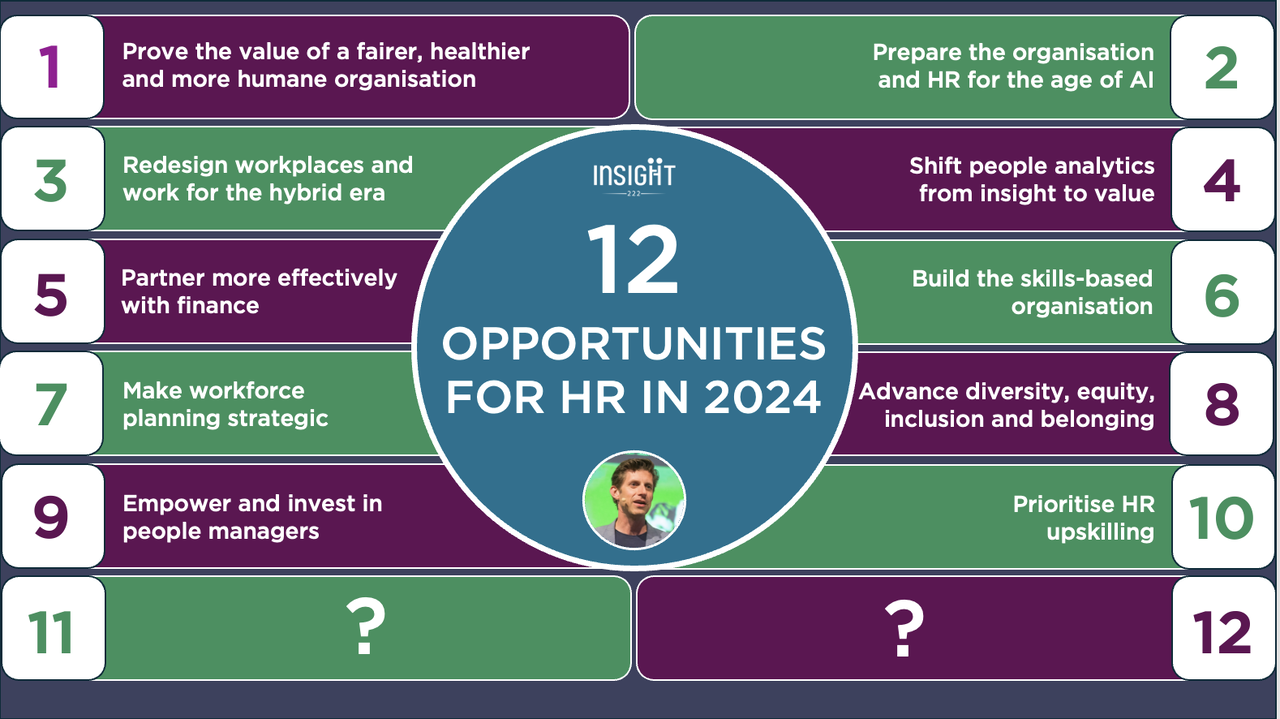
Readers may note that the title and accompanying image indicate 12 opportunities, whereas only ten are outlined. That is because – as was the case in the previous three years - I’m keen to crowdsource the final two opportunities from readers. What other opportunities should be included? Please let me know in the comments section below, and I’ll add my favourite two to an updated version in the New Year.
THE 2024 OPPORTUNITIES FOR HR
The first ten opportunities for HR to accelerate its journey from support function to strategic partner are set out below:
1. Prove the value of a fairer, healthier, and more humane organisation
One of HR’s key responsibilities as the steward of people and culture in the organisation (10) is to advocate for a ‘people, first’ approach. With record levels of burnout (11, 12, 13), deepening skills shortages (14), and raised employee expectations about work (15), HR has a pivotal role to play not only in hiring, developing, and retaining great talent, but fashioning the culture and environment to enable talent to perform and thrive. Putting wellbeing at the centre, developing an inclusive and equitable culture, personalising the employee experience, and listening and acting on the employee voice, are just four ways to deliver on this opportunity. Collectively, these initiatives are designed to reinforce the ‘H’ in HR and demonstrate that building a fairer, healthier, and more humane organisation isn’t just the ‘right thing’ to do for the workforce, but that it drives business success too (16). Indeed, research by firms including McKinsey, BCG and PwC (see FIG 2) finds that companies that provide a clear people advantage, who consistently invest in building and developing their human capital and imbue a compelling employee value proposition and experience are more resilient and enjoy better financial performance than their peers (17, 18, 19).
FIG 2:
2. Prepare the organisation and HR for the age of AI
While the hyperbole about generative AI has deepened HR’s engagement with AI (20, 21), research from Gartner finds that only 22% of HR leaders are highly engaged in enterprise-wide discussions on the topic (22). HR should seek to play a leading role as early studies find that AI doesn’t just boost operational performance and productivity (23) but can be used to build better organisations too (24). Four areas where HR should lobby to get involved – all while reinforcing the ‘H’ in HR - are (i) Aligning the workforce transformation that will be required due to AI in line with company strategy and vision (25). (ii) Leading on the development of responsible AI policies and enablement programs (26). (iii) Prioritising high-impact use cases for deploying AI across HR programs and the employee lifecycle (27, 28, 29, 30, FIG 3). (iv) Reimagining the work of key HR roles including the automation of repetitive tasks and increasing the focus on high-value strategic work (31, 32) (v) Building upskilling programs for leaders, managers, employees, and HR professionals. Research finds that if companies can activate the growth combination of data, technology, and people, they stand to gain a premium of up to 11% on top-line productivity. (33).
AI is the defining technology of our time, creating a massive paradigm that will transform the way we work with even greater impact than the introduction of the PC
Kathleen Hogan , Chief People Officer at Microsoft (34)
FIG 3
3. Redesign workplaces and work for the hybrid era
Since the pandemic, 90 percent of companies have embraced a range of hybrid work models (35) with most employees now working remotely over 25% of the time (36, FIG 4). Moreover, eight out of ten CHROs say they have no plans to decrease the amount of remote work in the next 12 months (37). Indeed, Nick Bloom predicts here that in the coming years remote work will experience a ‘swoosh effect’ due to the impact of technology as well as new firms and managers being more open to remote. (38, 39). The debate shouldn’t just be fixated on where people work, it should also provide an opportunity to test traditional assumptions about how work is done and whatwork even is (40). It’s likely that this transition will play out over many years (41), and will require experimentation, data collection and analysis, and iterative learning. This provides the opportunity for chief people officers – and their people analytics teams - to play a leading role in the redesign of work and workplaces for the hybrid era. Research is already being published on topics such as when in-person matters most (42, 43), how teams that are intentional about collaboration are more productive (44), and how to drive innovation through adaptive teaming (45). Hybrid is here to stay, so let’s make hybrid work!
FIG 4
4. Shift people analytics from insight to impact
As Isabel Naidoo, chief people officer at Wise, articulated at the Insight222 Global Executive Retreat in Colorado in September, 2023: “People Analytics is the fastest route to credibility for the chief people officer.” (46). Certainly, for HR to be a truly strategic business partner, it has to have an impactful people analytics function. Insight222's fourth annual People Analytics Trends study, (47) finds that the discipline continues to grow in importance and influence with 22% of people analytics leaders now reporting to the CHRO (compared to 13% in 2020). The challenge for many companies is to move people analytics from insight to impact (48, 49). Our research identified eight distinct characteristics (see FIG 5) that set Leading Companies apart from their peers and enable them to deliver value on a consistent basis. Chief people officers wanting to shift their people analytics team to an ‘A Team’ (see FIG 6) should focus on understanding their organisation’s most pressing business priorities and then align and prioritise people analytics activities that will support them. A capable and flourishing people analytics team eases the path towards a quantified organisation (50) and an evidence-based HR function (51) Certainly, people analytics is a foundational capability to helping HR progress and realise the opportunities outlined in this article.
People Analytics is the fastest route to credibility for the chief people officer
Isabel Naidoo, Chief People Officer at Wise (46)
FIG 5
FIG 6
5. Partner more effectively with Finance
Deploying financial capital and human capital together is the secret to the success of a talent-driven organisation (52). If HR seeks to become a truly strategic partner to the business, then it needs to have an effective partnership with finance not least because of increasing regulation about the disclosure of human capital information (53, 54). Research by Insight222 (55) finds that when it comes to delivering value with people analytics, a strong relationship with finance can make the difference. Of the 65 (out of 271 companies) surveyed who confirmed that they had built a partnership with finance, 99% reported that the people analytics team had delivered measurable outcomes over the last 12 months. In HR, we need to be better at building business cases for investment, and in quantifying the commercial value of what we do – just like other business functions. Building a strong and mutually beneficial partnership with finance – like Alan Susi at S&P Global (56) and Laura Wright Shubert at MetLife (57) have achieved – is a good place to start.
6. Build the skills-based organisation
Talent gaps and shortages represent the most pressing challenge that companies face (58), with three-quarters of CEOs being concerned about how the availability of key skills will impact on their growth strategies (59). These talent scarcity challenges will only be exacerbated by shrinking working populations – especially in the G7 economies (60) and rapid advances in technology meaning that 44% of workers’ skills will be disrupted by 2028 (61). This is leading to a shift from the traditional focus on jobs to one on skills (62) and the continued rollout of internal talent marketplaces (63, 64) with one study finding that 90% of companies are moving towards a skills-based approach (65). The effort to do so should not be underestimated with the same study finding that less than 20% are currently adopting skills-based approaches to a significant extent. While it is still early days, benefits cited by companies that have made this shift include (i) Standard Chartered unlocking productivity of $2.1m from a talent marketplace pilot in India (66, 67), (ii) IBM improving diversity through skills-based hiring (68), (iii) Unilever increasing productivity by 40% and significantly reducing attrition through its internal talent marketplace (69), and (iv) J&J democratising career development and mobility for its employees (70). The undoubted potential of skills-based approaches for hiring, learning, internal mobility, compensation, and workforce planning is tantalising, but it also makes it difficult for organisations to know where to start. HR can help by identifying a challenge in a specific business function and/or location, partnering with a senior business stakeholder and piloting a skills-based approach, starting to build a skills taxonomy, and then learning and iterating as you go.
As companies jostle to build a complete picture of what they need (for the future of work) and how to get there, we’re fast learning that the real currency is skills
Placid Jover, Chief Talent Officer at Unilever (71)
FIG 7
7. Make workforce planning strategic
The shift to skills, the pace and frequency of transformation, and rapid technological advances have all increased the urgency for organisations to become proficient in strategic workforce planning. It is now a top three challenge for people leaders (see FIG 8, 72). The availability of data-driven insights is altering the landscape with responsibility for SWP increasingly coming under the auspices of the people analytics team – this is the case in 50% of companies, based on 2023 research by Insight222 (73). This is driving the expansion from a pure focus on cost and operational based workforce planning to strategic and skills-based workforce planning (74, 75), which enables organisations to get a clearer view on future talent needs and how to close any gaps (76, 77). Steps for HR leaders to do this well include (i) Linking SWP to the business strategy (78). (ii) Joint ownership of SWP with the business and close collaboration with finance. (iii) Prioritising the most critical workforce segments. (iv) Focusing on skills as well as cost. (v) Combining HR, business, and external data to get a full picture (79). (vi) Measuring the impact of workforce planning activities and linking these to business outcomes. (80, 81)
FIG 8
8. Advance diversity, equity, inclusion and belonging
The business case for diversity, equity, inclusion and belonging (DEIB) continues to grow stronger. In a recent McKinsey study, leadership diversity is convincingly associated with company performance, societal impact, and employee experience (82, FIG 9). Moreover, research by Insight222 found that in 2023 – for the third successive year - DEIB is the area where people analytics is adding the most business value (83). These timely reminders of the value of DEIB are important in a year where the US Supreme Court ruling on affirmative action led to some companies rolling back on their DEIB initiatives (84, 85). As such, HR leaders have a critical role to play in advancing the DEIB agenda in their organisations, demonstrating that it isn’t just the right thing to do, but that is demanded by employees and leads to better business outcomes. People analytics can help in terms of enabling the organisation to measure outcomes and drive action (86), using advanced analytics to get deeper insights on belonging and inclusion, and supporting organisational moves to be more transparent – including providing data that forms the basis of annual DEIB reports e.g. Microsoft (87). Also, with demographics meaning that 150 million jobs will shift to older workers by the end of the decade (88), HR has an opportunity to ensure that their organisation is able to attract, develop and retain older workers, and enable them to thrive.
FIG 9
9. Empower and invest in people managers
75% of HR Leaders say that their managers are overwhelmed by the growth of their job responsibilities (89) while more than 50% of managers report feeling burned out (90). These concerning statistics are not surprising given that the role of the manager is being changed beyond recognition due to digitalisation, hybrid work and agile initiatives (91, 92). The pressure is exacerbated by companies cutting middle management roles in the current macroeconomic climate. Given that studies find that investing in people managers leads to better firm financial performance (93) and is key to realising the opportunities from AI (94), it’s time to better support and empower people managers. One way HR can do this is through democratising people data to help managers to be more productive, support decisions on hiring, promotion and pay, and equip them with insights to be more effective and human leaders. The benefit of successfully democratising people data to managers are vast, with one 2023 study calculating that in a 10,000 person organisation, this could amount to $400 million in cost savings, and almost $200 million in revenue expansion (95, 96). HR leaders can also support people managers through being more thoughtful about spans and layers, reimagining the role of the manager, implementing capability building programs, and prioritising manager experience and wellbeing (97).
10. Prioritise HR upskilling
If HR is to become a true strategic partner to the business and realise the opportunities from new operating models (98) then chief people officers need to prioritise efforts to upskill their HR professionals – particularly on topics such as business acumen, technology, and analytics (99). At Insight222, our HR in the Digital Age study identified nine skills for the future HR professional to be more data driven, experience led, and business focused (100, 101). Additionally, our 2023 study, Upskilling the HR Professional: Building Data Literacy as Scale, highlighted the critical role of the chief people officer and their direct reports in role-modelling the use of people data and analytics (102). With another study by Mercer finding that 41% of chief people officers wish they had had greater depth in people analytics prior to assuming their roles, there is clearly significant room for improvement (103). On a more positive note, 55% of companies now say they have a data driven culture in HR, which is up from 42% in 2021. 2024 is the year to improve this further, and from a data literacy perspective, Insight222 research highlights five skills (see FIG 10) that HR professionals need to develop (104). Moreover, the study also highlights that the investment required is between $600-$800 per person for an upskilling program (see example in FIG 11). Now is the time to invest in upskilling HR professionals.
FIG 10
FIG 11
References
(1) Jens Stefan Baier, Vinciane Beauchene, Julie Bedard, Jean-Michel Caye, Dr. Philipp Kolo, Fang Ruan, Alexander Alonso, PhD SHRM-SCP, Anthony Ariganello, Kai H. Helfritz, Bob Morton, Chartered CCIPD, Lucas van Wees, and Wilson Wong - Creating People Advantage: Set the Right People Priorities for Challenging Times (BCG, 2023)
(2) Dr. Patrick Guggenberger, Dana Maor, Michael Park, and Dr. Patrick Simon - The State of Organizations 2023: Ten shifts transforming organizations (McKinsey, 2023)
(3) Kathi Enderes and Josh Bersin, The Definitive Guide to Building a Dynamic Organization (LinkedIn, 2023)
(4) Guggenberger et al, see reference (2)
(5) David Green, The Best HR and People Analytics articles of October 2023 featuring quote from Barbara Lavernos, Deputy CEO at L’Oreal, from UNLEASH World, Paris (LinkedIn, 2023)
(6) The coronavirus crisis thrusts corporate HR chiefs into the spotlight (The Economist, 2020)
(7) Jonathan Gordin, Shari Chernack, Karen Shellenback, and Yamile Bruzza, Evolving the CHRO role in a rapidly changing world of work (Mercer 2023)
(8) Julie Bedard, Katie Lavoie, Renée Laverdière, Allison Bailey, Vinciane Beauchene, and Jens Stefan Baier, How Generative AI will Transform HR (BCG, 2023)
(9) Ellyn Shook, Yusuf Tayob, and Laurie Henneborn, MSLIS, The CHRO as a Growth Executive (Accenture, 2023)
(10) Diane Gherson, The New Deal of Work (SHRM People+Strategy, Fall edition, 2023)
(11) Jacqui Brassey, PhD, MA, MAfN (née Schouten), Erica Hutchins Coe, Martin Dewhurst, Kana Enomoto, Renata Giarola, Brad Herbig, and Barbara Jeffery, Addressing employee burnout: Are you solving the right problem? (McKinsey Health Institute, 2022)
(12) Kathleen Hogan, Why Leaders Can’t Ignore the Human Energy Crisis (LinkedIn, 2022)
(13) Dawn Klinghoffer and Katie Kirkpatrick-Husk PhD - With Burnout on the Rise, What Can Companies Do About It? (MIT Sloan Management Review, 2023)
(14) Mark Whittle and Chief Etheridge - Top 5 HR Trends and Priorities for 2024 (Gartner, 2023)
(15) Gherson (see reference 10)
(16) Angus Bauer, Human capital management research: how people are our greatest asset (Schroders, Saïd Business School, University of Oxford, and the California Public Employees’ Retirement System, 2023)
(17) Anu Madgavkar, Bill Schaninger, Ph.D., Dana Maor, Olivia White, Sven Smit, Hamid H. S., Jonathan Woetzel, Davis Carlin, and Kanmani Chockalingam - Performance through people: Transforming human capital into competitive advantage (McKinsey Global Institute, 2023)
(18) Amanda Luther, Romain de Laubier, Saibal Chakraborty, Dylan Bolden, Sylvain Duranton, Tauseef Charanya, and Patrick Forth - The New Blueprint for Corporate Performance (BCG, 2023)
(19) Bastiaan Starink and Jan Willem Velthuijsen - What every HR leader needs to show the CFO (PwC, 2023)
(20) Bedard et al (see reference 8)
(21) Kate Bravery, Jesse Bramall, William Self, Ravin Jesuthasan, CFA, FRSA, Benjamin Hoster, and Christopher Lomas - Chief People Officer’s quick guide to generative artificial intelligence (Mercer, 2023)
(22) Whittle and Etheridge (see reference 14)
(23) Kathleen Hogan - What Can Copilot’s Earliest Users Teach Us About Generative AI at Work? (Microsoft Work Trends, 2023)
(24) Guggenberger et al, (see reference 2)
(25) Baier et al (see reference 1)
(26) Guru Sethupathy and David Green ?? - How to Ensure AI in HR is Fair, Effective and Explainable (myHRfuture, 2023)
(27) Bedard et al (see reference 8)
(28) Baier et al (see reference 1)
(29) Whittle and Etheridge (see reference 14)
(30) Andrew Marritt and David Green ?? - The Impact of GPT and Generative AI Models on People Analytics (myHRfuture, 2023)
(31) Bedard et al (see reference 8)
(32) Ravin Jesuthasan, CFA, FRSA, Helen White, Kate Bravery, Jason Averbook, and Todd Lambrugo – Generative AI will transform three key HR roles (Mercer, 2023)
(33) Shook et al (see reference 9)
(34) Kathleen Hogan - Microsoft’s Chief People Officer shares how AI will impact workers (Fast Company, 2023)
(35) Guggenberger et al, (see reference 2)
(36) Jose Maria Barrero, Nick Bloom, Shelby Buckman, and Steven J. Davis – SWAA December 2023 Updates (WFH Research, 2023)
(37) Ben Wigert, Ph.D, MBA, Jim Harter, and Sangeeta Agrawal - The Future of the Office Has Arrived: It's Hybrid (Gallup, 2023)
(38) Nicholas Bloom predicts a working-from-home Nike swoosh (The Economist, 2023)
(39) Nick Bloom and David Green ?? – Unmasking Common Myths around Remote Work (Digital HR Leaders Podcast, myHRfuture, 2023)
(40) Lynda Gratton – Redesigning How We Work (Harvard Business Review, 2023)
(41) Dean Carter - Top 3 insights I’m hearing now from HR leaders (Guild, 2023)
(42) Michael Arena - Moments that Matter: 3 Network Advantages of Being Face-to-Face (HR Exchange Network, 2023)
(43) Karen Kocher and Dawn Klinghoffer - In the Changing Role of the Office, It’s All about Moments That Matter (Microsoft Work Trends, 2023)
(44) Mary Baker , 4 Modes of Collaboration Are Key to Success in Hybrid Work (Gartner, 2021)
(45) Michael Arena - Effective Strategies for Intentional Collaboration in the New World of Work (HR Exchange Network, 2023)
(46) David Green ?? - Influencing the World of Work: Insights from The Insight222 Global Executive Retreat 2023 (myHRfuture, 2023)
(47) Jonathan Ferrar, Naomi Verghese, and Heidi Binder-Matsuo - Investing to Deliver Value: A New Model for People Analytics (Insight222, 2023)
(48) Thomas Hedegaard Rasmussen, Mike Ulrich, and Dave Ulrich - Moving People Analytics From Insight to Impact (Sage Journals, 2023)
(49) Patrick Coolen, Sjoerd van den Heuvel, PhD, Karina Van De Voorde, and Jaap Paauwe - Understanding the adoption and institutionalization of workforce analytics: A systematic literature review and research agenda (Human Resource Management Review, 2023)
(50) Arthur Mazor, Steve Hatfield, Philippe Burger, Simona Spelman, Nicole Scoble-Williams, and Robin Jones - Beyond Productivity: The journey to the quantified organization (Deloitte, 2023)
(51) Rob Briner - Aligning HR with the business through the evidence-based HR process (HRD Connect, 2023)
(52) Dominic Barton, Dennis Carey, and Ram Charan - An agenda for the talent-first CEO (McKinsey, 2018)
(53) Dave Ulrich - Human Capability Improvement and Reporting: How to Make Dramatic Progress (LinkedIn, 2023)
(54) Yves Van Durme and David Green ?? - How to Prepare Your HR Data for EU CSRD Reporting (Digital HR Leaders podcast, myHRfuture, 2023)
(55) Ferrar et al (see reference 47)
(56) Ferrar et al, S&P case study (see reference 47)
(57) Jonathan Ferrar and David Green ?? – Excellence in People Analytics, Case study with Laura Wright Shubert of MetLife (Kogan Page, 2021)
(58) Baier et al (see reference 1)
(59) Navigating the rising tide of uncertainty, PwC 23rd Annual Global CEO Survey (PwC, 2020)
(60) James Root, Andrew Schwedel, Mike Haslett, and Nicole Bitler Kuehnle - Better with Age: The Rising Importance of Older Workers (Bain & Company, 2023)
(61) Attilio Di Battista, Sam Grayling, Elselot Hasselaar, Till Alexander Leopold, Ricky LI, Mark Rayner and Saadia Zahidi – The Future of Jobs Report 2023 (World Economic Forum, 2023)
(62) Josh Bersin - Introducing The Systemic HR™ Initiative (The Josh Bersin Company, 2023)
(63) Bo Cowgill, Jonathan Davis, Pablo Montagnes, Patryk Perkowski and Bettina Hammer - How to Design an Internal Talent Marketplace (Harvard Business Review, 2023)
(64) Jeff Schwartz, Jeroen Wels, and David Green ?? - Navigating the Talent Marketplace of the Future (Digital HR Leaders podcast, Gloat, myHRfuture, 2023)
(65) Susan Cantrell, Michael Griffiths, Robin Jones, and Julie Hiipakka - The skills-based organization: A new operating model for work and the workforce (Deloitte, 2022)
(66) Tanuj Kapilashrami - Investing for a resilient and inclusive future of work (LinkedIn, 2022)
(67) Tanuj Kapilashrami and David Green ?? - How Standard Chartered is Unlocking the Power of Skills in the Workplace (Digital HR Leaders podcast, myHRfuture, 2023)
(68) Jane Thier - Generative AI is the major turning point in skills-first hiring, says former IBM CEO Ginni Rometty: ‘People are afraid of what their jobs are going to look like’ (Yahoo Finance, 2023)
(69) Placid Jover – The Future of Work is Flexible (2023)
(70) Christina Norris-Watts, Doug Shagam, and David Green ?? - How Johnson & Johnson are Scaling Their Skills-Based Approach to Talent (Digital HR Leaders podcast, myHRfuture, 2023)
(71) Jover (see reference 69)
(72) Baier et al (see reference 1)
(73) Ferrar et al (see reference 47)
(74) Alicia Roach – The Evolution of SWP (LinkedIn, 2023)
(75) Simmi Mehta, Kevin Moss, and Dhruv Patel - Meet business outcomes by evolving to strategic workforce planning (Deloitte, 2023)
(76) Alex Browne and David Green ?? - Nestlé's 4B Methodology to Strategic Workforce Planning (Digital HR Leaders podcast, myHRfuture, 2023)
(77) Laura Wright Shubert and David Green ?? - How MetLife Made a Success of their Strategic Workforce Planning (Digital HR Leaders podcast, myHRfuture, 2022)
(78) Alicia Roach and Chris Hare - How to Democratise Strategic Workforce Planning (Digital HR Leaders podcast, eQ8, myHRfuture, 2022)
(79) Jeroen Van Hautte ? - How unlocking skills lies in capturing business data (TechWolf, 2023)
(80) Jonathan Ferrar - How to Build a Workforce Planning Strategy that Delivers Business Value (myHRfuture, 2021)
(81) Ian Bailie and Caroline Styr – A New Playbook for Workforce Planning (Insight222, 2021)
(82) Dame Vivian Hunt, Sundiatu Dixon-Fyle, Celia Huber, Maria del Mar Martinez, Sara Prince, and Ashley Thomas - Diversity matters even more: The case for holistic impact (McKinsey, 2023)
(83) Ferrar et al (see reference 47)
(84) Paul Rubenstein - Prioritizing DEI Is the Secret to Future-Proofing Your Business (Entrepreneur, 2023)
(85) Lily Zheng - How to Effectively — and Legally — Use Racial Data for DEI (Harvard Business Review, 2023)
(86) Lily Zheng - To Make Lasting Progress on DEI, Measure Outcomes (Harvard Business Review, 2023)
(87) Lindsay-Rae McIntyre - Microsoft’s 2023 Diversity and Inclusion Report: A decade of transparency, commitment and progress (Microsoft, 2023)
(88) Root et al (see reference 60)
(89) Whittle and Etheridge (see reference 14)
(90) Dawn Klinghoffer and Katie Kirkpatrick-Husk PhD - More Than 50% of Managers Feel Burned Out (Harvard Business Review, 2023)
(91) Diane Gherson and Lynda Gratton - Managers Can’t Do It All (Harvard Business Review, 2022)
(92) Stacia Sherman Garr and Priyanka Mehrotra - What’s Holding Back Manager Effectiveness, and How to Fix It (MIT Sloan Management Review, 2023)
(93) Emily Field, Bryan Hancock, Stephanie Smallets, Ph.D., and Brooke Weddle - Investing in People Managers pays off literally (McKinsey, 2023)
(94) Emily Field , Bryan Hancock, Ruth Imose, PhD, and Lareina Yee - Middle managers hold the key to unlock generative AI (McKinsey, 2023)
(95) Lexy Martin - Unlocking Manager Effectiveness: The Next Driver of Value (Visier, 2023)
(96) Lexy Martin and David Green ?? - How to Democratise Data for People Manager Effectiveness (Digital HR Leaders podcast, myHRfuture, 2023)
(97) Bill Schaninger, Ph.D., Bryan Hancock, and Emily Field – Power to the Middle: Why Managers Hold the Key to the Future of Work (Harvard Business Review Press, 2023)
(98) Sandra Durth, Neel Gandhi, Asmus Komm, and Florian Pollner – HR’s new operating model (McKinsey, 2022)
(99) Dave Ulrich, Joe Grochowski, Norm Smallwood, and Joseph Hanson - What Makes an Effective HR Function? (The RBL Group, 2023)
(100) Manpreet Randhawa - 9 Skills HR Professionals Need to Succeed in the Digital Age (myHRfuture, 2023)
(101) Caroline Styr and Ian Bailie - HR in the Digital Age (Insight222, 2021)
(102) Naomi Verghese and Jonathan Ferrar - Upskilling the HR Profession: Building Data Literacy at Scale (Insight222, 2023)
(103) Gordin et al (see reference 7)
(104) Verghese and Ferrar (see reference 99)
A selection of other 2024 HR predictions and trends
There are a plethora of other resources documenting predictions and trends for HR and the future of work in 2024 including:
Gartner - Top 5 HR Trends and Priorities for 2024
Visier Inc. - 10 Workforce trends for 2024: The New Rules of HR
Mercer – 2024 Global Talent Trends
McKinsey - What matters most? Eight CEO priorities for 2024
Ken Oehler – RADICL People Predictions for 2024
Damon Klotz and Didier Elzinga - 7 trends that will define HR in 2024
Dr. Solange Charas and Stela Lupushor - HR and Workforce Trends Predictions for 2024
Dan Schawbel - 10 Predictions for 2024 from a World-of-Work Expert
Joelle Emerson - New Data: 2023 DEI Trends & 2024 Opportunities
Francesca Di Meglio - 8 HR Trends for 2024
LinkedIn News - 34 Big Ideas that will change our world in 2024
__________________________________________________________________
ABOUT THE AUTHOR
David Green ?? is a globally respected author, speaker, conference chair, and executive consultant on people analytics, data-driven HR and the future of work. As Managing Partner and Executive Director at Insight222, he has overall responsibility for the delivery of the Insight222 People Analytics Program, which supports the advancement of people analytics in over 90 global organisations. Prior to co-founding Insight222, David accumulated over 20 years experience in the human resources and people analytics fields, including as Global Director of People Analytics Solutions at IBM. As such, David has extensive experience in helping organisations increase value, impact and focus from the wise and ethical use of people analytics. David also hosts the Digital HR Leaders Podcast and is an instructor for Insight222's myHRfuture Academy. His book, co-authored with Jonathan Ferrar, Excellence in People Analytics: How to use Workforce Data to Create Business Value was published in the summer of 2021.

 混合办公
混合办公
 混合办公
混合办公
 混合办公
混合办公



 扫一扫
添加客服
扫一扫
添加客服


