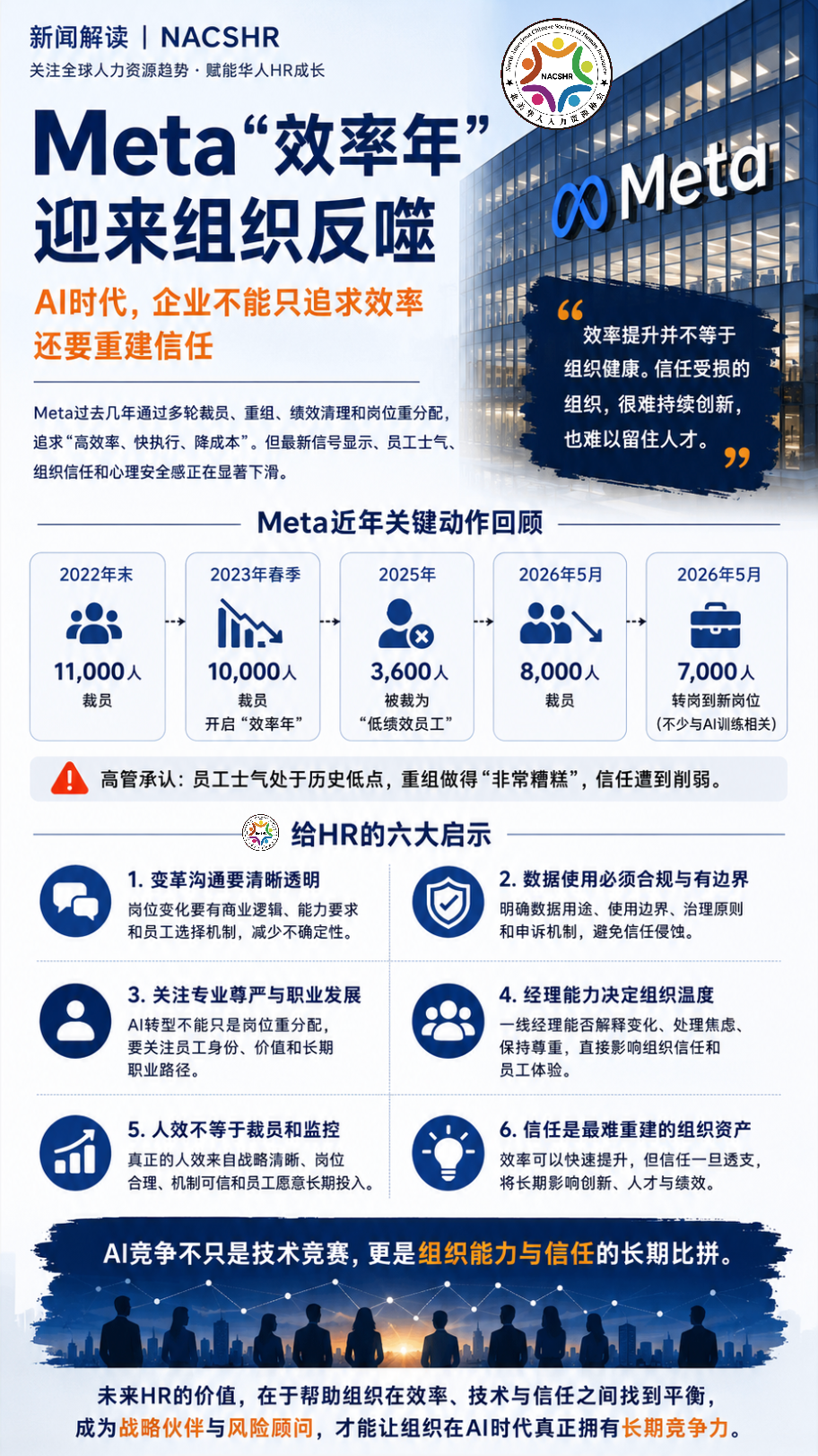
Meta高压管理模式迎来反噬:从“效率年”到组织信任危机Meta 的“效率年”正在迎来反噬。Business Insider 报道显示,自 2022 年以来,Meta 通过多轮裁员、重组、绩效清理、岗位再分配和员工监控,建立起一种更精简、更高压、更强调执行的管理模式。2022 年裁员 11,000 人,2023 年再裁 10,000 人,2025 年裁掉 3,600 名所谓 “low performers”,2026 年 5 月又裁员 8,000 人,并将 7,000 人重新分配到新岗位。现在,员工士气、组织信任和心理安全感正在成为 Meta 必须面对的问题。AI 时代企业确实需要效率,但如果效率建立在持续恐惧、不确定性和被监控感之上,创新能力反而可能被削弱。Meta 的案例提醒所有企业:人效管理不能只看成本、速度和绩效指标,还必须看员工是否仍然相信自己的专业价值会被尊重。
从“效率年”到信任危机:Meta正在经历管理模式的反作用
在过去几年里,Meta 一直被视为硅谷“效率革命”的代表企业。自 Mark Zuckerberg 提出 “year of efficiency” 之后,Meta 通过大规模裁员、组织重组、绩效清理、管理层级压缩和岗位再分配,试图把公司从过去高速扩张时期的庞大组织,改造成一个更精简、更快速、更高压、更强调执行结果的技术公司。这种转型曾经在资本市场获得积极反馈,也一度成为美国科技行业降本增效的标志性案例。
但最新信号显示,Meta 的高压管理模式正在进入一个新的阶段:效率的收益开始被组织信任的损耗所抵消。Business Insider 对 Meta 管理文化的最新分析指出,Meta 内部员工士气、心理安全感和组织信任正在承受明显压力。CTO Andrew Bosworth 在近期内部沟通中承认,员工士气可能处于公司历史上最糟糕的阶段之一,并表示公司在近期重组中做得非常糟糕,削弱了员工相信自身专业能力和贡献会被尊重的信任。Chief Product Officer Chris Cox 也承认公司内部环境艰难而残酷,Mark Zuckerberg 则承认公司犯过错误。
这不是简单裁员新闻,而是AI时代组织管理的拐点
从 HR 和组织管理角度看,这不是一个简单的科技公司裁员新闻,而是 AI 时代企业管理模式转型中的重要信号。Meta 的案例说明,当企业把效率、速度和成本控制推到极致时,如果没有同步维护员工信任、角色尊严和组织心理安全感,所谓“高绩效文化”很容易滑向“高恐惧文化”。
短期内,企业或许可以通过裁员和重组改善成本结构;但长期看,如果员工不再相信组织会尊重其专业能力,不再相信岗位调整具有公平性,不再相信管理层会承担清晰解释责任,创新能力、人才保留和组织承诺都会受到影响。对于任何处在 AI 转型中的企业而言,这都是一个非常现实的组织风险。
多轮裁员与岗位重组,正在重塑员工对组织的信任判断
Meta 过去几年的组织变化非常激烈。2022 年末,公司裁员 11,000 人;2023 年春季再裁员 10,000 人,并将这一阶段定义为 “year of efficiency”;2025 年,公司又裁掉 3,600 名被称为 “low performers” 的员工;2026 年 5 月,Meta 再次裁员 8,000 人,同时将 7,000 名员工重新分配到新岗位,其中不少岗位与 AI 训练相关。
这一系列动作背后,是 Meta 希望在 OpenAI、Anthropic、Google 等公司快速推进 AI 竞争的背景下,重新配置人力资本,把资源集中到更关键的技术方向。但组织重构越剧烈,越需要清晰的沟通、可信的机制和可被员工理解的变革逻辑。否则,员工看到的就不是战略升级,而是持续不确定、岗位安全感下降和专业价值被削弱。
AI岗位重分配不能只看资源配置,还要看专业尊严
AI 转型中的组织重构不能只被理解为“把人放到新的岗位上”。对于员工来说,岗位代表的不只是工作任务,还包括专业身份、职业路径、能力积累和组织认可。如果员工突然被重新分配到并不匹配其专业预期的 AI 训练岗位,又缺乏充分沟通、选择权和尊严感,这种转型就很容易被体验为降级、替代或被动安置。
企业希望员工支持 AI 战略,但员工首先会判断:AI 是增强我的能力,还是降低我的价值?组织是在帮助我适应未来,还是把我当作可以随时重组的资源?这也是 Meta 事件对 HR 的核心启示。AI 转型不能只围绕技术路线和资源投入展开,还必须处理员工对身份、价值和未来职业路径的深层焦虑。
人效管理不能被简化为裁员、压缩和监控
AI 时代的人力资源管理,不能只围绕“人效”这个词展开。人效当然重要,但人效不是简单地减少人数、压缩层级、提高产出指标,也不是通过监控和恐惧来迫使员工更快工作。真正可持续的人效,来自更清晰的战略优先级、更合理的岗位设计、更可信的绩效机制、更强的经理能力,以及员工愿意投入判断力、创造力和长期承诺的组织环境。
如果企业只把人效理解为“用更少的人完成更多任务”,那么 HR 就容易被推向单一的执行角色:执行裁员、推动重组、压缩预算、提高绩效压力。但如果企业把人效理解为“让组织能力真正服务业务战略”,HR 的角色就会完全不同。HR 不只是成本管理者,更是组织能力建设者、变革风险识别者和信任机制设计者。
员工监控争议背后,是企业数据治理与信任边界问题
Meta 的键盘监控争议尤其值得 HR 关注。员工反对的并不只是一个技术工具,而是背后的管理假设。当企业开始通过更细颗粒度的数据追踪员工行为,并把这些数据与 AI 模型训练、生产率评估或岗位替代联系在一起时,员工自然会产生被监控、被评估、被自动化替代的焦虑。
对于企业而言,技术监控或许看起来能提高透明度和效率;但对于员工而言,如果缺乏边界、目的说明、数据治理和申诉机制,监控会迅速侵蚀信任。未来 HR 在引入 AI 工具、员工行为数据分析和自动化绩效管理系统时,必须提前参与治理设计。关键问题不是“能不能收集数据”,而是“为什么收集、如何使用、谁能访问、是否透明、员工是否有申诉权”。
北美华人HR需要从执行角色走向组织风险顾问
这对北美华人 HR 群体同样具有现实意义。许多华人 HR 专业人士所在的企业,正在经历 AI 工具采购、组织重组、岗位合并、流程自动化和绩效体系调整。管理层可能会提出更高的人效要求,也可能希望 HR 用更少的人支持更复杂的业务需求。在这种情况下,HR 的角色不能只是执行裁员、重组和绩效清理,而应该成为组织风险的识别者、信任机制的设计者和变革沟通的推动者。
具体来说,HR 至少需要把握三个方向。
第一,在 AI 转型和组织重构中,必须明确岗位变化的商业逻辑、能力要求和员工选择机制,不能让员工在长期不确定中等待结果。
第二,在使用员工数据和监控工具时,必须建立清晰的治理原则,包括数据用途、使用边界、透明沟通、合规审查和员工反馈渠道。
第三,在强调绩效和效率的同时,不能忽视经理能力建设。很多组织信任问题并不是来自战略本身,而是来自一线经理无法解释变化、无法处理员工焦虑、无法在压力中保持尊重和公平。
AI竞争不只是技术竞赛,更是组织能力竞赛
Meta 的案例也提醒企业领导者:AI 竞争不是单纯的技术竞赛,也是组织能力竞赛。企业能否在 AI 时代保持竞争力,不只取决于模型、算力、产品路线和资本投入,也取决于员工是否仍然相信公司值得投入长期努力。一个组织如果长期依赖恐惧推动执行,可能会获得短期速度,却会失去高质量创新所需的心理安全感。
真正优秀的技术人才并不只是完成任务的人,他们还需要提出不同意见、承担实验风险、挑战既有路径,并在不确定中持续探索。缺乏信任的组织,很难要求员工进行真正有风险的创新。尤其在 AI 快速演进的环境下,企业最需要的并不是机械服从,而是跨职能协作、持续学习和高质量判断。
企业需要重新定义效率:效率不能以透支信任为代价
对于 HR 来说,这场讨论的重点不是否定效率,而是重新定义效率。效率不应该是“少人干更多事”的单一逻辑,而应该是让组织资源配置更精准、让员工能力使用更充分、让管理摩擦更少、让业务决策更清晰。企业需要降本增效,但也需要知道哪些成本不能随意削减:信任、心理安全感、组织公平感和员工尊严,就是最容易被低估、也最难重建的组织资产。
Meta 正在经历的并不是个别公司的管理波动,而是 AI 时代许多企业都会面对的共同问题。当技术变化加速、资本市场要求效率、管理层追求速度,HR 必须帮助组织回答一个更本质的问题:我们是在建设一个更高效的组织,还是在透支一个组织赖以运行的信任基础?
NACSHR观察:未来HR的价值在于平衡效率、技术与信任
NACSHR 认为,未来 HR 的价值将不只是完成事务性人力资源管理,而是在 AI、组织变革和商业压力之间建立新的平衡。企业需要效率,也需要尊重;需要速度,也需要透明;需要绩效,也需要信任。Meta 的经验表明,组织可以通过强硬管理快速改变成本结构,但只有通过可信的领导力、公平的机制和真实的人本管理,才能真正重建长期竞争力。
对北美华人 HR 来说,这也是职业角色升级的重要机会。AI 时代的 HR 不应只是政策执行者、流程维护者或裁员通知传递者,而应成为组织转型中的战略伙伴。真正有价值的 HR,能够在企业追求效率时提醒风险,在管理层推动变革时设计机制,在员工产生焦虑时建立沟通,在技术改变岗位时维护组织信任。Meta 的案例再次说明,未来企业竞争的关键不只是 AI 能力,也包括组织是否仍然有能力让优秀的人愿意留下、敢于表达、持续创造。
Employee Morale.
2026年06月27日
Employee Morale.
政府关门已至:企业HR如何应对运营与员工双重挑战?刚刚,2025年美国政府正式关门,企业HR该如何应对,你可能还有相关预案
2025年9月30日,美国国会未能在财政年度截止日前通过拨款法案或临时融资措施(Continuing Resolution),导致联邦政府自10月1日起正式进入关门状态。这是自2018–2019年长达35天的停摆以来,美国再一次发生大规模政府关门。
根据《禁止超支法》(Antideficiency Act),在拨款恢复前,除“必要服务”(essential services)外,所有非紧急职能必须暂停。由此,数十万联邦雇员和承包商的工作受到影响,企业和HR部门也被迫面对直接冲击。
对企业HR的主要影响
1. 招聘与合规流程停滞
E-Verify暂停:所有雇主必须暂时依赖I-9表格进行入职核查,待系统恢复后再补录。这给招聘带来延误和合规风险。
审批与执照延迟:涉及联邦许可、签证或合规认证的环节全面放缓。
2. 员工用工与合同不确定性
承包商停工:与联邦政府签订合同的企业面临付款暂停或合同冻结,导致项目延迟甚至停摆。
薪酬与福利不确定:被迫无薪休假的联邦雇员暂时无法获得工资,追溯补发需等待国会立法。部分员工或可申请失业补助,但若事后获追溯工资,需返还补助。
3. 企业运营与财务目标受阻
SHRM研究显示,仅1–3天的关门就会扰乱25%的企业运营;若持续超过一周,64%的企业运作及49%的财务目标将受到冲击。
延误的政府审批、拨款、贷款可能影响企业现金流和投资进度。
4. 员工心理与士气下降
调研显示,80%的员工担心压力上升,76%预计士气下降,75%担忧专注力和生产力降低。
对有家庭照护责任的员工影响更大:59%担心财务、51%担心工作稳定、49%担心食物安全、47%担心心理健康。
5. HR准备不足
47%的HR专业人士表示企业几乎没有应对预案,14%的企业完全无计划。关门已至,HR将被迫在高压环境下应急,风险显著。
HR的应对措施
立即启动危机管理
明确“必要岗位”和“被迫停工岗位”,书面通知员工其状态。
审查并更新内部政策,涵盖无薪休假、福利延续、工时安排等。
加强透明沟通
建立统一的信息渠道,及时更新薪酬、福利和合同状态。
通过FAQ、内部公告或视频说明会减轻员工焦虑。
强化员工支持
启动EAP(员工帮助计划),提供心理咨询与应急援助。
为有家庭照护责任的员工提供灵活安排或支持资源。
审查合同与财务风险
检查与政府相关合同条款,尽快与合作方沟通延期或缓解措施。
重新评估预算与现金流,建立财务缓冲。
持续监控政策进展
HR需密切跟进国会动态,关注追溯工资等立法进程。
与行业协会(如SHRM)保持互动,及时获取应对指南。
美国政府关门的历史回顾
2018–2019年:长达35天的关门,为历史最长。影响多个联邦部门,导致经济损失与信任危机。
2013年:因医保法案分歧,政府关门16天,标准普尔估算使当季GDP年化增长率下降0.6%。
1995–1996年:多次预算争议引发关门,总计21天,影响广泛。
整体情况:自1976年以来,美国已发生20余次关门,平均持续约8天,但近年来关门时间趋长,影响逐渐加剧。
此次关门不仅影响联邦雇员和承包商,更对企业HR提出严峻考验。招聘停滞、合同冻结、员工焦虑与士气下降,都需要HR部门即时响应与长期预案。事实证明,未雨绸缪的HR将更有能力保护企业稳定和员工信任。
? 来源:
SHRM《HR Leaders Brace for Shutdown Impact》
The Guardian 《US Government Shutdown Coverage 2025》
Reuters 《US government shutdowns raise uncertainty but rarely have lasting effect on economy》
U.S. Congressional Budget Office 历史文件
Wikipedia《United States federal government shutdowns》
Employee Morale.
2025年10月01日
Employee Morale.
AIHR:Measuring Employee Experience: A Practical Guide for 2024
Keeping your employees engaged, motivated, and satisfied throughout their journey with your organization is key to business success. Measuring employee experience allows HR professionals to understand how their workforce feels and ensure the team remains fulfilled.
In this article, we’ll explore how to measure employee experience, evaluate the results, and turn them into meaningful action.
Contents
What is employee experience (EX)?
Why measure employee experience?
How to measure employee experience
Best practices for measuring employee experience
FAQ
What is employee experience (EX)?
Employee experience (EX), in its simplest form, is how employees perceive their stay at your organization from when they apply for a job to after they leave.
It encompasses various dimensions – ranging from the physical workspace and technological tools being used to the organizational culture, professional growth opportunities made available, and social interactions they have with colleagues or superiors.
It’s more than just a collection of daily experiences at work; EX profoundly shapes an employee’s perceptions about their employer and impacts their decision to stay or leave.
DIVE DEEPEREmployee Experience vs. Employee Engagement: 4 Differences To Know
Why measure employee experience?
87% of employee experience experts say that a great employee experience helps retain and attract talent. However, only 51% of employees feel that their organization is delivering on the experience they promised.
By measuring employee experience, you can uncover and fix issues and discrepancies to reap the benefits of a satisfied and engaged workforce.
Let’s break down the reasons why you should measure employee experience.
Enhanced productivity and performance
Research shows that superior employee experience (EX) may lead to enhanced productivity.
Employees who feel satisfied, empowered, and valued are more motivated to perform at their highest level. They significantly contribute to organizational goals, which can result in an over 50% increase in revenue.
By focusing on optimizing the employee journey – from end to end – companies can foster a work environment that stimulates both individual and team performance.
LEARN MORE23 Key Employee Experience Statistics You Should Know in 2024
Retaining talent
Monitoring and enhancing EX levels significantly contributes to improving retention rates. Employees who resonate with their company culture and find meaning in their work stay longer in their organizations.
Examining facets like workplace habits or preferences provides employers invaluable insights related to employee experience – which ultimately feeds into long-term staff retention strategies.
Making informed decisions related to HR practices
A robust method of measuring employee experience offers in-depth insights into how employees perceive things such as career development opportunities or even intricate details like office seating arrangements.
This helps HR shape policies and practices strategically and make smarter decisions that maximize the workforce potential while actively minimizing discontentment factors.
Enhanced customer experience
A happier workforce equals happier customers. Companies with great employee experience report 2X as high customer satisfaction levels compared to businesses scoring low on employee experience.
A well-executed EX strategy will aid your organization in delivering higher standards of service, creating a ripple effect that extends far beyond merely measuring employee experience for internal benefit.
Australian Defence Bank collaborated with the employee and customer experience management platform Insync to measure and improve EX and CX.
Investing in their employees has helped them build a motivated workforce and get outstanding business results. Not only are they in the top 10% for employee engagement compared to other financial organizations, but they have also achieved record deposit growth in transaction and savings account balances.
Innovation, growth, and improved organizational performance
As we’ve already alluded to, keeping your finger on the pulse of EX can set the scene for broader innovation and growth within an organization.
Employee experience goes hand in hand with employee engagement, which helps foster an innovative culture and a passionate commitment to ongoing improvement—an infallible recipe to drive the company performance northward.
To sum it up, measuring employee experience isn’t simply good practice, but it can bring numerous strategic benefits that make a profound impact on organizations and their competitive standing in the market.
How to measure employee experience
Employee experience is a multifaceted and intangible concept, which is not easy to quantify at first sight. Successfully measuring it involves defining relevant employee experience metrics and methods of measurement to collect the data.
Let’s take a closer look.
1. Define and track employee experience metrics
Employee experience metrics allow organizations to gain insight into the wellbeing, satisfaction, and productivity of their teams. The following metrics serve as good indicators of the employee experience levels at your organization:
Retention rates
Retention rates signify how many employees remained within the company over a specified period. A high employee retention rate generally implies positive experiences at work, while low rates indicate potential problems or dissatisfactions among staff.
Intent to stay
This metric shows how many employees foresee themselves staying with an organization over a lengthy period. It can provide insights into the workforce’s commitment level and their perception of future opportunities within the company.
Number of employee referrals
The number of referrals from existing staff suggests how highly they rate working within the organization. The higher this figure is, the more positive opinions workers hold about their employee experience, and that’s why they’re willing to recommend you as an employer.
Productivity metrics
Productivity indicators such as performance ratings or meeting project deadlines can reveal a lot about how efficiently an employee works. High productivity levels generally imply a supportive environment that propels the team towards achieving set objectives.
Employee Net Promoter Score (eNPS)
The eNPS asks employees on a scale from 0-10 whether they would recommend their place of work to others – typically friends or family members. The data gleaned helps appraise the overall employee experience levels.
Employee Experience Index
The Employee Experience Index score takes into account an array of factors influencing the overall workplace atmosphere, like engagement levels, empowerment feelings, job fulfillment factors, and key performance indicator achievement. It provides a holistic overview of what it might be like working for your organization.
The exact dimensions of the Employee Experience Index depend on how an organization defines it. Two well-known Employee Experience Index systems have been developed by IBM and Forrester.
2. Administer surveys
Once you know what insights you’re hoping to gain, you can start collecting data. Surveys are an indispensable tool for measuring employee experience.
There are a couple of types of surveys that you can utilize.
Employee experience surveys
Employee experience surveys provide an avenue for employees to confidentially share views about their workplace, its leadership practices, and its culture. Organizations typically conduct employee experience surveys annually, bi-annually, or quarterly.
Including both quantitative and qualitative questions in your survey will provide you with comprehensive data on your respondents’ perspectives.
Quantitative questions, usually closed-ended, help gather structured data that you can do a statistical analysis of, revealing patterns and trends in responses.
On the other hand, qualitative questions, typically open-ended, elicit descriptive and narrative responses that dive deeper into the nuances and complexities of participants’ experiences and feelings. These responses shed light on the ‘why’ and ‘how’ behind the numbers, uncovering the underlying motivations, beliefs, and emotions that drive behaviors and opinions.
By incorporating both types of questions, you can capture the breadth of information and the depth of insights.
Employee experience survey questions examples
Next to the eNPS question “On a scale from 1 to 10, how likely are you to recommend our organization as a place to work to your friends and family?”, examples of quantitative employee experience survey questions include:
On a scale of 1 to 10, with 1 being “Not at all” and 10 being “Extremely”:
How satisfied are you with the opportunities for professional development within the company?
How confident do you feel in your current role and responsibilities?
How supported do you feel by your direct supervisor or manager?
Qualitative questions you can consider covering in your survey are:
In your opinion, what 2-3 changes could be made to improve the overall work environment and culture?
What aspects of our company’s culture do you value the most?
If you could recommend one thing to improve team collaboration, what would it be and why?
Pulse surveys
Pulse surveys are short, frequent surveys designed to quickly capture employee feedback and continuously gauge overall sentiment about their workplace experience.
Focusing on a few key questions, they are less burdensome for employees, leading to higher response rates. These surveys can help organizations zoom in on current events or specific workplace issues that impact employee experience.
However, regularly collecting data can lead to an abundance of information. Organizations must have the capacity and tools to analyze and act on this data to prevent it from becoming overwhelming or underutilized.
It’s crucial to use pulse surveys strategically and in combination with other feedback mechanisms to ensure a comprehensive understanding of the employee experience.
New hire surveys
New hire surveys help you capture insights about one of the most crucial “moments that matter” in an employee’s journey: their onboarding. This initial phase sets the tone for an employee’s tenure with the company, shaping their perceptions, expectations, and overall sentiment toward the organization.
You can glean valuable feedback about the effectiveness of your onboarding processes, the clarity of role expectations, and the cultural immersion experience.
This feedback not only provides a snapshot of the new employees’ experience but also offers actionable insights for organizations to refine their onboarding processes so that they create a positive and lasting first impression.
3. Conduct qualitative interviews
One-on-one dialogues with employees afford a deeper understanding of the intricacies at play regarding the overall employee experience.
By conducting employee interviews, you can complement and enrich your survey data. They provide you with an excellent opportunity to ask open-ended questions and give your employees space to express their opinions and perceptions.
Two common types of interviews to gather qualitative data are stay interviews and exit interviews.
Stay interviews
These discussions aim to find out why employees opt to remain with an organization. HR professionals can then identify the positive aspects of their working experiences that should be reinforced or replicated.
Exit interviews
Exit interviews help you assess why employees leave your organization and how they see their time spent working for you. These discussions allow you to better understand the challenges our employees face at work, providing insights into potential corrective measures.
By adopting these varied approaches blending both quantitative and qualitative employee experience measurement methods, businesses can effectively gauge worker sentiments – thereby improving employee experiences and driving organizational success.
Best practices for measuring employee experience
Measuring employee experience effectively goes beyond defining relevant metrics and conducting surveys and interviews.
To get a comprehensive view of employee experience at your organization and put your findings into action, you need to follow these five best practices.
Setting clear objectives
Begin with a set of distinct objectives that align with your company’s overall business strategy. This is crucial for accurately evaluating the employee experience.
Why exactly do you want to assess employee experience? Are you aiming to increase productivity or retention rates or encourage higher creativity levels across teams?
Your end goals play an indispensable role in determining which part of the employee journey needs focus and what type of feedback you need from the employees.
Conducting research across different employee groups
When you’re measuring employee experience, you need to recognize diversity within your workforce. That helps you accurately capture different facets of the work experiences of diverse groups in your organization.
Make sure to survey or interview employees from diverse backgrounds, different job levels, departments, and lengths of service to understand the unique challenges they might face.
Dell Technologies partnered with an employee experience measurement platform Voxxify to design a hybrid work plan for one of their European offices. Over 60% of employees responded to the survey, providing more than 2,100 individual comments.
The analysis results helped identify four areas of focus. These included updating the handbook for managers and employees for hybrid work considerations, defining the value of coming into the office, supporting employees’ mental wellness, and optimizing facilities and technology to enhance the work environment.
The office now sees occupancy rates of 60% or more on Tuesdays through Thursdays, and the success of the measurement effort has led to plans to repeat it annually.
Overcoming survey fatigue and ensuring participation
It may be tempting to send surveys left and right for comprehensive data collection when measuring employee experience. However, you should really avoid doing so. Survey fatigue can quickly pile up, draining previously enthusiastic participants’ eagerness to provide valuable insights.
To keep engagement high and maximize response rates, make sure your surveys are succinct yet thorough. Carefully plan your survey schedule to not overwhelm your team. For example, you can send out a comprehensive survey quarterly or bi-annually, with a couple of shorter pulse surveys in between.
It also helps to effectively communicate the purpose behind these assessments, so employees see them not as tasks but as avenues towards improving their work lives. You can, for instance, share examples of initiatives you implemented based on employee feedback.
Guaranteeing confidentiality
Nothing squashes honesty quicker than a sense of insecurity surrounding responses’ anonymity, which makes maintaining confidentiality critical to effective employee experience measurement.
If you use external applications for gathering feedback, emphasize their confidentiality features.
You should also invest in fostering an environment where employees feel they can honestly express thoughts and concerns without fear of retribution. Doing so will not only amplify trust but also provide you with more authentic data to work on.
Acting on employee feedback
Once you’ve gathered and analyzed employee feedback, it’s time to take action. Prioritize high-impact initiatives and create a plan for how to implement these.
Employees need to believe that their input sparks real change; otherwise, they might lose engagement in such processes altogether. Recognize employee contributions and communicate plans about future improvements based on their input clearly. Transparency here fosters a sense of responsibility among the staff and improves morale during periods of change.
Ultimately, measuring employee experience is a cyclical process. It starts from setting clear objectives leading up each step to enacting feedback-led changes and then identifying newer areas for improvement continuously.
Key takeaway
Staying on top of your employees’ experiences at work allows companies to detect dissatisfaction early enough and tackle issues before they develop into bigger problems. It’s a great way to improve HR practices and design employee experience that promotes productivity, talent retention rates, and ultimately a better workplace environment.
Relevant employee experience metrics help you quantify the concept and solidify your measurement process. Surveys and qualitative interviews give voice to your employees, offering rich insights into the workers’ perceptions of the workplace.
However, it’s the organization’s responsiveness to feedback that significantly impacts the effectiveness of measuring employee experience. It is key to not just listen but also take action based on employees’ feedback for positive changes.
FAQ
What are the most important employee experience metrics to measure?
When it comes to measuring employee experience, key metrics that organizations use include:
– Retention rates: Your business’s retention rates can reveal much about employees’ willingness to commit long-term to an organization.
– Intent to stay: Beyond just assessing current employee tenure, discerning whether staff members aspire to stay with the company for the foreseeable future is a valuable indicator of how they perceive their journey at your organization.
– Employee Net Promoter Score (eNPS): This quantifies how likely employees would recommend their workplace to others – a telling sign of overall satisfaction and positive employee experience.
A combination of several employee experience metrics paints a nuanced picture of overall employee experience in any organization.
Are surveys the best way to measure employee experience?
Surveys play an instrumental role in gauging overall employee experience levels—all thanks to their ability for large-scale data collection and sentiment analysis. They also provide insights into potential pain points and highlight areas for improvement according to actual employee sentiments.
However, while valuable, relying solely on surveys can lead to limited insights. Conducting different types of interviews, like stay and exit interviews, helps complement the survey data with deeper insights.
What is the Employee Experience Index?
The Employee Experience Index is a metric that aims to give a comprehensive view of employees’ experience. Essentially, it helps you gauge the overall ‘health’ of organizational culture and environment.
IBM’s Employee Experience Index assesses employee experience on five core dimensions: Belonging, Purpose, Achievement, Happiness, and Vigor.
The Employee Experience Index from Forrester evaluates three elements of EX: Empower, Inspire, and Enable.

 Employee Morale.
 Employee Morale.
 Employee Morale.






 扫一扫
添加客服
扫一扫
添加客服


