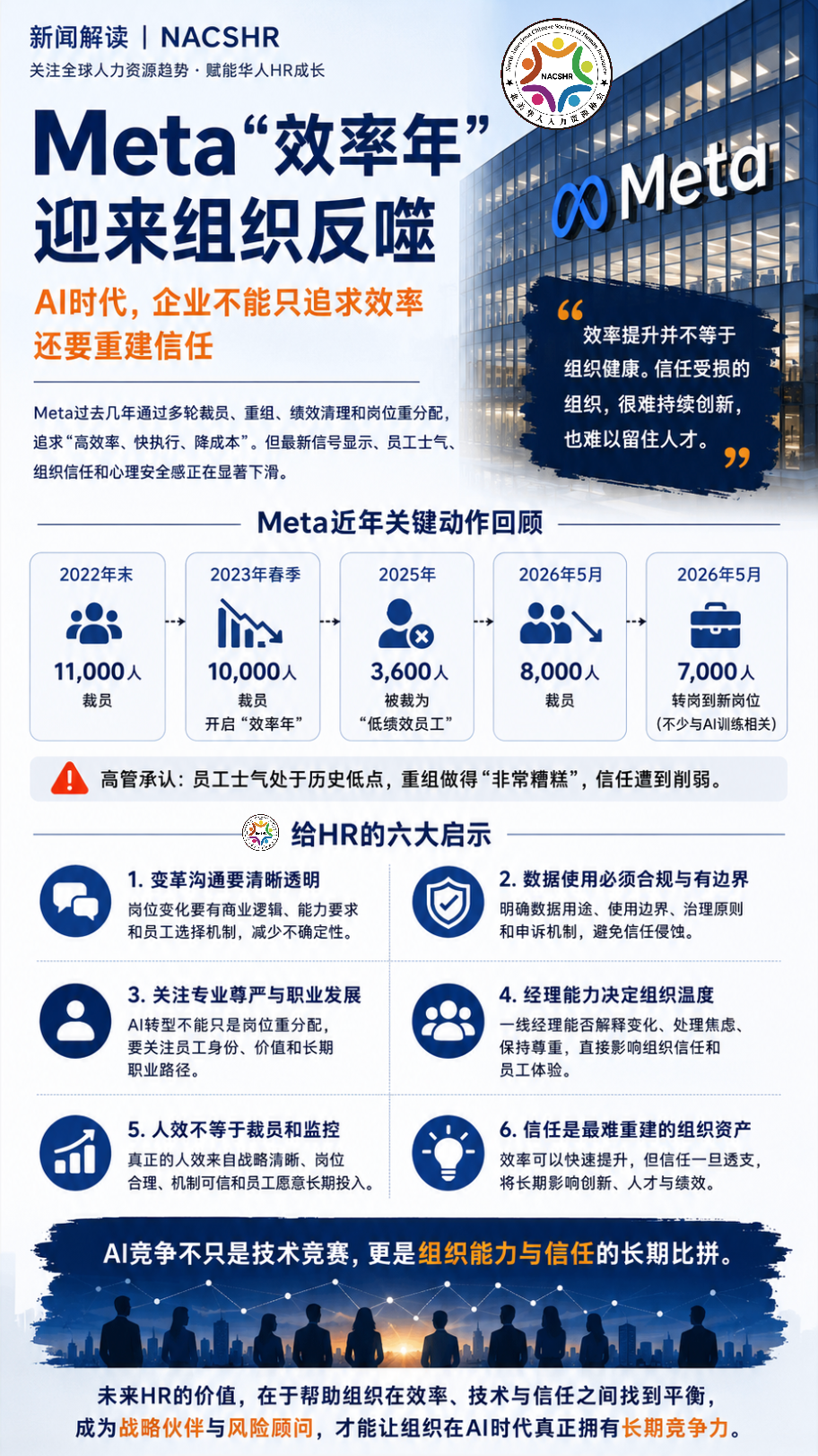
Meta高压管理模式迎来反噬:从“效率年”到组织信任危机Meta 的“效率年”正在迎来反噬。Business Insider 报道显示,自 2022 年以来,Meta 通过多轮裁员、重组、绩效清理、岗位再分配和员工监控,建立起一种更精简、更高压、更强调执行的管理模式。2022 年裁员 11,000 人,2023 年再裁 10,000 人,2025 年裁掉 3,600 名所谓 “low performers”,2026 年 5 月又裁员 8,000 人,并将 7,000 人重新分配到新岗位。现在,员工士气、组织信任和心理安全感正在成为 Meta 必须面对的问题。AI 时代企业确实需要效率,但如果效率建立在持续恐惧、不确定性和被监控感之上,创新能力反而可能被削弱。Meta 的案例提醒所有企业:人效管理不能只看成本、速度和绩效指标,还必须看员工是否仍然相信自己的专业价值会被尊重。
从“效率年”到信任危机:Meta正在经历管理模式的反作用
在过去几年里,Meta 一直被视为硅谷“效率革命”的代表企业。自 Mark Zuckerberg 提出 “year of efficiency” 之后,Meta 通过大规模裁员、组织重组、绩效清理、管理层级压缩和岗位再分配,试图把公司从过去高速扩张时期的庞大组织,改造成一个更精简、更快速、更高压、更强调执行结果的技术公司。这种转型曾经在资本市场获得积极反馈,也一度成为美国科技行业降本增效的标志性案例。
但最新信号显示,Meta 的高压管理模式正在进入一个新的阶段:效率的收益开始被组织信任的损耗所抵消。Business Insider 对 Meta 管理文化的最新分析指出,Meta 内部员工士气、心理安全感和组织信任正在承受明显压力。CTO Andrew Bosworth 在近期内部沟通中承认,员工士气可能处于公司历史上最糟糕的阶段之一,并表示公司在近期重组中做得非常糟糕,削弱了员工相信自身专业能力和贡献会被尊重的信任。Chief Product Officer Chris Cox 也承认公司内部环境艰难而残酷,Mark Zuckerberg 则承认公司犯过错误。
这不是简单裁员新闻,而是AI时代组织管理的拐点
从 HR 和组织管理角度看,这不是一个简单的科技公司裁员新闻,而是 AI 时代企业管理模式转型中的重要信号。Meta 的案例说明,当企业把效率、速度和成本控制推到极致时,如果没有同步维护员工信任、角色尊严和组织心理安全感,所谓“高绩效文化”很容易滑向“高恐惧文化”。
短期内,企业或许可以通过裁员和重组改善成本结构;但长期看,如果员工不再相信组织会尊重其专业能力,不再相信岗位调整具有公平性,不再相信管理层会承担清晰解释责任,创新能力、人才保留和组织承诺都会受到影响。对于任何处在 AI 转型中的企业而言,这都是一个非常现实的组织风险。
多轮裁员与岗位重组,正在重塑员工对组织的信任判断
Meta 过去几年的组织变化非常激烈。2022 年末,公司裁员 11,000 人;2023 年春季再裁员 10,000 人,并将这一阶段定义为 “year of efficiency”;2025 年,公司又裁掉 3,600 名被称为 “low performers” 的员工;2026 年 5 月,Meta 再次裁员 8,000 人,同时将 7,000 名员工重新分配到新岗位,其中不少岗位与 AI 训练相关。
这一系列动作背后,是 Meta 希望在 OpenAI、Anthropic、Google 等公司快速推进 AI 竞争的背景下,重新配置人力资本,把资源集中到更关键的技术方向。但组织重构越剧烈,越需要清晰的沟通、可信的机制和可被员工理解的变革逻辑。否则,员工看到的就不是战略升级,而是持续不确定、岗位安全感下降和专业价值被削弱。
AI岗位重分配不能只看资源配置,还要看专业尊严
AI 转型中的组织重构不能只被理解为“把人放到新的岗位上”。对于员工来说,岗位代表的不只是工作任务,还包括专业身份、职业路径、能力积累和组织认可。如果员工突然被重新分配到并不匹配其专业预期的 AI 训练岗位,又缺乏充分沟通、选择权和尊严感,这种转型就很容易被体验为降级、替代或被动安置。
企业希望员工支持 AI 战略,但员工首先会判断:AI 是增强我的能力,还是降低我的价值?组织是在帮助我适应未来,还是把我当作可以随时重组的资源?这也是 Meta 事件对 HR 的核心启示。AI 转型不能只围绕技术路线和资源投入展开,还必须处理员工对身份、价值和未来职业路径的深层焦虑。
人效管理不能被简化为裁员、压缩和监控
AI 时代的人力资源管理,不能只围绕“人效”这个词展开。人效当然重要,但人效不是简单地减少人数、压缩层级、提高产出指标,也不是通过监控和恐惧来迫使员工更快工作。真正可持续的人效,来自更清晰的战略优先级、更合理的岗位设计、更可信的绩效机制、更强的经理能力,以及员工愿意投入判断力、创造力和长期承诺的组织环境。
如果企业只把人效理解为“用更少的人完成更多任务”,那么 HR 就容易被推向单一的执行角色:执行裁员、推动重组、压缩预算、提高绩效压力。但如果企业把人效理解为“让组织能力真正服务业务战略”,HR 的角色就会完全不同。HR 不只是成本管理者,更是组织能力建设者、变革风险识别者和信任机制设计者。
员工监控争议背后,是企业数据治理与信任边界问题
Meta 的键盘监控争议尤其值得 HR 关注。员工反对的并不只是一个技术工具,而是背后的管理假设。当企业开始通过更细颗粒度的数据追踪员工行为,并把这些数据与 AI 模型训练、生产率评估或岗位替代联系在一起时,员工自然会产生被监控、被评估、被自动化替代的焦虑。
对于企业而言,技术监控或许看起来能提高透明度和效率;但对于员工而言,如果缺乏边界、目的说明、数据治理和申诉机制,监控会迅速侵蚀信任。未来 HR 在引入 AI 工具、员工行为数据分析和自动化绩效管理系统时,必须提前参与治理设计。关键问题不是“能不能收集数据”,而是“为什么收集、如何使用、谁能访问、是否透明、员工是否有申诉权”。
北美华人HR需要从执行角色走向组织风险顾问
这对北美华人 HR 群体同样具有现实意义。许多华人 HR 专业人士所在的企业,正在经历 AI 工具采购、组织重组、岗位合并、流程自动化和绩效体系调整。管理层可能会提出更高的人效要求,也可能希望 HR 用更少的人支持更复杂的业务需求。在这种情况下,HR 的角色不能只是执行裁员、重组和绩效清理,而应该成为组织风险的识别者、信任机制的设计者和变革沟通的推动者。
具体来说,HR 至少需要把握三个方向。
第一,在 AI 转型和组织重构中,必须明确岗位变化的商业逻辑、能力要求和员工选择机制,不能让员工在长期不确定中等待结果。
第二,在使用员工数据和监控工具时,必须建立清晰的治理原则,包括数据用途、使用边界、透明沟通、合规审查和员工反馈渠道。
第三,在强调绩效和效率的同时,不能忽视经理能力建设。很多组织信任问题并不是来自战略本身,而是来自一线经理无法解释变化、无法处理员工焦虑、无法在压力中保持尊重和公平。
AI竞争不只是技术竞赛,更是组织能力竞赛
Meta 的案例也提醒企业领导者:AI 竞争不是单纯的技术竞赛,也是组织能力竞赛。企业能否在 AI 时代保持竞争力,不只取决于模型、算力、产品路线和资本投入,也取决于员工是否仍然相信公司值得投入长期努力。一个组织如果长期依赖恐惧推动执行,可能会获得短期速度,却会失去高质量创新所需的心理安全感。
真正优秀的技术人才并不只是完成任务的人,他们还需要提出不同意见、承担实验风险、挑战既有路径,并在不确定中持续探索。缺乏信任的组织,很难要求员工进行真正有风险的创新。尤其在 AI 快速演进的环境下,企业最需要的并不是机械服从,而是跨职能协作、持续学习和高质量判断。
企业需要重新定义效率:效率不能以透支信任为代价
对于 HR 来说,这场讨论的重点不是否定效率,而是重新定义效率。效率不应该是“少人干更多事”的单一逻辑,而应该是让组织资源配置更精准、让员工能力使用更充分、让管理摩擦更少、让业务决策更清晰。企业需要降本增效,但也需要知道哪些成本不能随意削减:信任、心理安全感、组织公平感和员工尊严,就是最容易被低估、也最难重建的组织资产。
Meta 正在经历的并不是个别公司的管理波动,而是 AI 时代许多企业都会面对的共同问题。当技术变化加速、资本市场要求效率、管理层追求速度,HR 必须帮助组织回答一个更本质的问题:我们是在建设一个更高效的组织,还是在透支一个组织赖以运行的信任基础?
NACSHR观察:未来HR的价值在于平衡效率、技术与信任
NACSHR 认为,未来 HR 的价值将不只是完成事务性人力资源管理,而是在 AI、组织变革和商业压力之间建立新的平衡。企业需要效率,也需要尊重;需要速度,也需要透明;需要绩效,也需要信任。Meta 的经验表明,组织可以通过强硬管理快速改变成本结构,但只有通过可信的领导力、公平的机制和真实的人本管理,才能真正重建长期竞争力。
对北美华人 HR 来说,这也是职业角色升级的重要机会。AI 时代的 HR 不应只是政策执行者、流程维护者或裁员通知传递者,而应成为组织转型中的战略伙伴。真正有价值的 HR,能够在企业追求效率时提醒风险,在管理层推动变革时设计机制,在员工产生焦虑时建立沟通,在技术改变岗位时维护组织信任。Meta 的案例再次说明,未来企业竞争的关键不只是 AI 能力,也包括组织是否仍然有能力让优秀的人愿意留下、敢于表达、持续创造。
AI Training
2026年06月27日
AI Training
你以为大家都懂 AI?其实他们都在装懂——Pluralsight《2025 AI 技能报告》深度解读
“我其实不太懂,但又不好意思说。”——这是许多技术人员和高管面对 AI 时的真实心声。
在我们谈论 AI 如何颠覆行业、重塑岗位的时候,也许我们忽略了一个关键问题:究竟有多少人真的懂 AI?
Pluralsight 最新发布的《2025 AI 技能报告》给出了一个惊人的答案:大多数人其实都在“演戏”。
是的,你没有听错。报告调查了来自美国和英国的 1,200 位技术高管和从业者,发现整整 79% 的人承认夸大了自己对 AI 的理解,而站在组织最前线的高管,居然有 91%“装懂”。这不仅是一场职场里的集体错觉,也是一面照见现实的镜子:AI 正在迅速成为新的职场“裸泳”试炼。
“会不会用 AI”变成了一种表演
在很多公司,使用 ChatGPT 或 Copilot 本应是一种提升效率的手段,但却被悄悄贴上了“偷懒”的标签。报告显示,61% 的人觉得在工作中用生成式 AI 会被认为不够敬业。
于是,人们开始偷偷摸摸地用 AI —— 不打招呼、不留痕迹,生怕别人知道自己依赖了工具。这种“影子 AI”现象,让整个职场变得有点像小学考试时偷偷翻书的学生:大家都在作弊,却都装作没有。
“我懂 AI”成为职场社交货币
在调查中,九成从业者自信地说:我有足够的技能把 AI 工具融入工作中。 但问题来了:几乎同样比例的人又说,是“其他人”的 AI 技能不够,才导致项目失败。
这不是一个技术问题,而是一个认知偏差问题。正如报告所言,这可能是“达克效应”(Dunning-Kruger Effect)在作怪:越不懂的人越自信,越懂的人越谨慎。
我们真的会被 AI 取代吗?
报告也揭示了另一种深层焦虑:90% 的受访者担心自己被 AI 替代,而这个比例较去年增长了 19%。最焦虑的行业包括:内容创作、数据分析、销售和市场。
但现实其实并不那么残酷。数据显示,有近一半的企业正在新增 AI 相关职位。换句话说,AI 并不是“替代者”,而是“重塑者”。只是那些被“重塑”之前的人,必须先完成一场认知与技能的跃迁。
真正的赢家,懂得不断更新
幸运的是,大多数公司正在醒来。59% 的企业已经开始提供 AI 培训,54% 的企业通过涨薪来缓解员工的焦虑,甚至有些公司开始为员工提供“AI 心理建设”。
更可喜的是,有 8 成的技术从业者表示:AI 真的让我的工作更轻松了。
从数据建模到个性化推荐,从云管理到自动化任务,这些看似“高冷”的 AI 应用,正在变得触手可及。
写在最后:别再装了,真的可以学
也许我们都该承认:AI 发展太快了,不懂是常态,懂才是稀缺。真正拉开差距的,从来不是“演得像不像”,而是你有没有诚实地面对自己的技能盲区,并持续进步。
这份报告不是在揭示一个笑话,而是在给每一个职场人提个醒:别再装了,时间不等人,AI 的浪潮已经拍到了你脚边。
你是要假装会游泳,还是现在就跳下去学?
AI Training
2025年04月03日
AI Training
麦肯锡:AI赋能职场,企业如何跨越管理障碍,实现智能化未来?员工对 AI 的适应速度远超领导层的预期
AI 如何重塑职场?
人工智能(AI)正在以惊人的速度重塑职场生态,许多企业正试图利用 AI 提高生产力、优化决策流程并增强市场竞争力。然而,AI 技术的广泛应用远非一蹴而就,企业的 AI 部署不仅涉及技术升级,更考验管理者的战略眼光和执行力。
麦肯锡的《Superagency in the Workplace》 这份报告深入研究了 AI 在职场中的应用现状,基于对 3,613 名员工和 238 名 C 级高管 的调查,揭示了企业在 AI 落地过程中的机遇与挑战。报告认为,AI 在职场的变革潜力堪比蒸汽机之于工业革命,但当前的最大障碍并非技术问题,而是领导层的行动力不足。
尽管 92% 的企业计划在未来三年增加 AI 投资,但只有 1% 认为自己 AI 发展成熟,表明大多数企业仍停留在 AI 试点阶段,尚未实现全面部署。更值得注意的是,报告发现员工对 AI 的接受度远超管理层的预期,但企业的 AI 发展速度依然滞后。领导者的犹豫和执行力缺失,正成为 AI 规模化应用的最大瓶颈。
本文将从员工接受度、领导层挑战、组织架构变革、AI 治理、商业价值实现等多个维度,介绍报告的核心观点,并补充对 AI 发展的进一步思考。
一、员工比领导更快接受 AI,企业行动缓慢
报告的核心发现之一是:员工已经在积极使用 AI,而领导者仍然低估了 AI 的普及度。
数据显示:
员工使用 AI 的频率比领导层预期高出 3 倍,但许多企业尚未提供系统性培训;
70% 以上的员工认为 AI 在未来两年内将改变至少 30% 的工作内容;
94% 的员工和 99% 的高管都表示对 AI 工具有一定熟悉度,但只有 1% 的企业认为 AI 应用已成熟。
这一现象表明,AI 在企业中的主要障碍并非员工适应能力,而是管理层的滞后决策。许多企业高管仍然停留在探索 AI 价值的阶段,而员工已经在日常工作中广泛使用 AI 工具,如自动生成文档、数据分析、代码编写等。员工在推动 AI 发展方面的主动性,远远超出管理层的认知。
然而,企业未能为员工提供足够的 AI 培训和资源,导致 AI 的应用仍然停留在浅层次,难以转化为真正的生产力提升。例如,48% 的员工认为 AI 培训是 AI 规模化应用的关键,但许多公司仍未建立 AI 学习机制。企业如果不采取措施缩小这一认知鸿沟,可能会错失 AI 带来的长期竞争优势。
二、AI 领导力挑战:速度焦虑与执行落差
尽管 AI 的发展潜力巨大,但报告指出,47% 的企业高管认为公司 AI 发展过于缓慢,主要原因包括:
AI 技术成本的不确定性:短期 ROI(投资回报率)难以量化,导致企业不敢大规模投资;
AI 人才短缺:AI 相关技术人才供不应求,企业缺乏相应的招聘和培养体系;
监管与安全问题:企业在数据隐私、算法透明度等方面的担忧阻碍了 AI 落地。
这种“速度焦虑”让企业在 AI 发展过程中陷入试点—停滞—观望的循环:
试点阶段:部分企业已启动 AI 试点项目,如客服自动化、数据分析等;
停滞阶段:由于短期收益不确定,试点项目难以规模化推广;
观望阶段:企业倾向于等待行业先行者经验,而非主动探索 AI 的商业价值。
报告强调,AI 的落地不仅是技术问题,更是企业管理问题。领导者需要具备更强的战略决心,加快 AI 投资,并明确 AI 在企业中的角色,才能真正推动 AI 规模化应用。
三、如何实现 AI 规模化落地?
1. AI 人才培养
AI 的大规模应用依赖于系统性的 AI 人才培训。然而,报告发现,近一半的员工认为企业提供的 AI 支持有限。企业需要采取措施:
建立 AI 培训体系,涵盖 AI 基础知识、业务应用和 AI 伦理等内容;
推广 AI 试点项目,让员工亲身参与 AI 工具的开发和使用;
设立 AI 激励机制,鼓励员工利用 AI 提升工作效率。
2. 组织架构调整
AI 不能仅仅作为 IT 部门的创新项目,而应当成为企业整体战略的一部分。报告建议:
设立 AI 战略委员会,确保 AI 发展与企业长期战略保持一致;
推动 AI 在各业务部门落地,提升 AI 在实际业务流程中的应用深度;
强化 AI 风险管理,确保 AI 应用在数据安全和监管方面的合规性。
3. AI 治理:平衡速度与安全
虽然 AI 带来了极大的商业价值,但报告指出,企业在 AI 治理方面仍存在诸多挑战:
51% 的员工担心 AI 可能带来的网络安全风险;
43% 的员工关注 AI 可能导致的数据泄露;
企业需要建立 AI 伦理标准,确保 AI 透明、公正、合规。
四、AI 时代的商业价值:企业如何真正实现 ROI?
尽管企业对 AI 充满期待,但报告显示,目前仅 19% 的企业 AI 投资带来了 5% 以上的收入增长,表明大多数企业的 AI 应用尚未转化为可观的商业回报。为了提升 AI 价值,企业需要:
从“技术驱动”转向“业务驱动”,确保 AI 应用直接创造商业价值;
优化 AI 目标设定,明确 AI 在核心业务中的定位;
加强 AI 应用场景探索,特别是在客户服务、供应链管理等高回报领域进行深入部署。
AI 成败的关键在于管理层
AI 的成功不仅依赖技术本身,更取决于企业领导者的执行力和战略眼光。企业若要真正迈向 AI 时代,需要:
加速 AI 战略落地,推动组织变革;
加强 AI 人才培养,提高员工 AI 适应能力;
建立 AI 治理体系,确保 AI 安全合规发展。
在 AI 时代,最危险的不是迈得太快,而是思考得太小、行动得太慢。
附录:《Superagency in the Workplace》 下载
AI Training
2025年03月14日
AI Training
How Generative AI Adds Value to the Future of Work
这篇Upwork的文章深入探讨了生成式人工智能(AI)在重新塑造工作价值方面的变革力量,强调了自动化和创新不仅改变了工作岗位,还在各个行业提高了生产力和创造力。文章着重讨论了对劳动力市场的细微影响,强调了技能发展和道德考虑的重要性,并对人工智能与人类合作的未来提供了前瞻性的视角。
Authors: Dr. Ted Liu, Carina Deng, Dr. Kelly Monahan
Generative AI’s impact on work: lessons from previous technology advancements
In this study, we provide a comprehensive analysis of the initial impact of generative AI (artificial intelligence) on the Upwork marketplace for independent talent. Evidence from previous technological innovations suggests that AI will have a dual impact: (1) the displacement effect, where job or task loss is initially more noticeable as technologies automate tasks, and (2) the reinstatement effect, where new jobs and tasks increase earnings over time as a result of the new technology. Take for example the entry of robotics within the manufacturing industry. When robotic arms were installed along assembly lines, they displaced some of the tasks that humans used to do. This was pronounced in tasks that were routine and easy to automate. However, new tasks were then needed with the introduction of robotics, such as programming the robots, analyzing data, building predictive models, and maintaining the physical robots. The effects of new technologies often counterbalance each other over time, giving way to many new jobs and tasks that weren’t possible or needed before. The manufacturing industry is now projected to have more jobs available as technologies continue to advance, including Internet of Things (IoT), augmented reality, and AI, which transform the way work is completed. The issue now at hand is ensuring enough skilled workers are able to work alongside these new technologies.
While this dynamic of displacement and reinstatement generally takes years to materialize, as noted above in the manufacturing example, the effects of generative AI may be taking place already on Upwork. For the platform as a whole, we observe that generative AI has increased the total number of job posts and the average spend per new contract created. In terms of work categories, generative AI has reduced demand in writing and translation, particularly in low-value work, while enhancing earnings in high-value work across all groups. In particular, work that relies on this new technology like Data Science and Analytics are reaping the benefits. The report highlights the importance of task complexity and the skill-biased nature of AI's impact. Skills-biased technology change is to be expected as the introduction of new technologies generally favors highly skilled workers. We observe this on our platform as high-skill freelancers in high-value work are benefiting more, while those in low-value work face challenges, underscoring the need for skilling and educational programs to empower freelancers to adapt and transition in this evolving work landscape.
Understanding the lifecycle of work on Upwork and the impact of gen AI
Generative AI has a growing presence in how people do their work, especially since the public release of ChatGPT in 2022. While there’s been extensive discussion about the challenges and opportunities of generative AI, there is limited evidence of such impact based on transaction data in the broader labor market. In this study, we use Upwork’s platform data to estimate the short-term effects of generative AI on freelance outcomes specifically. The advantage of the Upwork platform is that it is in itself a complete marketplace for independent talent, as we observe the full life cycle of work: job posts, matching, work execution, performance reviews, and payment. Few other instances exist where a closed-system work market can be studied and observed. Thus, the results of this study offer insights into not only the online freelance market, but also the broader labor market.
How technological progress disrupts the labor market is not a new topic. Acemoglu and Restrepo (2019) argue that earning gain arises from new tasks created by technological progress, which they term the “reinstatement effect,” even if the automation of certain tasks may have a displacement effect in the labor market initially. What this means is that there may be a dynamic effect going on: the displacement effect (e.g., work loss) may be more noticeable in the beginning of a new technology entry, but as new jobs and tasks are being created, the reinstatement effect (e.g., rates increase, new work) will begin to prevail. In the broader labor market, such dynamics will likely take years to materialize. But in a liquid and active independent work marketplace like Upwork, it’s possible that we’re already observing this transition happening.
Existing studies such as this provides a useful conceptual framework to think about the potential impact of generative AI. It’s likely that in the short term, the replacement of generative AI will continue to be more visible, not just at Upwork, but also in the broader labor market. Over time and across work categories, however, generative AI will likely spur new tasks and jobs, leading to the reinstatement effect becoming stronger and increasing rates for those occupations with new tasks and a higher degree of task complexity. We’ve already seen evidence of new demand as a result of gen AI on our Upwork platform, with brand new skill categories like AI content creator and prompt engineer emerging in late 2022 and early 2023. We test this hypothesis of both work displacement and reinstatement, and provide insights into how generative AI affects work outcomes.
Impact of generative AI on work
To understand the short-term impact of generative AI on the Upwork freelance market, we capitalize on a natural experiment arising from the public release of ChatGPT in November 2022. Because this release was largely an unanticipated event to the general public, we’re able to estimate the causal impact of generative AI. The essential idea behind this natural experiment is that we want to compare the work groups affected by AI with the counterfactual in which they are not. To implement this, we use a statistical and machine-learning method called synthetic control. Synthetic control allows us to see the impact that an intervention, in this case, the introduction of gen AI, has on a group over time by comparing it to a group with similar characteristics not exposed to the intervention. The advantage of this approach is that it allows us to construct reasonably credible comparison groups and observe the effect over time.
The units of analysis we use are work groups on the Upwork platform; we analyze variables such as contract number and freelancer earnings. Instead of narrowly focusing on a single category like writing, we extend the analysis to all the major work groups on Upwork. Moreover, we conduct additional analysis of the more granular clusters within each major group. The synthetic control method allows for flexibility in constructing counterfactuals at different levels of granularity. The advantage of our comprehensive approach is that we offer a balanced view of the impact of generative AI across the freelance market.
Generative AI’s short-term impact on job posts and freelancer earnings
Looking at the platform as a whole, we observe that generative AI has increased the total number of job posts by 2.4%, indicating the overall increased demand from clients. Moreover, as shown in Figure 1, for every new job contract, there is an increase of 1.3% in terms of freelancer earnings per contract, suggesting a higher value of contracts.
Figure 1 Effect of Generative AI on Freelancer Earning per Contract
The Upwork platform has three broad sectors: 1. Technological and digital solutions (tech solutions); 2. Creative & outreach; 3. Business operations and consulting. We have observed both positive and negative effects within each of the sectors, but two patterns are worth noting:
The reinstatement effect of generative AI seems to be driving growth in freelance earnings in sectors related to tech solutions and business operations. In contrast, within the creative sector, while sales and marketing earnings have grown because of AI, categories such as writing and translation seem disproportionately affected more by the replacement effect. This is to be expected due to the nature of tasks within these categories of work, where large language models are now able to efficiently process and generate text at scale.
Generative AI has propelled growth in high-value work across the sectors and may have depressed growth in low-value work. This supports a skills-biased technology change argument, which we’ve observed throughout modern work history.
More specifically and within tech solutions, data science & analytics is a clear winner, with over 8% of growth in freelance earnings attributed to generative AI. This makes sense as the reinstatement effect is at work; new work and tasks such as prompt engineering have been created and popularized because of generative AI. Simultaneously, while tools such as ChatGPT automate certain scripting tasks (therefore leading to a replacement effect), it mainly results in productivity enhancements for freelancers and potentially leads to them charging higher rates and enjoying higher overall earnings per task.
In terms of contracts related to business operations, we observe that accounting, administrative support, and legal services all experience gains in freelance earnings due to generative AI, ranging from 6% to 7%. In this sector, customer service is the only group that has experienced reduced earnings (-4%). The reduced earnings result for customer service contracts is an example of the aggregate earnings outcomes of AI, related to the study by Brynjolfsson et al (2023), who find that generative AI helps reduce case resolution time at service centers.
A potential outcome of this cut in resolution time is that service centers will need fewer workers, as more tasks can be completed by a person working alongside AI. At the same time, the reinstatement effect has not materialized yet because there are no new tasks being demanded in such settings. This may be an instance where work transformation has not yet been fully realized, with AI enabling faster work rather than reinventing a way of working that leads to new types of tasks. A contrasting case is the transformation that happened with bank tellers when ATMs were introduced. While the introduction of these new technologies resulted in predictions of obsolete roles in banks, something different happened over time. Banks were able to increase efficiency as a result of ATMs and were able to scale and open more branches than before, thereby creating more jobs. In addition, the transactional role of a bank teller became focused on greater interpersonal skills and customer relationship tasks.
When taken together, the overall gains in such business operations work on Upwork are an encouraging sign. These positions tend to require relatively intensive interpersonal communication, and it seems the short-term effects of generative AI have helped increase the value of these contracts, similar to what we saw in the banking industry when ATMs were introduced.
As of now, the replacement effect of AI seems more noticeable in creative and outreach work. The exception is sales and marketing contracts, which have experienced a 6.5% increase in freelance earnings. There is no significant impact yet observed on design. For writing and translation, however, generative AI seems to have reduced earnings by 8% and 10% respectively. However, as we will discover, task complexity has a moderating effect on this.
High-value work benefit from generative AI, upskilling needed for low-value work
Having discussed the overall impact of generative AI across categories, we now decompose the impact by values. The reason we’re looking at the dimension of work value is that there may be a positive correlation between contract value and skill complexity. Moreover, skill complexity may also be positively correlated with skill levels. Essentially, by evaluating the impact of AI by different contract values, we can get at the question of AI's impact by skill levels. This objective is further underscored by a discrepancy that sometimes exists in the broader labor markets – a skills gap between demand and supply. It simply takes time for upskilling to take place, so it’s typical for demand to exceed supply until a more balanced skilled labor market takes place. It is worth noting, however, freelancers on the Upwork platform seem more likely than non-freelancers to acquire new skills such as generative AI.
For simplicity, let’s assume that the value of contracts is a good proxy for the level of skill required to complete them. We’d then assume that high-skill freelancers typically do high-value work, and low-skill freelancers do low-value work. In other words, our goal is also to understand whether the impact of generative AI is skills-biased and follows a similar pattern from what we’ve seen in the past with new technology disruptions. Note that we’re focusing on the top and bottom tails of the distribution of contract values, because such groups (rather than median or mean) might be most susceptible to displacement and/or reinstatement effects, therefore of primary concern. We define high-value (HV) work as those with $1,000 or more earnings per contract. For the remaining contracts, we focus on a subset of work as low-value (LV) work ($251-500 earnings).
Figure 2 shows the impact of AI by work value, across groups on Upwork. As we discussed before, writing and translation work has experienced some reduction in earnings overall. However, if we look further into the effect of contract value, we see that the reduction is largely coming from the reduced earnings from low-value work. At the same time, for these two types, generative AI has induced substantial growth in high-value earnings – the effect for translation is as high as 7%. We believe the positive effect on translation high-value earning is driven by more posts and contracts created. In the tech solutions sector, the growth in HV earnings in data science and web development is also particularly noticeable, ranging from 6% to 9%. Within the business solutions sector, administrative support is the clear winner.
There are two takeaways from this analysis by work value. First, while we’re looking at a sample of all the contracts on the platform, it’s possible that the decline of LV work is more than made up for by the growth of HV work in the majority of the groups. In other words, except for select work groups, the equilibrium results for the Upwork freelance market overall seem to be net positive gains from generative AI. Second, if we assume that freelancers with high skills (or a high degree of skill complexity) tend to complete such HV work (and low-skill freelancers do LV work), we observe that the impact of generative AI may be biased against low-skill freelancers. This is an important result: In the current discussion of whether generative AI is skill-based, there exists limited evidence based on realized gains and actual work market transactions. We are one of the first to provide market-transaction-based evidence to illustrate this potentially skill-biased impact. Finally, additional internal Upwork analysis finds that independent talent engaged in AI-related work earn 40% more on the Upwork marketplace than their counterparts engaged in non-AI-related work. This suggests there may be additional overlap between high-skill work and AI-related work, which can further reinforce the earning potential of freelancers in this group.
Figure 2
Case study: 3D content work
To illustrate the impact of generative AI in more depth, we have conducted a case study of Engineering & Architecture work within the tech solutions sector. The reason is that we want to illustrate the potentially overlooked aspects of AI impact, compared with the examples of data science and writing contracts. This progress in generative AI has the potential to reshape work in traditional areas like design in manufacturing and architecture, which rely heavily on computer-aided design (CAD) objects, and newer sectors such as gaming and virtual reality, exemplified by NVIDIA's Omniverse.
Based on activities on the Upwork platform, we see that there is consistent growth of job posts and client spending in this category, with up to 12% of gross service value growth year over year in 2023 Q3, and over 11% in job posts during the same period. Moreover, applying the synthetic control method, we show a causal relationship between gen AI advancements and the growth in job posts and earnings per contract. More specifically, there is a significant increase in overall earnings because of AI, an average 11.5% increase. Additionally, as shown by Figure 3, the positive effect also applies to earning per contract. This indicates a positive impact on freelancer productivity and quality of work, due to the fact that we’re measuring the income for every unit of work produced. This suggests that gen AI is not just a facilitator of efficiency but also enhances the quality of output.
Figure 3 Effect of Generative AI on Freelancer Earning per Contract in EngineeringIn a traditional workflow to create 3D objects without generative AI, freelancers would spend extensive time and effort to design the topology, geometry, and textures of the objects. But with generative AI, they can do so through text prompts to train models and generate 3D content. For example, this blog by NVIDIA’s Omniverse team showcases how ChatGPT can interface with traditional 3D creation tools.
Thus, the positive trajectory of generative AI in 3D content generation we see is driven by several factors. AI significantly reduces job execution time, allowing for higher productivity. It facilitates the replication and scaling of 3D objects, leading to economies of scale. Moreover, freelancers can now concentrate more on the creative aspects of 3D content, as AI automates time-consuming and tedious tasks.
This shift has not led to a decrease in rates due to the replacement effect. In fact, this shift of workflow may create new tasks and work. We will likely see a new type of occupation in which technology and humanities disciplines converge. For instance, a freelancer trained in art history now has the tools to recreate a 3D rendering of Japan in the Edo period, without the need to conduct heavy coding. In other words, the reinstatement effect of AI will elevate the overall quality and value proposition of the work, and ultimately enable higher earning gains. This paradigm shift underscores generative AI's role in not just transforming work processes but also in creating new economic dynamics within the 3D content market. Fortunately, it seems many freelancers on Upwork are ready to reap the benefits: 3D-related skills, such as 3D modeling, rendering, and design, are listed among the top five skills of freelancer profiles as well as in job posts.
A dynamic interplay: task complexity, skills, and gen AI
Focusing on the Upwork marketplace for independent talent, we study the impact of generative AI by using the public release of ChatGPT as a natural experiment. The results suggest a dynamic interplay of replacement and reinstatement effects; we argue that this dynamic is influenced by task complexity, suggesting a skill-biased impact of gen AI. Analysis across Upwork's work sectors shows varied effects: growth in freelance earnings in tech solutions and business operations, but a mixed impact in the creative sector. Specifically, high-value work in data science and business operations see significant earnings growth, while creative contracts like writing and translation experience a decrease in earnings, particularly in lower-value tasks. Using the case study of 3D content creation, we show that generative AI can significantly enhance productivity and quality of work, leading to economic gains and a shift toward higher-value tasks, despite initial concerns of displacement.
Acemoglu and Restrepo (2019) argue that the slowdown of earning growth in the United States the past three decades can partly be explained by new technologies’ replacement effect overpowering the reinstatement effect. But with generative AI, we’re at a point of completely redefining what human tasks mean, and there may be ample opportunities to create new tasks and work. It's evident that while high-value types of work are being created, freelancers engaged in low-value tasks may face negative impact, possibly due to a lack of skills needed to capitalize on AI benefits. This situation underscores the necessity of supporting freelancers not only in elevating their marketability within their current domains but also in transitioning to other work categories.
To ensure as many people as possible benefit, there’s an imperative need to provide educational resources for them to gain the technical skills, and more importantly skills of adaptability to reinvent their work. This helps minimize the chance of missed opportunities by limiting skills mismatch between talent and new demands created by new technologies. Upwork has played a significant role here by linking freelancers to resources such as Upwork Academy’s AI Education Library and Education Marketplace, thereby equipping them with the necessary tools and knowledge to adapt and thrive in an AI-present job market. This approach can help bridge the gap between low- and high-value work opportunities, ensuring a more equitable distribution of the advantages brought about by generative AI.
Methodology
To estimate the causal impact of generative AI, we take a synthetic control approach in the spirit of Abadie, Diamond, and Hainmueller (2010). The synthetic control method allows us to construct a weighted combination of comparison units from available data to create a counterfactual scenario, simulating what would have happened in the absence of the intervention. We use this quasi-experimental method due to the infeasibility of conducting a controlled large-scale experiment. Additionally, we use Lasso regularization to credibly construct the donor pool that serves the basis of the counterfactuals and minimize the chance of overfitting the data.
Moreover, we supplement the analysis by scoring whether a sub-occupation is impacted or unaffected by generative AI. The scoring utilizes specific criteria: 1. Whether a certain share of job posts are tagged as AI contracts by the Upwork platform; 2. AI occupational exposure score, based on a study by Felten, Raj, and Seamans (2023), to tag these sub-occupations. We also use data smoothing techniques through three-month moving averages. We analyzed data collected on our platform from 2021 through Q3 2023. We specifically look at freelancer data across all 12 work categories on the platform for high-value contracts, defined as those with a contract of at least $1,000, and low-value contracts, consisting of those between $251 and under $500.
The main advantage of our approach is that it is a robust yet flexible way to identify the causal effects on not only the Upwork freelance market but also specific work categories. Additionally, we control for macroeconomic or aggregate shocks such as U.S. monetary policy in the pre-treatment period. However, we acknowledge the potential biases in identifying which sub-occupations are influenced by generative AI and the effects of external factors in the post-treatment period.
About the Upwork Research Institute
The Upwork Research Institute is committed to studying the fundamental shifts in the workforce and providing business leaders with the tools and insights they need to navigate the here and now while preparing their organization for the future. Using our proprietary platform data, global survey research, partnerships, and academic collaborations, we produce evidence-based insights to create the blueprint for the new way of work.
About Ted Liu
Dr. Ted Liu is Research Manager at Upwork, where he focuses on how work and skills evolve in relation to technological progress such as artificial intelligence. He received his PhD in economics from the University of California, Santa Cruz.
About Carina Deng
Carian Deng is the Lead Analyst in Strategic Analytics at Upwork, where she specializes in uncovering data insights through advanced statistical methodologies. She holds a Master's degree in Data Science from George Washington University.
About Kelly Monahan
Dr. Kelly Monahan is Managing Director of the Upwork Research Institute, leading our future of work research program. Her research has been recognized and published in both applied and academic journals, including MIT Sloan Management Review and the Journal of Strategic Management.

 AI Training
 AI Training
 AI Training
 AI Training




 扫一扫
添加客服
扫一扫
添加客服


