HR Predictions for 2024: The Global Search For Productivity2024年的HR预测强调了生产力和AI在商业和雇佣实践中的关键作用。这篇文章讨论了公司在动态的经济条件和不断变化的劳动力市场背景下,如何适应他们的人才管理和招聘策略。强调了员工赋权的增加,劳动力市场的变化,以及技能发展的重要性。文章还探讨了劳动力囤积、混合工作模式和员工激活等关键概念。此外,还涉及领导力挑战、薪酬公平、DEI计划,以及可能的四天工作周。
一起来看Josh Bersin 带来新得见解
For the last two decades I’ve written about HR predictions, but this year is different. I see a year of shattering paradigms, changing every role in business. Not only will AI change every company and every job, but companies will embark on a relentless search for productivity.
Think about where we have been. Following the 2008 financial crisis the world embarked on a zero-interest rate period of accelerating growth. Companies grew revenues, hired people, and watched their stock prices go up. Hiring continued at a fevered pace, leading to a record-breaking low unemployment rate of 3.5% at the end of 2019.
Along came the pandemic, and within six months everything ground to a halt. Unemployment shot up to 15% in April of 2020, companies sent people home, and we re-engineered our products, services, and economy to deal with remote work, hybrid work arrangements, and a focus on mental health.
Once the economy started up again (thanks to fiscal stimulus in the US), companies went back to the old cycle of hiring. But as interest rates rose and demand fell short we saw layoffs repeat, and over the last 18 months we’ve seen hiring, layoffs, and then hiring again to recover.
Why the seesaw effect?
CEOs and CFOs are operating in what we call the “Industrial Age” – hire to grow, then lay people off when things slow down.
Well today, as we enter 2024, all that is different. We have to “hoard our talent,” invest in productivity, and redevelop and redeploy people for growth.
We live in a world of 3.8% unemployment rate, labor shortages in almost every role, an increasingly empowered workforce, and a steady drumbeat of employee demands: demands for pay raises, flexibility, autonomy, and benefits. More than 20% of all US employees change jobs each year (2.3% per month), and almost half these changes are into new industries.
Why is this the “new normal?”
There are several reasons. First, as we discuss in our Global Workforce Intelligence research, industries are overlapping. Every company is a digital company; every company wants to build recurring revenue streams; and soon every company will run on AI. Careers that used to stay within an industry are morphing into “skills-based careers,” enabling people to jump around more easily than ever before.
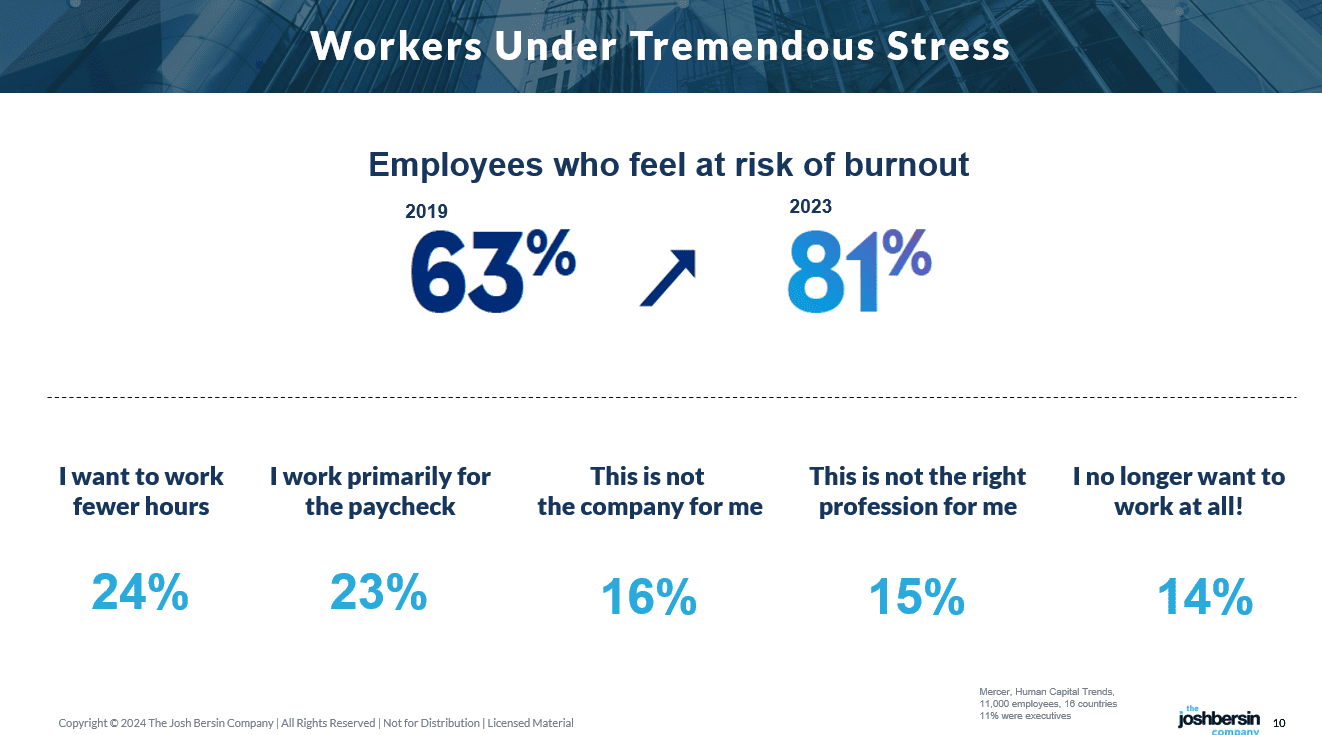
Second, employees (particularly young ones) feel empowered to act as they wish. They may quietly quit, “work their wage,” or take time out to change careers. They see a long runway in their lives (people live much longer than they did in the 1970s and 1980s) so they don’t mind leaving your company to go elsewhere.
Third, the fertility rate continues to drop and labor shortages will increase. Japan, China, Germany, and the UK all have shrinking workforce populations. And in the next decade or so, most other developed economies will as well.
Fourth, labor unions are on the rise. Thanks to a new philosophy in Washington, we’ve seen labor activity at Google, Amazon, Starbucks, GM, Ford, Stellantis, Kaiser, Disney, Netflix, and others. While union participation is less than 11% of the US workforce, it’s much higher in Europe and this trend is up.
What does all this mean?
There are many implications.
First, companies will be even more focused on building a high-retention model for work (some call it “labor hoarding.”) This means improving pay equity, continuing hybrid work models, investing in human-centered leadership, and giving people opportunities for new careers inside the company. This is why talent marketplaces, skills-based development, and learning in the flow of work are so important.
Second, CEOs have to understand the needs, desires, and demands of workers. As the latest Edelman study shows, career growth now tops the list, along with the desire for empowerment, impact, and trust. A new theme we call “employee activation” is here: listening to the workforce and delegating decisions about their work to their managers, teams, and leaders.
Third, the traditional “hire to grow” model will not always work. In this post-industrial age we have to operate systemically, looking at internal development, job redesign, experience, and hiring together. This brings together the silo’d domains of recruiting, rewards and pay, learning & development, and org design. (Read our Systemic HR research for more.)
What does “business performance” really mean?
If you’re a CEO you want revenue growth, market share, profitability, and sustainability. If you can’t grow by hiring (and employees keep “activating” in odd ways), what choice do you have? It’s pretty simple: you automate and focus on productivity.
Why do I see this as the big topic in 2024? For three big reasons.
First, CEOs care about it.
The 2024 PwC CEO survey found that CEO’s believe 40% of the work in their company is wasted productivity.
As shocking as that sounds, it rings true to me: too many emails, too many meetings, messy hiring process, bureaucratic performance management, and more. (HR owns some of these problems.)
Second, AI enables it.
AI is designed to improve white-collar productivity. (Most automation in the past helped blue or gray collar workers.) Generative AI lets us find information more quickly, understand trends and outliers, train ourselves and learn, and clean up the mess of documents, workflows, portals, and back office compliance and administration systems we carry around like burdens.
Third, we’re going to need it.
How will you grow when it’s so hard to find people? Time to hire went up by almost 20% last year and the job market is getting even tougher. Can you compete with Google or OpenAI for tech skills?
Internal development, retooling, and automation projects are the answer. And with Generative AI, the opportunities are everywhere.
What does all this mean for HR?
Well as I describe in the HR Predictions, we have a lot of issues to address.
We have to accelerate our shift to a dynamic job and organization structure. We have to get focused and pragmatic about skills. We have to rethink “employee experience” and deal with what we call “employee activation.” And we are going to have to modernize our HR Tech, our recruiting, and our L&D systems to leverage AI and make these systems more useful.
Our HR teams will be AI-powered too. As our Galileo™ customers already tell us, a well-architected “expert assistant” can revolutionize how HR people work. We can become “full-stack” HR professionals, find data about our teams in seconds instead of weeks, and share HR, leadership, and management practices with line leaders in seconds. (Galileo is being used as a management coach in some of the world’s largest companies.)
There are some other changes as well. As the company gets focused on “growth through productivity,” we have to think about the 4-day week, how we institutionalize hybrid work, and how we connect and support remote workers in a far more effective way. We have to refocus on leadership development, spend more time and money on first line managers, and continue to invest in culture and inclusion. We have to simplify and rethink performance management, and we have to solve the vexing problem of pay-equity.
And there’s more.
DEI programs have to get embedded in the business (the days of the HR DEI Police are over). We have to clean up our employee data so our AI and talent intelligence systems are accurate and trustworthy. And we have to shift our thinking from “supporting the business” to “being a valued consultant” and productizing our HR offerings, as our Systemic HR research points out.
All this is detailed in our new 40-page report “HR Predictions for 2024,” launching this week, including a series of Action Plans to help you think through all these issues.
And let me remind you of a big idea. Productivity is why HR departments exist.
Everything we do, from hiring to coaching to development to org design, is only successful if it helps the company grow. As experts in turnover, engagement, skills, and leadership, we in HR have make people and the organization productive every day. 2024 is a year to focus on this higher mission.
One final thing: taking care of yourself.
The report has 15 detailed predictions, each with a series of action steps to consider. The last one is really for you: focus on the skills and leadership of HR. We, as stewards of the people-processes, have to focus on our own capabilities. 2024 will be a year to grow, learn, and work as a team. If we deal with these 15 issues well, we’ll help our companies thrive in the year ahead.
Details on the Josh Bersin Predictions
The predictions study is our most widely-read report each year. It includes a detailed summary of all our research and discusses fifteen essential issues for CEOs, CHROs, and HR professionals. It will be available in the following forms:
Webinar and launch on January 24: Register Here (replays will be available)
Infographic with details: Available on January 24.
Microlearning course on Predictions: Available on January 24.
Detailed Report and Action Guide: Available to Corporate Members and Josh Bersin Academy Members (JBA). (Note you can join the JBA for $495 per year and that includes our entire academy of tools, resources, certificate courses, and SuperClasses in HR.)

 Economic Conditions
 Economic Conditions




 扫一扫
添加客服
扫一扫
添加客服


