Yes, AI Is Really Impacting The Job Market. Here’s What To Do.Josh Bersin 在 2025 年末指出,美国就业市场正在出现结构性变化。整体失业率上升至 4.6%,其中应届大学毕业生的失业率接近 10%,成为最受冲击的群体。与此同时,不要求大学学历的岗位持续增长,一线员工的重要性正在被重新定义。更值得关注的是信任问题。Edelman 调研显示,70% 的员工不信任企业关于 AI 裁员的说法,只有 27% 信任 CEO。AI 不只是技术工具,而是一场社会与组织层面的转型。Josh Bersin 强调,AI 并非消灭岗位,而是放大能力。真正的挑战在于,企业是否愿意投资年轻人才,是否能用透明沟通化解 AI 焦虑。
详细来看
All year I’ve been studying the employment data and talking with press about the smallish impact of AI on the job market. Most of the slowdown in US jobs, from my data and conversations, has been driven by cost-cutting and general economic uncertainty, not explicit AI job replacement.
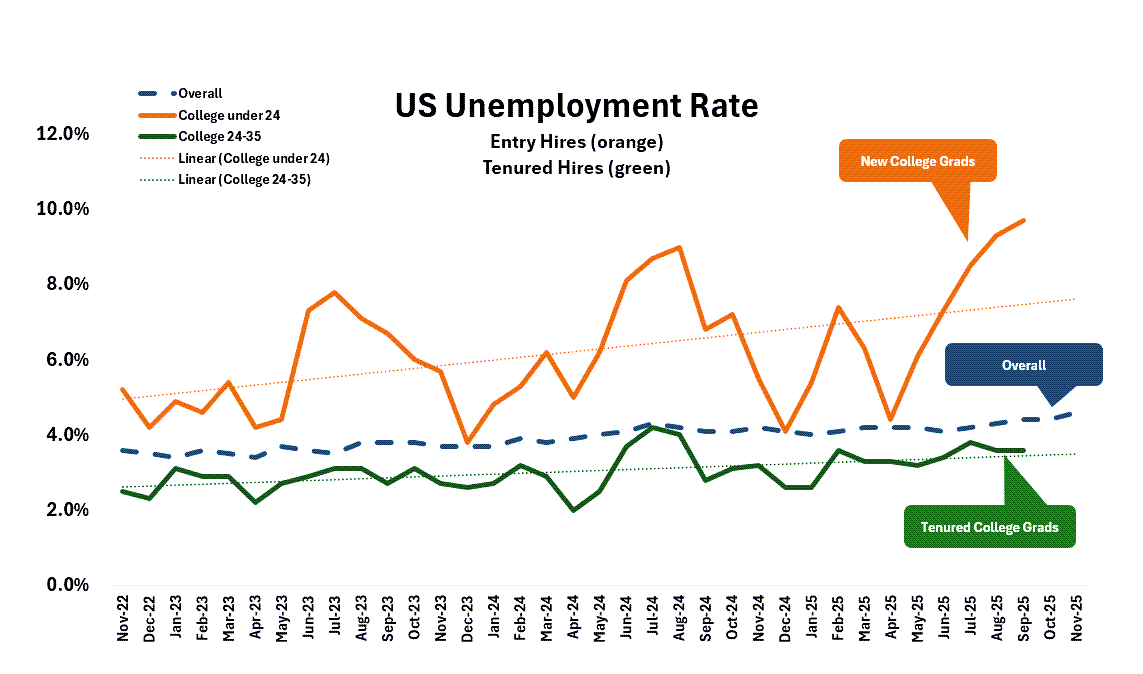
Well going into 2026 the situation is changing. The US unemployment rate is now 4.6%, up from 4.2% one year ago (a 9.5% increase) and 3.7% in November of 2023 (a 24.7% increase in two years). These are significant increases, especially considering that unemployment was 3.6% in November of 2022.
This tells me that the US economy is slowing after the post-pandemic “revenge buying” frenzy of 2021 and 2022. And of course US tariffs, inflation, and relatively high interest rates all contribute.
But now let’s look under the covers and break out unemployment into two sub-groups: new college graduates (24 years and younger), and more seasoned workers (age 25-35). Suddenly you see a divergence.
The green line, tenured college graduates, shows a steady unemployment rate below the average. This makes sense: these are experienced employees with skills, judgement, and seasoned decision-making maturity.
The orange line, new college graduates, is trending upward. In fact right now it’s almost 10%, which is the highest it has been since July 2021, the peak recovery from the pandemic. Looking backwards, the only time young college grad unemployment was this high was in 2011, a period of recovery from the 2008 recession. (St. Louis Fed agrees.)
And by the way, to round this out, jobs that do not require a degree are plentiful, roughly 82% of the workforce (up from 79% five years ago). So AI is not only slowing new college grad hiring, it’s also reducing the total number of jobs that require college.
There are three important things happening here:
First, whether it’s correct or not, employers are slowing down entry level hiring. Companies hire new college grads for many reasons (largely for talent pipeline), and many newly minted grads are far more AI-ready than we are. Despite this, it appears to economists that it’s harder than ever for these young folks to compete, so they need to “sell” their AI readiness and learning capacity.
Second, the frontline workforce is becoming much more important. The general automation of white collar work (it’s still early days) and the explosion of jobs in healthcare, social services, retail, repair, entertainment and distribution are making the “college grad” part of the workforce relatively smaller. That’s not to say the money isn’t good, but as a CEO or leader more and more of your energy has to go into supporting these frontline workers. (Read our Frontline-First research for more.)
Third, employees don’t trust CEO talk about jobs. A new study by Edelman shows a massive lack of people’s trust in business leaders (and AI scientists) around AI. This 5,000+ worker survey found that 70% of US workers do not trust statements about AI job reductions. When asked “who you do trust” only 27% of US workers trust the CEO. So we, as leaders, have a trust problem.
Here’s the trust data, and this is all about “Trust in AI’s Value” not “trust in the AI platform.”
AI Is a Socio-Technological Innovation
As I talked about in this week’s podcast, AI is “socio-technological.” It has many societal and sociological impacts.
If only half your employees believe what leaders are telling them, they’re going to hold back, grumble, and resist change. This is why economic insecurity is high: people are concerned about their jobs, careers, and future earnings.
(So AI anxiety could actually lower economic productivity!)
The solution to this is not to ignore the topic, but rather to discuss it openly.
None of us really know how much impact AI will have (I do know most platforms over-sell its value right now), and AI is a little scary.
We have to get comfortable with phones that talk back to us, creepy emails that know our name, avatar-based job interviews, AI-driven career advice, and AI-informed performance reviews. And in 2026 we’re going to see digital twins, robots, and more real-life animations of people at work. (Galileo Learn uses a “Josh Agent” to coach and challenge you as you learn.)
Here’s my advice. If you’re holding back on entry-level hiring you may be making a mistake. Younger staff, who have lived with this technology for more of their lives, are likely to be the ones to most quickly use AI, build with AI, and innovate with its new applications.
People who are tenured tend to see new tools as a way to “speed up what they know how to do.” New employees might just say “why not do it this way?” and bring you the reinvention you need.
Everyone Has The Opportunity To Be A Superworker Now
AI is not a job killer, it’s a big job-leveler.
You, as a younger worker, have access to information and research which was often hoarded by experts. If you’re willing to roll up your sleeves, you can move from “apprentice” to “newly minted expert” quickly. And if you’re looking for a job there’s no excuse for not becoming an expert on the company before you talk with a recruiter.
For senior, more tenured people the same applies. You can’t rely on your experience alone any more: you, too, should be digging in and learning about new technologies, tools, and advancements in your domain.
Employers: Be Careful How You Think
For hiring managers and executives, beware of the “tenure trap” above. Just because a senior person knows your business better, you may find that the young “AI-Guru” right out of college catches up fast. Remember, tenured people may see AI as a way to “do things the old way faster” rather than “rethink the way we work.”
For HR leaders and recruiters, remember one thing. Younger workers may learn faster and ultimately improve productivity at a faster rate (plus they cost less). If you seek out fast-learning AI pioneers they could be your Superworkers of the future.
And for CEOs and other execs, be honest and thoughtful about your plans. All our research points to AI as a “scaling technology,” not one to “eliminate jobs.” The more honest and supportive you are, the faster your employees will adapt and help your company stay ahead.

 Edelman信任指数
 Edelman信任指数

 扫一扫
添加客服
扫一扫
添加客服


