聚合AI时代的华人HR力量 ——2025 NACSHR北美华人人力资源年度论坛在硅谷圆满落幕
Redefining HR in the Age of AI: NACSHR 2025 Annual Conference Concludes Successfully in Silicon Valley
2025年10月4日至5日,NACSHR 2025 北美华人人力资源年度论坛在硅谷成功举办。这场由北美华人人力资源协会(NACSHR)主办的行业盛会,以“AI时代的人力资源变革与未来领导力”为主题,汇聚了来自旧金山湾区、洛杉矶、休斯顿、纽约、西雅图、温哥华及墨西哥等地的六十多位华人HR嘉宾与行业领袖,共同探讨AI技术、人本文化与组织创新的未来方向。在这场为期两天的深度交流中,参会者既是学习者,也是分享者;既是倾听者,更是共创者。正如NACSHR 发起人 Gawain在开幕致辞中所言:
“NACSHR不仅仅是华人HR的在北美的互动交流平台,更是一种连接的力量。我们在这里相互启发、相互成就,在AI的时代共同成长。”
本次论坛延续了NACSHR一贯的宗旨——以专业连接华人HR的全球力量,在AI与全球化浪潮下,汇聚思想、凝聚行动,为北美华人职场社群注入了新的信任与信心。
第一日 · 从AI到组织——重塑战略与协作的力量
10月4日的主题围绕“组织、AI与领导力”展开。多位嘉宾以不同视角深入剖析了AI如何重塑组织设计、决策逻辑与人才价值。
How to Design Your Organization to Support Global Business — Bijun Zhang
大会首日由本次论坛的主席 Bijun Zhang 开场。她以《How to Design Your Organization to Support Global Business》为主题,从组织设计与全球战略协同的角度,分享了跨地域团队在AI时代的成长之道。
她指出,组织设计的核心,不仅是结构,更是信任机制的建立。
“在跨时区、跨文化的团队中,真正的竞争力来自于‘清晰的边界’与‘有效的连接’。”
Bijun结合多地实践案例,提出通过“授权矩阵 + 沟通链路 + 文化共识”三要素,让全球团队在敏捷环境中高效协作。她总结道:“组织的韧性,不在规模,而在结构设计的智慧。”
The Art of Business Partnering in the Age of AI — Angela Rui
来自Canadian Solar 的 Global HR Director Angela Rui 带来了关于“AI时代的业务伙伴艺术”的分享。她认为,AI已成为HRBP最具影响力的“共驾工具”,帮助HR从事务性支持者成长为决策共创者。
Angela以实战案例讲述,如何通过AI工具洞察员工行为模式、优化绩效反馈、支持战略决策。
“AI让数据更透明,但真正的价值在于HR如何提出更好的问题。”
她强调,在AI与业务共驾的过程中,人性洞察将是HR无法被取代的核心竞争力。
川普2.0签证移民新政解读与HR应对之道 — Jiaqi (Jacky) Ji 律师
来自 Reid & Wise律所 的律师 Jiaqi (Jacky) Ji 带来了一场兼具专业性与现实指导意义的主题演讲。他从“政策误读”切入,详细剖析了近期引发热议的“10万美元入境费”事件,指出在社交媒体与碎片化信息环境下,HR应如何保持政策判断力与合规决策力。
“这是一场现实版的‘烽火戏诸侯’——政策还未实施,恐慌已先传播。”
Jacky系统解析了薪酬加权抽签机制、LCA提前布局策略及应对H-1B改革的关键要点。他提醒企业HR:
“在全球化与政治风险并存的时代,合规不仅是防御,更是战略能力。”
Panel:Organization Efficiency & AI Implementation
由 硅谷人才专家Tom Zhang 博士 主持的圆桌论坛聚焦“组织效率与AI实施”。与会嘉宾包括 Linda Lee(AI Fund Talent Partner)、Linsha Yao 与 Yalan Tan 等来自科技与生物医药行业的HR专家。
嘉宾们围绕“AI工具落地的关键障碍”展开深入探讨。讨论达成共识:
“AI能带来工具效率,但真正决定成败的,是文化的开放度与管理层的信任度。”
论坛现场氛围热烈,案例交流兼具前瞻性与实操性。
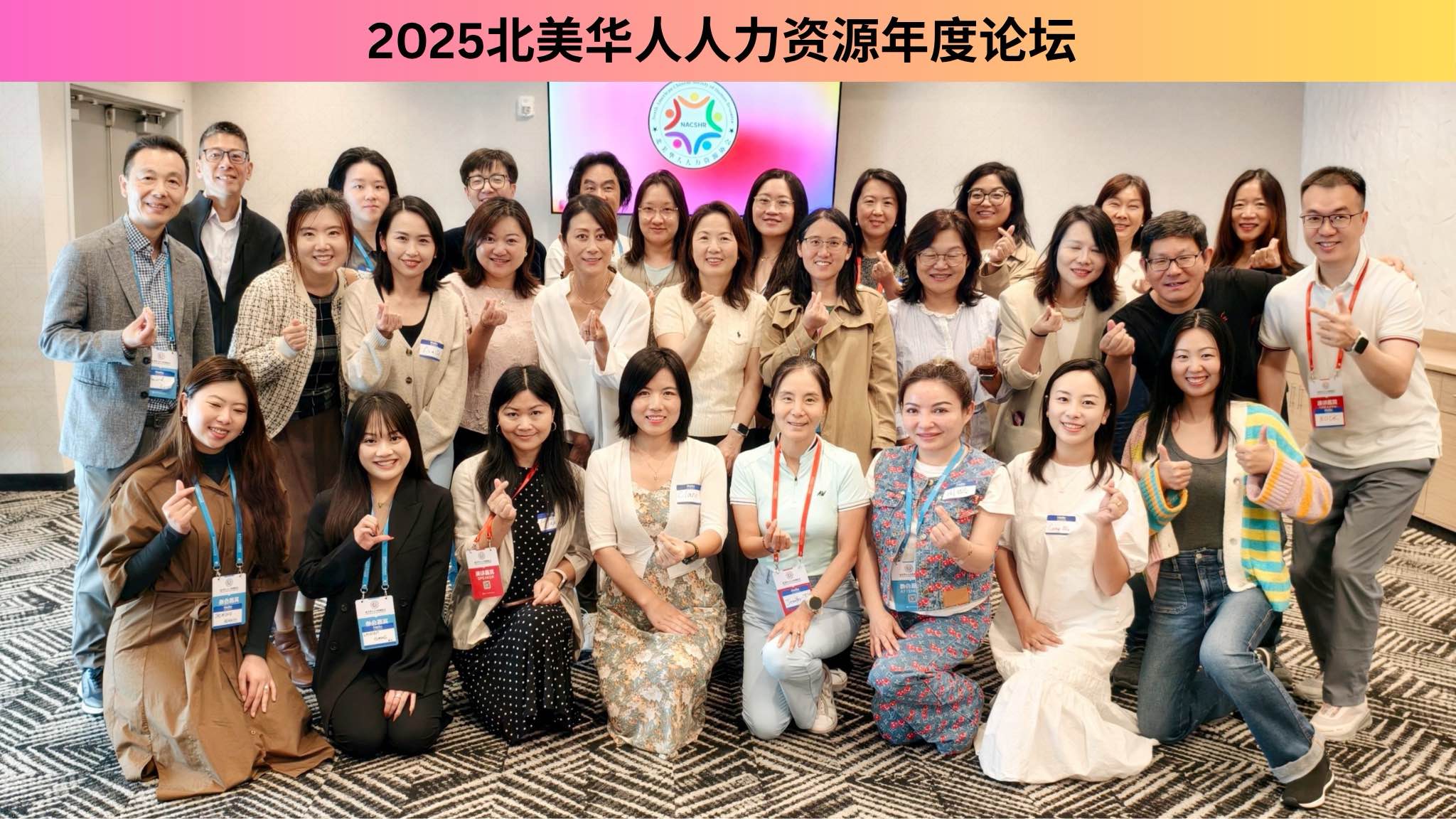
会议间隙,不分嘉宾还参与了会议合影的拍摄。
Thought Leadership Session:AI & HR Leadership — Tina Weinberger
来自 Cisco/Splunk 的高级HR业务伙伴 Tina Weinberger 以《Beyond the Hype: AI + HR Leadership》为题,带来极具洞察力的分享。她指出,AI对HR最大的改变,并非工作流程,而是“对工作的感受”。
“AI not only changes how we work — it changes how we feel about work.”
Tina提出“AI Confidence Framework”,包括四个核心要素:透明沟通、持续赋能、伦理治理、人机闭环。她强调,AI领导力的真正挑战不是工具选择,而是信任的建立。
“作为HR领袖,我们的使命不是管理变革,而是引导人走过变革。”
HR’s Next Evolution: How to Co-Pilot with AI Agents — Dr. Tom Q. Zhang
硅谷人才专家 Tom 博士在演讲中提出“共驾思维(Co-pilot Mindset)”,他指出:
“AI不会取代HR,但懂AI的HR,会取代不懂AI的HR。”
他展示了AI在招聘筛选、绩效预测、员工发展分析中的创新应用,并通过案例说明HR如何以AI为“副驾驶”,实现数据决策与人文洞察的融合。并强调未来的HR必须是会使用AI工具的人,同时在现场他还发布了一个正在招聘的HR主管岗位,其中之一的要求就是必须熟悉AI工具使用!这一要求引发全场同仁的思考和共鸣,也象征AI时代HR的新技能门槛
Solving HR Compliance and Payroll Challenges in North America with PEO — Joeyee Choon (ADP)
作为NACSHR战略合作伙伴代表,来自 ADP 的 Joeyee Choon 分享了PEO模式在北美合规与薪资管理中的创新实践。她指出:“在美国这样一个多州、多税制的环境中,共雇(Co-employment) 已成为企业提高合规与效率的关键机制。”
她以真实客户案例展示,企业通过PEO可平均节约20%的成本,并将HR从事务性流程解放出来。
“合规不是负担,而是组织持续成长的护栏。”
Redefining HR: Finding Your Unique Advantage in the Age of AI — Sandy Qian
来自 TransGlobal Insurance Agency 的 Sandy Qian 带来题为《Redefining HR: Finding Your Unique Advantage in the Age of AI》的主题演讲。她以IKIGAI模型为框架,引导HR思考个人使命与组织目标的契合点。
“AI可以自动化你的任务,但IKIGAI定义了你无法被取代的价值。”
Sandy提出,未来的HR应成为“技术的拥抱者、人性的守护者、组织文化的建设者”。
Panel:Building Leaders and Organizations in a Global Context
当天最后一个论坛由 Joki Jin 主持,嘉宾包括 Jane Xu、Carrie Peng、Cindy Fan、Grace Zhao等来自跨国科技与咨询领域的HR领导者。大家共同探讨了“全球背景下的组织领导力与人才流动趋势”,分享了多元文化团队中的实践心得。
“领导力的未来,不在权力,而在连接。”
她们从华人HR的视角出发,讨论如何在跨文化语境中平衡本地合规与全球战略,实现组织一致性与文化多样性共存。
Special Guest & VIP Dinner
夜幕降临,NACSHR特设的VIP Dinner 成为大会的温情收尾。在轻松的氛围中,嘉宾们围绕“AI与组织共生”“职业成长的长期主义”展开自由交流。这一环节不仅是社交聚会,更是一次深度链接与合作关系的延伸。许多嘉宾在会后已开启跨城市项目合作,成为未来持续共创的开端。
第二日 · 从组织到人本——在AI时代重新发现热爱与使命
10月5日的议程从技术与组织的视角,逐步走向“人性与热爱”的话题。AI不再是冷冰冰的系统,而成为激发创造力的伙伴。
From Business Leader to HR Head — Annie Jie Xu
开场分享嘉宾 Annie Jie Xu 分享了自己从20多年的商业领导者到HR负责人的转型之路。她以阿里巴巴二十年的成长经历为例,讲述如何从商业运营思维过渡到以人为本的组织建设!她谈到:最差的领导是很忙,最好的领导是会往后退。别人不帮你,是正常的,但是把事情做到极致,影响力就够了,别人也会来帮你。同时谈到阿里CPO童文红的职业经历启发了在场的每一位HR同仁。
“HR是企业灵魂的建构者。”
Annie以她的经历呼应了AI时代的人本管理主题——技术永远重要,但理解“人”的能力更不可或缺。
AI驱动的组织文化变革:如何让人机协作成为竞争优势 — Austin (Bo) Sun
Clausey AI 创始人 Austin Sun 带来对AI文化转型的系统思考。他以WM(Waste Management)的实践为例,指出:
“AI项目失败的90%原因不是技术,而是文化。”
Austin分享了如何通过内部AI培训、开放讨论与文化引导,让员工从焦虑到信任,最终实现AI共创。
“Don’t sell AI tools — build cultural momentum.”他的分享让“AI文化”从抽象概念变为可操作实践。
预见AI领导力进化 — Zhibin Liu
来自香港金融管理学院的 Zhibin Liu 客座教授,心理学家,以组织心理学视角探讨“高绩效与低焦虑的AI组织”。他通过实证研究与心理模型,说明AI领导力需要情绪智能(EQ)与适应智能(AQ)的双轮驱动。
“未来的领导者,既懂技术逻辑,也懂人心温度。”
Performance and Rewards Redesign in a Changing Workforce
由 Gabby Zhao 主持的圆桌论坛邀请 Cathy Wu、Freya Wang、Eva Meng 等HR专家,从多行业角度探讨绩效与激励机制的再设计。在AI与远程工作并行的环境下,如何用数据衡量绩效、用文化驱动动力,成为共识焦点。
如何找到自己的热爱,并把它创造到工作中 — 张岩
国际认证教练、团队领导力导师 张岩 带来最具情感共鸣的演讲。
“热爱,不是找到的,而是被创造的。”
她提出“四步法”:探索纯愿、广而告之、聆听回响、循响而行。
“幸福不是找到理想的工作,而是让当下的工作变得理想。”她的演讲以温暖和力量为论坛注入人文收尾,成为两天会议的情感高点。
HR in Startups: Building HR Functions from Zero to One
由 Libby Sun 主持,嘉宾包括 Lisa Qi、Yuqing Zhang、Ethan Zheng。他们从初创企业的角度探讨HR体系建设与快速成长的平衡。
“在初创企业,HR不是后台,而是生存引擎。”几位嘉宾以实战案例分享如何在资源有限的环境中搭建HR制度与文化支撑。
Thriving as Chinese HR Professionals in the North American Workplace
由 Mindy Gao、Jane Liang、William Chin参与的最后一场论坛,以“华人HR的职业成长与文化认同”为核心。他们探讨了如何在北美职场中建立影响力、获得认可,并以社群的方式彼此赋能。
“我们不仅在职场中工作,更在用行动定义‘华人HR’的力量。”
论坛在热烈掌声中落幕。两天16个环节的思想碰撞,带来了丰富的启发与情感共鸣。NACSHR以实际行动践行着“连接、学习与成长”的理念,为北美华人HR群体构建了一个持续交流、相互成就的专业共同体。
“当技术重塑世界,我们用热爱与连接重塑HR的未来。”
Stay Together, Stay Powerful.
Organization Design
2025年10月06日
Organization Design
Josh Bersin人工智能实施越来越像传统IT项目Josh Bersin的文章《人工智能实施越来越像传统IT项目》提出了五个主要发现:
数据管理:强调数据质量、治理和架构在AI项目中的重要性,类似于IT项目。
安全和访问管理:突出AI实施中强大的安全措施和访问控制的重要性。
工程和监控:讨论了持续工程支持和监控的需求,类似于IT基础设施管理。
供应商管理:指出了AI项目中彻底的供应商评估和选择的重要性。
变更管理和培训:强调了有效变更管理和培训的必要性,这对AI和IT项目都至关重要。
原文如下,我们一起来看看:
As we learn more and more about corporate implementations of AI, I’m struck by how they feel more like traditional IT projects every day.
Yes, Generative AI systems have many special characteristics: they’re intelligent, we need to train them, and they have radical and transformational impact on users. And the back-end processing is expensive.
But despite the talk about advanced models and life-like behavior, these projects have traditional aspects. I’ve talked with more than a dozen large companies about their various AI strategies and I want to encourage buyers to think about the basics.
Finding 1: Corporate AI projects are all about the data.
Unlike the implementation of a new ERP system, payroll system, recruiting, or learning platform, an AI platform is completely data dependent. Regardless of the product you’re buying (an intelligent agent like Galileo™, an intelligent recruiting system like Eightfold, or an AI-enabling platform to provide sales productivity), success depends on your data strategy. If your enterprise data is a mess, the AI won’t suddenly make sense of it.
This week I read a story about Microsoft’s Copilot promoting election lies and conspiracy theories. While I can’t tell how widespread this may be, it simply points out that “you own the data quality, training, and data security” of your AI systems.
Walmart’s My Assistant AI for employees already proved itself to be 2-3x more accurate at handling employee inquiries about benefits, for example. But in order to do this the company took advantage of an amazing IT architecture that brings all employee information into a single profile, a mobile experience with years of development, and a strong architecture for global security.
One of our clients, a large defense contractor, is exploring the use of AI to revolutionize its massive knowledge management environment. While we know that Gen AI can add tremendous value here, the big question is “what data should we load” and how do we segment the data so the right people access the right information? They’re now working on that project.
During our design of Galileo we spent almost a year combing through the information we’ve amassed for 25 years to build a corpus that delivers meaningful answers. Luckily we had been focused on data management from the beginning, but if we didn’t have a solid data architecture (with consistent metadata and information types), the project would have been difficult.
So core to these projects is a data management team who understands data sources, metadata, and data integration tools. And once the new AI system is working, we have to train it, update it, and remove bias and errors on a regular basis.
Finding 2: Corporate AI projects need heavy focus on security and access management.
Let’s suppose you find a tool, platform, or application that delivers a groundbreaking solution to your employees. It could be a sales automation system, an AI-powered recruiting system, or an AI application to help call center agents handle problems.
Who gets access to what? How do you “layer” the corpus to make sure the right people see what they need? This kind of exercise is the same thing we did at IBM in the 1980s, when we implemented this complex but critically important system called RACF. I hate to promote my age, but RACF designers thought through these issues of data security and access management many years ago.
AI systems need a similar set of tools, and since the LLM has a tendency to “consolidate and aggregate” everything into the model, we may need multiple models for different users.
In the case of HR, if build a talent intelligence database using Eightfold, Seekout, or Gloat which includes job titles, skills, levels, and details about credentials and job history, and then we decide to add “salary” … oops.. well all of a sudden we have a data privacy problem.
I just finished an in-depth discussion with SAP-SuccessFactors going through the AI architecture, and what you see is a set of “mini AI apps” developed to operate in Joule (SAP’s copilot) for various use cases. SAP has spent years building workflows, access patterns, and various levels of user security. They designed the system to handle confidential data securely.
Remember also that tools like ChatGPT, which access the internet, can possibly import or leak data in a harmful way. And users may accidentally use the Gen AI tools to create unacceptable content, dangerous communications, and invoke other “jailbreak” behaviors.
In your talent intelligence strategy, how will you manage payroll data and other private information? If the LLM uses this data for analysis we have to make sure that only appropriate users can see it.
Finding 3: Corporate AI projects need focus on “prompt engineering” and system monitoring.
In a typical IT project we spend a lot of time on the user experience. We design portals, screens, mobile apps, and experiences with the help of UI designers, artists, and craftsmen. But in Gen AI systems we want the user to “tell us what they’re looking for.” How do we train or support the user in prompting the system well?
If you’ve ever tried to use a support chatbot from a company like Paypal you know how difficult this can be. I spent weeks trying to get Paypal’s bot to tell me how to shut down my account, but it never came close to giving me the right answer. (Eventually I figured it out, even though I still get invoices from a contractor who has since deceased!)
We have to think about these issues. In our case, we’ve built a “prompt library” and series of workflows to help HR professionals get the most out of Galileo to make the system easy to use. And vendors like Paradox, Visier (Vee), and SAP are building sophisticated workflows that let users ask a simple question (“what candidates are at stage 3 of the pipeline”) and get a well formatted answer.
If you ask a recruiting bot something like “who are the top candidates for this position” and plug it into the ATS, will it give you a good answer? I’m not sure, to be honest – so the vendors (or you) have to train it and build workflows to predict what users will ask.
This means we’ll be monitoring these systems, looking at interactions that don’t work, and constantly tuning them to get better.
A few years ago I interviewed the VP of Digital Transformation at DBS (Digital Bank of Singapore), one of the most sophisticated digital banks in the world. He told me they built an entire team to watch every click on the website so they could constantly move buttons, simplify interfaces, and make information easier to find. We’re going to need to do the same thing with AI, since we can’t really predict what questions people will ask.
Finding 4: Vendors will need to be vetted.
The next “traditional IT” topic is going to be the vetting of vendors. If I were a large bank or insurance company and I was looking at advanced AI systems, I would scrutinize the vendor’s reputation and experience in detail. Just because a firm like OpenAI has built a great LLM doesn’t mean that they, as a vendor, are capable of meeting your needs.
Does the vendor have the resources, expertise, and enterprise feature set you require? I recently talked with a large enterprise in the middle east who has major facilities in Saudi Arabia, Dubai, and other countries in the region. They do not and will not let user information, queries, or generated data leave their jurisdiction. Does the vendor you select have the ability to handle this requirement? Small AI vendors will struggle with these issues, leading IT to do risk assessment in a new way.
There are also consultants popping up who specialize in “bias detection” or testing of AI systems. Large companies can do this themselves, but I expect that over time there will be consulting firms who help you evaluate the accuracy and quality of these systems. If the system is trained on your data, how well have you tested it? In many cases the vendor-provided AI uses data from the outside world: what data is it using and how safe is it for your application?
Finding 5: Change management, training, and organization design are critical.
Finally, as with all technology projects, we have to think about change management and communication. What is this system designed to do? How will it impact your job? What should you do if the answers are not clear or correct? All these issues are important.
There’s a need for user training. Our experience shows that users adopt these systems quickly, but they may not understand how to ask a question or how to interpret an answer. You may need to create prompt libraries (like Galileo), or interactive conversation journeys. And then offer support so users can resolve answers which are wrong, unclear, or inconsistent.
And most importantly of all, there’s the issue of roles and org design. Suppose we offer an intelligent system to let sales people quickly find answers to product questions, pricing, and customer history. What is the new role of sales ops? Do we have staff to update and maintain the quality of the data? Should we reorganize our sales team as a result?
We’ve already discovered that Galileo really breaks down barriers within HR, for example, showing business partners or HR leaders how to handle issues that may be in another person’s domain. These are wonderful outcomes which should encourage leaders to rethink how the roles are defined.
In our company, as we use AI for our research, I see our research team operating at a higher level. People are sharing information, analyzing cross-domain information more quickly, and taking advantage of interviews and external data at high speed. They’re writing articles more quickly and can now translate material into multiple languages.
Our member support and advisory team, who often rely on analysts for expertise, are quickly becoming consultants. And as we release Galileo to clients, the level of questions and inquiries will become more sophisticated.
This process will happen in every sales organization, customer service organization, engineering team, finance, and HR team. Imagine the “new questions” people will ask.
Bottom Line: Corporate AI Systems Become IT Projects
At the end of the day the AI technology revolution will require lots of traditional IT practices. While AI applications are groundbreaking powerful, the implementation issues are more traditional than you think.
I will never forget the failed implementation of Siebel during my days at Sybase. The company was enamored with the platform, bought, and forced us to use it. Yet the company never told us why they bought it, explained how to use it, or built workflows and job roles to embed it into the company. In only a year Sybase dumped the system after the sales organization simply rejected it. Nobody wants an outcome like that with something as important as AI.
As you learn and become more enamored with the power of AI, I encourage you to think about the other tech projects you’ve worked on. It’s time to move beyond the hype and excitement and think about real-world success.

 Organization Design
 Organization Design



 扫一扫
添加客服
扫一扫
添加客服


