Yes, AI Is Really Impacting The Job Market. Here’s What To Do.Josh Bersin 在 2025 年末指出,美国就业市场正在出现结构性变化。整体失业率上升至 4.6%,其中应届大学毕业生的失业率接近 10%,成为最受冲击的群体。与此同时,不要求大学学历的岗位持续增长,一线员工的重要性正在被重新定义。更值得关注的是信任问题。Edelman 调研显示,70% 的员工不信任企业关于 AI 裁员的说法,只有 27% 信任 CEO。AI 不只是技术工具,而是一场社会与组织层面的转型。Josh Bersin 强调,AI 并非消灭岗位,而是放大能力。真正的挑战在于,企业是否愿意投资年轻人才,是否能用透明沟通化解 AI 焦虑。
详细来看
All year I’ve been studying the employment data and talking with press about the smallish impact of AI on the job market. Most of the slowdown in US jobs, from my data and conversations, has been driven by cost-cutting and general economic uncertainty, not explicit AI job replacement.
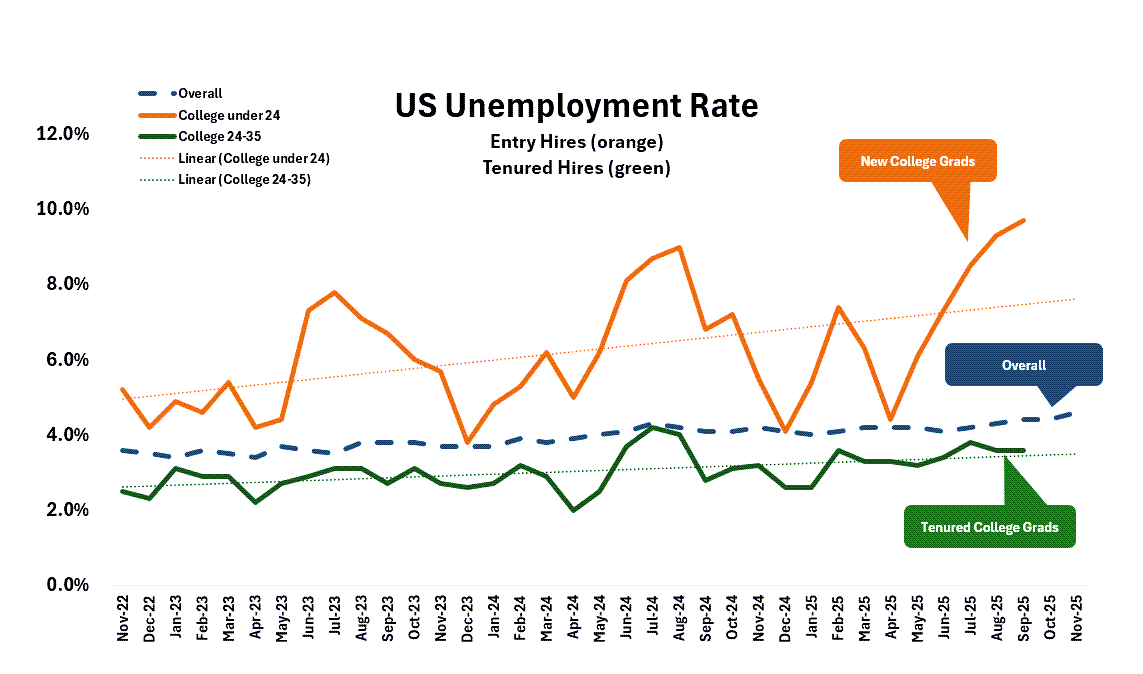
Well going into 2026 the situation is changing. The US unemployment rate is now 4.6%, up from 4.2% one year ago (a 9.5% increase) and 3.7% in November of 2023 (a 24.7% increase in two years). These are significant increases, especially considering that unemployment was 3.6% in November of 2022.
This tells me that the US economy is slowing after the post-pandemic “revenge buying” frenzy of 2021 and 2022. And of course US tariffs, inflation, and relatively high interest rates all contribute.
But now let’s look under the covers and break out unemployment into two sub-groups: new college graduates (24 years and younger), and more seasoned workers (age 25-35). Suddenly you see a divergence.
The green line, tenured college graduates, shows a steady unemployment rate below the average. This makes sense: these are experienced employees with skills, judgement, and seasoned decision-making maturity.
The orange line, new college graduates, is trending upward. In fact right now it’s almost 10%, which is the highest it has been since July 2021, the peak recovery from the pandemic. Looking backwards, the only time young college grad unemployment was this high was in 2011, a period of recovery from the 2008 recession. (St. Louis Fed agrees.)
And by the way, to round this out, jobs that do not require a degree are plentiful, roughly 82% of the workforce (up from 79% five years ago). So AI is not only slowing new college grad hiring, it’s also reducing the total number of jobs that require college.
There are three important things happening here:
First, whether it’s correct or not, employers are slowing down entry level hiring. Companies hire new college grads for many reasons (largely for talent pipeline), and many newly minted grads are far more AI-ready than we are. Despite this, it appears to economists that it’s harder than ever for these young folks to compete, so they need to “sell” their AI readiness and learning capacity.
Second, the frontline workforce is becoming much more important. The general automation of white collar work (it’s still early days) and the explosion of jobs in healthcare, social services, retail, repair, entertainment and distribution are making the “college grad” part of the workforce relatively smaller. That’s not to say the money isn’t good, but as a CEO or leader more and more of your energy has to go into supporting these frontline workers. (Read our Frontline-First research for more.)
Third, employees don’t trust CEO talk about jobs. A new study by Edelman shows a massive lack of people’s trust in business leaders (and AI scientists) around AI. This 5,000+ worker survey found that 70% of US workers do not trust statements about AI job reductions. When asked “who you do trust” only 27% of US workers trust the CEO. So we, as leaders, have a trust problem.
Here’s the trust data, and this is all about “Trust in AI’s Value” not “trust in the AI platform.”
AI Is a Socio-Technological Innovation
As I talked about in this week’s podcast, AI is “socio-technological.” It has many societal and sociological impacts.
If only half your employees believe what leaders are telling them, they’re going to hold back, grumble, and resist change. This is why economic insecurity is high: people are concerned about their jobs, careers, and future earnings.
(So AI anxiety could actually lower economic productivity!)
The solution to this is not to ignore the topic, but rather to discuss it openly.
None of us really know how much impact AI will have (I do know most platforms over-sell its value right now), and AI is a little scary.
We have to get comfortable with phones that talk back to us, creepy emails that know our name, avatar-based job interviews, AI-driven career advice, and AI-informed performance reviews. And in 2026 we’re going to see digital twins, robots, and more real-life animations of people at work. (Galileo Learn uses a “Josh Agent” to coach and challenge you as you learn.)
Here’s my advice. If you’re holding back on entry-level hiring you may be making a mistake. Younger staff, who have lived with this technology for more of their lives, are likely to be the ones to most quickly use AI, build with AI, and innovate with its new applications.
People who are tenured tend to see new tools as a way to “speed up what they know how to do.” New employees might just say “why not do it this way?” and bring you the reinvention you need.
Everyone Has The Opportunity To Be A Superworker Now
AI is not a job killer, it’s a big job-leveler.
You, as a younger worker, have access to information and research which was often hoarded by experts. If you’re willing to roll up your sleeves, you can move from “apprentice” to “newly minted expert” quickly. And if you’re looking for a job there’s no excuse for not becoming an expert on the company before you talk with a recruiter.
For senior, more tenured people the same applies. You can’t rely on your experience alone any more: you, too, should be digging in and learning about new technologies, tools, and advancements in your domain.
Employers: Be Careful How You Think
For hiring managers and executives, beware of the “tenure trap” above. Just because a senior person knows your business better, you may find that the young “AI-Guru” right out of college catches up fast. Remember, tenured people may see AI as a way to “do things the old way faster” rather than “rethink the way we work.”
For HR leaders and recruiters, remember one thing. Younger workers may learn faster and ultimately improve productivity at a faster rate (plus they cost less). If you seek out fast-learning AI pioneers they could be your Superworkers of the future.
And for CEOs and other execs, be honest and thoughtful about your plans. All our research points to AI as a “scaling technology,” not one to “eliminate jobs.” The more honest and supportive you are, the faster your employees will adapt and help your company stay ahead.
Superworker
2025年12月22日
Superworker
超级员工的崛起 -The Rise of the Superworker: Delivering On The Promise Of AI《超级员工的崛起》研究报告揭示了AI如何深刻改变工作场所与工作方式。随着AI技术融入工作流程,传统工作模型被重新定义,AI正助力“超级员工”以创新的方式提升生产力和创造力。
报告指出,企业若想在AI时代中保持竞争力,必须重新设计工作与组织模式。首先,需要通过AI实现任务自动化并提高工作效率;其次,推动工作流程的整合,利用智能代理提升整体生产力;最后,培养员工适应变化的能力,推动动态化的工作环境。
AI并不是简单地取代工作,而是通过赋能实现员工能力的跃升。例如,一些企业利用AI快速生成培训计划,将原本需要数月的工作缩短为数天。报告也强调,随着AI成为“同事”,全新岗位将随之出现,如知识库维护员、AI数据隐私与伦理管理者等。
为了迎接这一变革,报告提出了五大关键战略:重新设计工作与组织模式,构建动态人才模型,调整薪酬与绩效体系,加强以人为本的领导力,以及加速系统性HR®的转型。只有将技术与人的因素完美结合,企业才能成功实现AI转型。
报告强调,AI的核心并非技术,而是通过创新推动人与组织的共同成长。1月28日的发布会将深入剖析这些趋势与战略。
We’re excited to launch our groundbreaking research “The Rise of the Superworker,” a deep dive into the impact of AI on the future of work. As our hallmark research for the year, it defines the roadmap for leadership, technology, and HR. (Register for the launch webinar on January 28.)
The Workforce and Workplace Environment
We are entering a year of political change, economic disruption, and changing labor markets. As I discussed recently (The Tumultuous Year Ahead), the world is experiencing talent shortages in front-line and blue collar work (US unemployment remains at 4.1%) while white-collar employment is softening. CEOs are investing in AI in a quest for productivity and workers are asking to be retrained. And many core values (diversity and inclusion, pay equity, remote work) remain challenging.
Companies believe that AI will transform their business, so investment in technology is exploding. Yet as history tells us, this “trillian dollar AI-based re-engineering” effort is about people, not technology. As the research points out, the AI revolution, as exciting as it feels, is all about redesigning the way we get things done. And that lands in the laps of HR: how we redesign, reskill, and redeploy people in a world of highly intelligent systems.
Understanding The Superworker and The Superworker Company
Let’s start with the basics. Companies are filled with business processes, tools, and job models designed around traditional people-centric work. Every job function, from sales to marketing to manufacturing, has been designed around the old-fashioned job families of the past.
In other words, we’ve run our companies as “people machines.” We design a set of jobs and job families, then hire, train, and promote people to grow. This model creates a sprawling company filled with skills challenges, people wanting promotion, and fragility as the business goes through change.
The digital revolution, which defines the last 27 years of transformation, did speed things up. It automated many processes and opened up the ideas of self-service, e-commerce, and direct consumer transactions. But it didn’t fundamentally change how companies are organized: rather it accelerated the processes we had.
Suddenly, with AI everything is different. As the most intelligent and data hungry technology ever, AI stands to integrate and redefine every business process and “superpower” every employee. And this shift, toward copilots, agents, digital twins, and intelligent platforms, forces us to rethink how we’re organized, what we do, and what we define as a “job.”
We are building a company of Superworkers.
What exactly is a “Superworker?”
A Superworker is an individual who uses AI to dramatically enhance their productivity, performance, and creativity. As routine work gets automated, AI has the potential to empower everyone, eliminating some roles while empowering many others.
A “Superworker company” is an organization that embraces this transformation, building a culture of adaptability where people reinvent themselves. Our new Dynamic Organization research shows that such change-ready companies outperform their peers by six-times.
Just as Superman Clark Kent learned to channel his powers, we must learn to harness AI for individual and team performance. This means not just automating existing tasks, but rethinking how work gets done, empowering people to do more, and creating opportunities for growth.
The Historical Perspective: From Automation to Autonomy
We’ve seen waves of automation before, but this time it’s different.
In the past we used machines to automate the work of craftsmen and tradespeople. A welder, farmer, or shoemaker had his or her expertise built into a machine so their craft could scale at low cost. The expert didn’t go away, rather he or she helped design the machine.
AI does the same for white collar work. Writers, analysts, marketers, and sales people are now superpowered, leveraging their skills to drive scale. AI will not replace these special individuals: it empowers them to scale and expand their impact.
But in the case of AI we go further: it doesn’t just automate tasks; it becomes a co-worker itself: listening, learning, reasoning, and acting. So new and better jobs are created, designing, training, and managing the AI.
And the shift to Superworker happens everywhere: from the retail clerk to the nursing supervisor to the senior executive.
The New Corporate Imperative: Redesign Work and Jobs
This transformation won’t happen without effort.
Today, as AI systems still mature, our challenge is not implementing AI, but redesigning jobs, and business processes around AI. And that’s why success with AI is a people problem, not a technology one. And if you don’t get this right, your AI transformation will lag.
Academic studies show that 45% of change management programs fail, and 72% of the reason is “people resistance.” So consider this:
For each dollar spent on machine learning technology, companies may need to spend nine dollars on intangible human capital,” Erik Brynjolfsson wrote in 2022, citing research by him and others.
Consider the four stage model below, where we look at “current jobs” vs “re-engineered jobs” on the horizontal, and level of output on the vertical.
AI transformation begins with assistance, then moves to augmentation, then to work replacement and then to autonomy. The level of performance improvement goes up exponentially.
This process of rethinking business processes takes time. When electricity was invented companies replaced horse-driven machines with motors. Decades later engineers realized we could redesign the entire manufacturing process by integrating the entire supply chain.
The same will happen again. We may start by automating emails and data access, but over time we build “digital twins” and configurable agents to manage entire projects and business processes.
One of our clients built an entire platform that can interview stakeholders, import documentation, build training programs, and publish training and certification programs by AI. Humans are still needed, but now they’re the “super-curators” and “craftsmen” perfecting the product. New programs that took 3-6 months can be generated in a few days.
This kind of redesign is now being used for claims analysis, sales enablement, RFP generation, and workplace design. (Our report 100 Use Cases For Galileo explains dozens of such solutions available now for HR.)
The Work Redesign Challenge
How do we get there? Business and HR teams work together, following these stages.
Improve efficiency at current job: Use AI to make existing work more efficient: same job as before, new tools to make it easier. Examples include an office worker using MS Copilot.
Automate tasks to increase scale: An engineer uses AI to write code. A marketer builds videos and campaigns automatically. An HR manager rapidly builds job descriptions or analyzes performance.
Integrate processes to improve productivity: Agents now handle multiple connected steps. A retail clerk automatically checks out customers; a nurse uses a machine to monitor dozens of patients and make diagnostics; an HR manager builds learning programs in minutes.
Leverage autonomy for more: The AI manages multi-step processes (customer service, candidate communications, recruiting, campaign design) and the people “manage” the digital employee.
This creates four types of Superworker:
An Example: The HR Business Partner
Consider the role of HR Business Partner (HRBP), a complex job that’s constantly changing.
An HR business partner (HRBP) equipped with AI like Galileo™ can automatically analyze turnover, productivity, individual performance, and leadership potential. The AI HR Agent can help compare job candidates against multiple requirements. Analysis, coaching, and hiring speed goes up, and the HRBP is now a Superworker.
Then the transformation continues. What if we give the AI to managers. Do we need the HRBP at all? (IBM has made this step.)
Yes, now the HRBP manages the AI. Just as Wayze may drive you automatically, someone behind the scenes is monitoring your trip to help you when things go wrong. This “Superworker” job is the upgraded role of the HRBP.
AI As A Job Creation Technology
Many new jobs will be created. Who maintains the knowledge base that feeds the AI? Who ensures data privacy and security? Who handles the ethical issues that arise? Who monitors the AI to make sure it’s trained well? And once these multi-step digital employees exist, who will manage them?
These are new Superworker jobs.
Five Imperatives for 2025
How do we make this transition a success?
Here are five key imperatives detailed in our study:
Redesign Work, Jobs, and Organizational Models: Focus on the customer, how success is measured, then apply AI. This is what we call “productivity-based job design”. Deconstruct work into activities, evaluate AI solutions, and determine the human role alongside AI, using the models above.
Create a Dynamic Talent Model: The traditional “prehire to retire” model is becoming obsolete. We need a more dynamic approach where people move across roles and projects. Prioritize internal mobility and foster a culture of growth. Focus on “doing more with what we have” by upgrading the productivity of our existing workforce. Focus on building “talent density“.
Rethink Pay, Rewards, and Performance: Move from traditional pay models to “systemic rewards,” based on role, skills, and output. New roles may warrant higher pay, not lower. (Lightcast sees a $45,000 premium for workers with AI skills.)
Refine Leadership and Culture: Focus on human-centered leadership: this is a time of change. Ensure leaders understand AI, foster innovation, and focus on productivity, not headcount. Start co-design projects in every functional areas. Get line employees involved in transformation efforts.
Accelerate the Shift to Systemic HR®: HR must operate in a consulting role. Integrate HR silos, develop a change-enablement team. Experiment with AI tools in HR and train the HR team about AI.
Let me give you an example.
One of our large clients, a healthcare company, created a “transformation enablement” team in HR that does co-design workshops throughout the business, helping with process redesign, role design, job changes and pay and rewards changes. They built a set of tools and methodologies which are well established. HR professionals rotate into this team for education. Every HR function should set up “AI transformation teams” like this.
AI isn’t here to replace us; it’s here to empower us.
How To Get The Research and Learn
The Rise of the Superworker predictions report is available to all users of Galileo™, The Josh Bersin Academy, or Corporate Members. (A Galileo Pro membership is only $39 per month, and JBA membership is $49 per month.)
If you want to learn more and follow our ongoing case studies, briefs, and AI tools, download the Rise of the Superworker Overview today. You will be registered for regular updates. And please register for our launch webinar on January 28 where I will detail this entire story.
The Superworker era has arrived, join us in the journey!

 Superworker
 Superworker


 扫一扫
添加客服
扫一扫
添加客服


