ADP Lyric HCM, The Next-Gen HR Platform Many Have Waited ForJosh Bersin 写文章介绍了ADP的 Lyric HCM,给予了高度评价。ADP于2018年启动了一项秘密项目,目标是开发下一代企业人力资源管理平台。这个项目最终被命名为ADP Lyric HCM,它的设计旨在应对当代灵活多变的工作环境。Lyric HCM基于高度可扩展的微服务架构,能够处理包括全职、兼职、临时工、自由职业者等多种员工类型,同时支持多重管理结构。该平台具有灵活性,可帮助企业快速适应组织重组、兼并收购等变化,且能够实现全球薪资和税务管理,提供符合各地法律法规的自定义规则。
Lyric HCM的设计不仅注重系统的灵活性,还融入了大量的AI功能,使其在用户体验上更加智能化和易用。通过ADP Assist这一AI工具,用户可以通过自然语言与系统互动,轻松进行复杂的HR操作。此外,Lyric HCM还提供实时的行业基准数据,帮助企业根据最新的薪酬和岗位信息做出决策。该系统的“人本位”架构使其更具灵活性,相比传统以职位为基础的系统,它可以更好地满足当代企业多重任务、多角色管理的需求。
Lyric HCM不仅支持多种HR功能,如招聘、绩效管理、培训和发展,还拥有一个统一的员工体验平台,员工可以通过简单的查询完成例如婚假申请等事务。此外,ADP还建立了强大的全球服务团队,确保客户获得定制化的实施和长期支持。
自上线以来,ADP Lyric HCM已经吸引了超过120个大型客户,证明了其系统的稳定性和可扩展性。其核心市场定位是为全球化、分布式的企业提供服务,尤其是在零售、医疗保健、餐饮等行业。作为一款融合AI技术的全新平台,Lyric HCM展示了未来人力资源管理系统的潜力,并成为Workday、Oracle、SAP等主要HCM供应商的有力竞争对手。
In the Spring of 2018 I attended a confidential meeting in New York City to learn about a project called Lifion. ADP had hired a new team of engineers convened in a secret mission to build the “next-generation platform” for ADP’s offerings in the enterprise market.
This new system, designed ten years after the release of Workday, was intended to be a highly scalable, configurable, micro-services based system, capable of managing payroll, HR processes, and all talent applications for any category of employee. The system had to support dynamic teams, many worker modalities (full-time, part-time, hourly, gig, contract), and enable a company to manage many organization structures within its corporate function, each with different business rules and overlapping employees.
It was designed, in a sense, for the highly flexible, dynamic companies of the post-pandemic era.
In addition to this flexible architecture, the system was designed to support workers with multiple managers (and multiple time sheets), dynamic reconfiguration for M&A or new business entities, and global payroll and tax services with custom business rules that might be variable across the company. It needed to include a recruiting module, a variety of options for goals and performance management, tools for onboarding and development, excellent reporting, and an easy-to-use narrative interface that let any employee, manager, or HR professional use, configure, or run reports on the system.
In my initial meeting I walked away impressed, and I wrote an article describing this project. Today, almost six years later, this product has a name (ADP Lyric HCM) and it has reached general availability for ADP customers with 1,000 customers or more.
Today ADP has 120+ large accounts so the system is proven. And since its inception Lyric HCM has been infused with extensive AI features (ADP Assist is on par with SAP Joule as a true AI interface) and benchmark information from ADP’s data cloud.
In other words, this system has the potential to be a “The Next Generation” HCM platform in the market.
What Is ADP Announcing And Offering
The core HR system has to do a lot of things. Not only does it have to manage payroll, benefits, and tax rules (in a global, constantly changing regulatory environment), it has to be flexible, easy to configure, and filled with easy-to-use interfaces for employees and HR. And by “flexible” I mean the system has to make it easy to open a new org structure, move employees around, and create multiple modes for a “manager” or supervisor.
Almost all traditional HCM providers, Workday, Oracle, and SAP, were not designed to work this way. These vendors built contract work add-ons but in most cases when you want to flatten your organization, merge with another company, or reorganize roles it’s difficult. Flattening the organization often means “re-implementing” your HRMS. Most companies only do it once a decade.
ADP Lyric HCM is designed to fix this. Imagine a company like Gold’s Gym where the company is constantly opening new Gyms and hiring new managers, with employees dual reporting to multiple managers.
I talked with Gold’s Gym and as you can imagine the company went through a transformation during the pandemic. Started as a Southern California fitness company, Gold’s was acquired and is now a global organization branching into many new offerings. Facilities were consolidated and each local fitness center operates with a lot of management independence.
For example, an employee who is a trainer in one gym with one manager may also be a trainer or support staff in another gym with another manager. This type of “work-centric” (as opposed to “job-centric”) operation is becoming very common. Lyric HCM supports these multi-manager work models, including features for performance management, time tracking, and contract workers.
Think about any retailer, healthcare company, or other highly distributed operation. One Gold’s Gym may pay overtime in one way, another in a different way. You can imagine the permutations. Every company has situations like this.
I was recently at Rolls-Royce where they are centralizing engineering teams away from product groups, making 30 to 40% of their engineers “floaters.” Rolls has enormous contracts with government and commercial customers, each with different financial models. They need a system like this just like a gym, restaurant chain, or elder care network.
There’s more. In addition to these HRMS and global payroll features, ADP has built an employee experience platform, employee communications system, and learning and development system. You simply type a query like “I’m getting married” and the system shows a page that consolidates tasks and resources in one place. If an HR manager wants to “pay a bonus” the system asks what organization, shows a list of people, and lets the manager define the bonus without hunting for menus and panels.
Highlights Of The Next Gen Approach
Since this system was architected in the age of AI, it has some very unique capabilities out of the box.
First, in the area of flexibility, this is a “person-based” architecture, as opposed to a “role-based” architecture. That feature alone enables all these features to be possible.
Second, in the area of usability, the system is among the most “AI-enabled” interfaces I’ve seen. While most HCMs are building assistants to speed through transactions, Lyric HCM literally “learns” what you’re trying to do and prompts you through the process. Remember these HCM systems are complex (Workday’s “Users Guide” is 2500 pages long), so we want the system to feel approachable not intimidating.
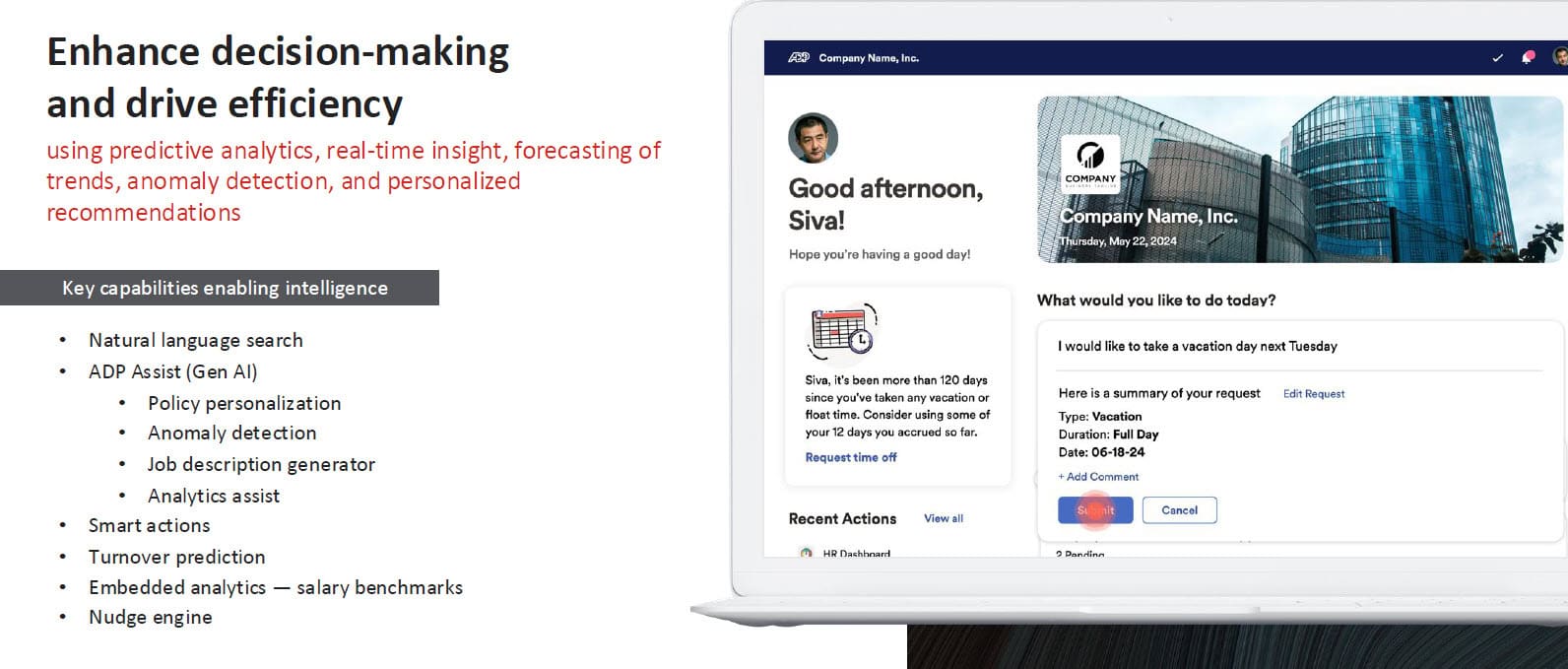
As you can see from this slide, ADP also offers embedded benchmarks as well as a nudge engine. The benchmarks come from ADP’s data cloud, giving companies up to date salary ranges and other metrics by job title and job level (no other HCM platforms do this). The nudge engine is used for Lyric HCM’s onboarding and development system, reminding users of tasks or activities they need to perform.
ADP Assist, the company’s Gen AI tool, lets you ask questions about any employee or group, legal and tax issues, and payroll or financial data. It’s quite powerful and I would say it rivals Joule as a conversational interface for HCM.
Third, the system has a novel and approachable interface for employees. Rather than offer people a variety of “centers” or “portals” to find things, the system is smart enough to give employees exactly what it thinks they need. Typical HR transactions like changing your family status or address, or looking at benefits or pay are simple. Persona-based dashboards are designed for payroll or tax managers. And any HR professional can customize the interface for their use.
Because the system is so dynamic, users can set up smart reports and other views to pinpoint the data and organizational unit they’re interested in. And ADP has built a management development tool (to take newly promoted supervisors through development), an onboarding system, and many features for performance and goal management.
Where Will This Go? ADP Services
When we think about ADP’s platforms we have to remember that ADP is not just a cloud software company. Most of the company’s revenue comes from services: payroll, PEO, and license fees around those offerings. This means ADP’s sales and service organization is very service-centric and highly trained in all areas of HR. (Most HR software sales teams are not HR domain experts.)
To support Lyric HCM the company put together a global service team combined with dedicated client success executives to make sure each customer has a personalized, outcome-based implementation plan. This means ADP Lyric HCM is not just a great platform, but a set of people to help with configuration, utilization, integration, and long-term planning. ADP is starting to work with integrators, but likely will handle most of their customer implementations themselves.
Impact On The Market.
At this point Lyric HCM is positioned as an offering for mid to large companies headquartered in the United States with global workforces. This means Lyric HCM is directly positioned to compete with UKG, Ceridian, Workday, Oracle, SAP, and vendors like Darwinbox, HiBob (which is going upmarket), Lattice, and others. The “Pay” companies (Paychex, Paycor, Paycom) are focused primarily on smaller companies, but as they grow their offering they may compete as well.
That is not to say ADP can solve every client need. These platforms mature over many years and each vendor has different industry and focus features. At this point I believe ADP will most likely win in industries like retail, hospitality, health care, and other distributed, hourly workforce companies. And given ADP’s focus on small and medium business, it will take time for ADP to reach large companies.
Nevertheless, it’s time for change in HCM. Designed for agility and infused with AI, ADP Lyric HCM shows us a future we’ve been looking for.

 agility
 agility
 agility




 扫一扫
添加客服
扫一扫
添加客服


