美国48% 员工认为需要 100 万美元才能安心退休:HR 正在面对怎样的长期风险?美国的员工对退休成本的认知正在迅速上升,48% 认为至少需要 100 万美元才能安心退休,但仅有 27% 预计自己能够实现这一目标,超过一半的员工因此考虑推迟退休。代际差异进一步加剧:Gen Z 在高度焦虑的同时最乐观,也最积极尝试 AI 财务工具;Gen X 则成为最不安的一代,夹在家庭责任与退休时间压力之间。详细请查看
在通胀高企、生活成本持续攀升、职场不确定性加剧的背景下,企业 HR 正站在一个关键的十字路口:员工的财务压力正在真实侵蚀生产力,但他们对未来的信心却并未消失。Betterment at Work 的《2025 Retirement Readiness Report》,给 HR 提供了一份极具现实意义的答案。这不是一份单纯讨论退休的报告,而是一张美国职场“财务心理结构”的全景图。
一、一个反直觉的现实:员工更焦虑了,却并没有放弃未来
报告最重要、也最容易被误读的发现是:90% 的员工表示存在中度到重度财务焦虑,但仍有 71% 的员工认为自己在“退休准备度”上是有信心的。
从 HR 视角看,这不是乐观主义,而是一种新的心理分层模式正在形成。
员工正在学会把财务生活拆成两层:
当下层:信用卡债务、房租、食品、医疗、突发支出
未来层:退休、长期储蓄、401(k)、资产增长
他们接受“现在很难”,但仍选择相信“未来可控”。这是一种高度理性的适应机制,也解释了为什么在财务压力上升的同时,401(k) 参与率却达到了 91% 的历史新高。
二、真正的危机不在焦虑,而在预期与现实的巨大断层
2025 年最值得 HR 警惕的数据之一是:48% 的员工认为退休至少需要 100 万美元以上,而只有 27% 预计自己最终能存到这一水平。
这意味着什么?
意味着员工对“退休成本”的认知正在快速升级,但对“实现路径”的把握并没有同步增强。直接后果是:
54% 的员工已认真考虑推迟退休
女性与婴儿潮一代受影响最为明显
财务不安全感开始向组织层面外溢,影响留任与绩效
对 HR 而言,这不是个人理财问题,而是长期劳动力结构风险。
三、代际差异不再是“偏好不同”,而是“财务世界不同”
报告非常清晰地呈现了一个趋势:不同代际员工已经生活在完全不同的财务生态中。
Gen Z
退休信心最高(88%)
日常财务焦虑也最高
更早使用 AI 做财务规划
却最不了解雇主福利内容
Gen X
退休信心最低(61%)
同时承担房贷、子女教育、赡养老人
是“最需要支持,却最容易被忽略”的一代
Baby Boomers
对市场波动高度敏感
更担心临近退休时的系统性风险
这对 HR 的启示非常直接:统一福利方案正在系统性失效。
四、福利的角色正在被重新定义:不再是“成本”,而是“稳定器”
76% 的员工表示:财务类福利比一年前更重要。57% 的员工明确表示:更好的福利(而非更高工资)会促使他们跳槽。
在员工眼中,真正有价值的福利高度集中在三类:
有竞争力的 401(k) 匹配
雇主支持的紧急储蓄机制
学生贷款与债务支持(尤其对年轻员工)
福利已经从“加分项”转变为留人、稳人、提效的基础设施。
五、AI 正在进入员工财务生活,但 HR 不能“全权外包”
目前仅 22% 的员工使用 AI 进行退休或财务规划,但在 Gen Z 中已达到 34%。使用 AI 的员工更可能:
增加 401(k) 缴费
更了解自身福利
报告财务状况改善
但员工的保留同样明确:
对数据隐私的担忧
对缺乏人类判断的担忧
对复杂财务决策“去人化”的不安
这意味着:AI 是放大器,而不是替代品。
HR 的价值恰恰在于:把 AI 工具嵌入一个“有人类解释、有信任、有边界”的体系中。
六、对企业 HR 的终极拷问:你提供的是福利,还是财务安全感?
报告最后给 HR 抛出的不是一个技术问题,而是一个战略问题:
员工并不是缺乏意愿,也不是不努力,而是越来越依赖企业是否能提供可持续的财务支持架构。
这要求 HR 做出三项根本转变:
从福利管理者 → 财务安全设计者
从统一方案 → 分代际、分阶段支持
从“成本视角” → “生产力与留任视角”
结语
2025 年的员工并不天真。他们清楚当下的压力,也清楚未来的风险。他们愿意继续相信,但前提是——企业要给他们一个“值得相信的结构”。
而这,正是 HR 在未来几年中最不可替代的价值所在。
baby boomers
2025年12月15日
baby boomers
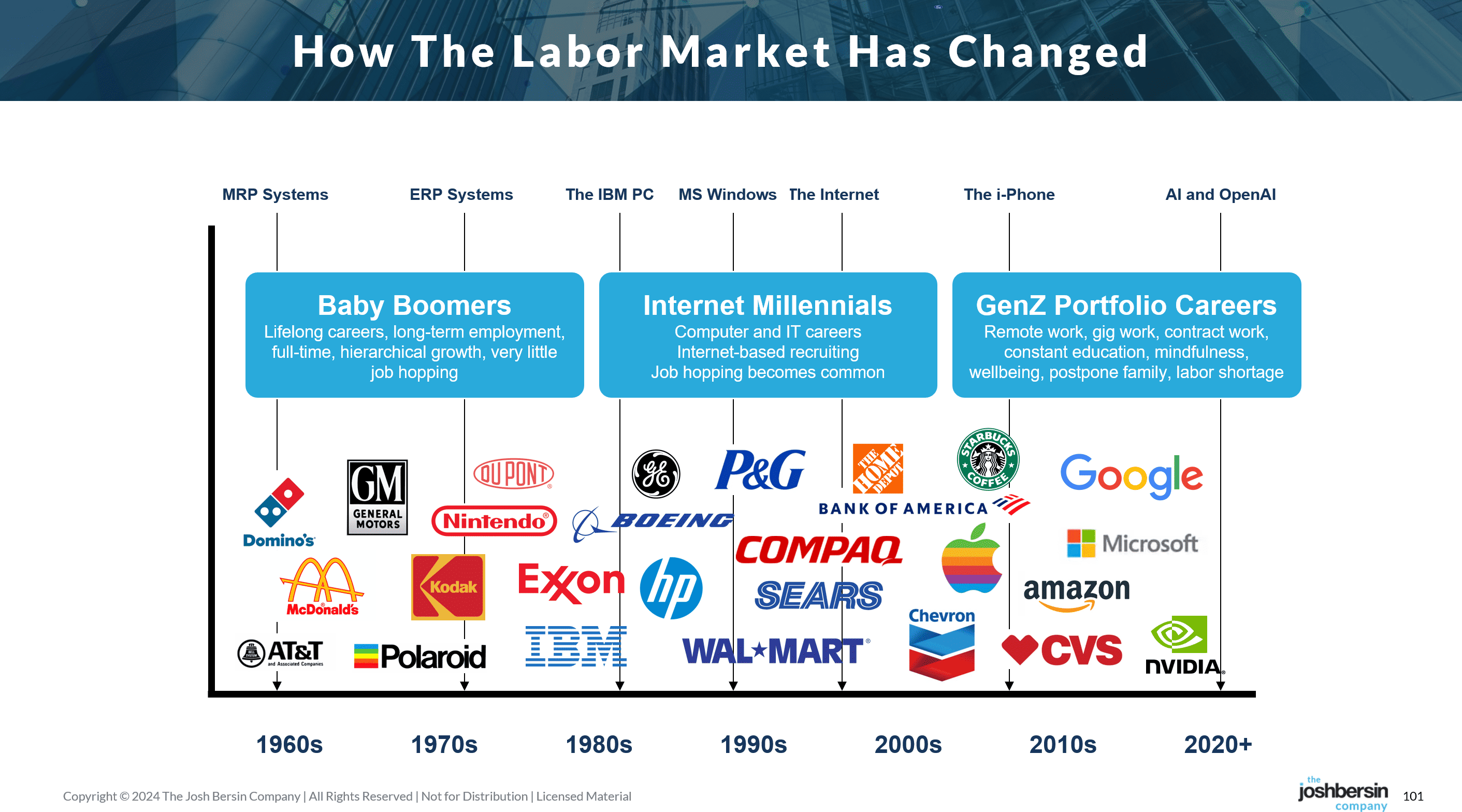
Josh Bersin :劳动力市场已完全改变:您真的准备好了吗?Josh Bersin 最新撰文谈到,随着以婴儿潮一代为主的劳动力队伍的衰落和具有独特期望和职业模式的新一代的崛起,劳动力市场发生了巨大的变化。这一新劳动力的特点是偏好组合职业和副业,他们要求尊重、灵活性和精心设计工作的机会。企业在适应这些变化时面临着挑战,职位普遍空缺,人员流动增加。文章强调,企业需要采用一种动态的组织模式,优先考虑授权、内部流动性和员工积极性,以便在这个新的劳动力市场中茁壮成长。这种适应的关键在于了解劳动力现在寻求的是成长、灵活性以及他们的价值观与工作之间有意义的结合。
英文原文如下,推荐了解
The labor market has changed before our eyes. Employers and HR teams better watch out.
Over the last five decades baby boomers defined the workforce. Today things could not be more different, and this change impacts all of us.
I was born in the 1950s, growing up in a world where the middle class experienced steadily increasing standards of living. My father was a scientist, my mother sold art, and my brother and I had a nice middle-class life.
This included a three stage career: education | work | retirement. I went to college, studied hard, and got a good job as an engineer. My career went on a predictable path. I worked for Exxon and then IBM – each company giving me training, development, and potential for long-term career. I met many great people, learned about work, got married and had a family.
My cohort, the baby boomers, was huge. Companies built entire talent systems for us – onboarding, training, predictable career growth, developmental assignments, leadership development, and retirement programs. We strapped ourselves in and enjoyed the journey.
Fast forward to now: things are very different.
Today’s working population bulge (median age 33, born in the early 1990s,) entered the workforce in a disrupted world. They joined companies during a boom, experienced the pandemic in their 20’s, and live in a world where everything is on the internet. While my generation revered our employers, these workers see every corporate mistake in real-time. They expect their bosses to earn their respect, otherwise they’ll “quietly quit” or start moonlighting on the side.
While my generation expected to work for only a few employers during a career, today people build what Lynda Gratton calls “a portfolio career.” More than 2/3 of workers have side-hustles and their resume is filled with projects, businesses, activities, and professional interests. If you look at the LinkedIn profiles of most high performers they look like personal journeys, far different from the linear career paths we had in the past.
While most of these changes came slowly, the end result is profound: the expectations, needs, and demands of workers are different. And businesses have struggled to keep up. Companies have vast amounts of unfilled positions, we suffer high turnover in almost every role, and labor unions are growing in number.
What do companies do? We have to accept and understand that the labor market has totally changed.
We live in a world where employees will live into their 100s. Young workers are postponing getting married and having children and they see their career as a long series of experiences. The norms of a long-term linear career have ended: people try new things, change industries, and live in what I call a “pixelated” job market.
And rather than blindly trust employers, people bring high expectations to work. Young workers don’t expect to “become the job,” they want the job to “become them.” (Often called “job crafting.”) And given the shortage of workers in every role, this trend is just getting bigger.
While economists believe the job market will soften and employers will have more power over time, I think those days are over. Life just isn’t going back to the way it was. Despite the growth of AI, companies are more dependent on their workforce than ever. And with 70% of the jobs now service-related (healthcare, retail, hospitality), employees really are our product.
I look at it this way. Companies and employers live in a pool of labor: it’s the needs and expectations of people who decide what we can and should do. People are upset about inflation. They’re worried about climate change. They want CEOs to behave ethically. And they want flexible work that lets them live a joyful life.
And every year the workforce becomes more educated and connected. (The percentage of US workers with degrees has gone up to 54%, up from 38% fifteen years ago.) People know about the company’s financial results or other issues far before an announcement even comes out.
While many of these trends are obvious, many companies aren’t ready. Last year I talked to the CHRO of Boeing and he told me the problems were highlighted by employees years ago. They simply were not listening, and now they’re a company in crisis. And that leads to the topic of “employee activation.”
In the old days senior leaders made decisions, workers carried out the orders. Ideas and strategies were “top-down.”
Today much of the intelligence we need to grow our companies is sitting with front-line workers. We need to “activate employees” and listen to them directly. The worker in the store, plant, or front office who feels frustrated by some system or process is the person who should advise us what to do. The old idea of “management by walking around” must come back. (Our Org Design Superclass explains this in detail.)
I don’t mean chaos, holacracy, or lack of controls. Successful companies have a clear mission, a series of strategic initiatives, and budgets to hold people accountable. But they empower everyone to be a leader, unleashing power from the bottom up. (Come to Irresistible and learn about how Marriott and Delta airlines exemplify this model.)
The key is building what we call a “Dynamic Organization” – one which is flat, team-centric, connected, and accountable. Our research shows that only 7% of companies operate this way: most are still very hierarchical and slow to adapt. But change is coming, as companies like Delta, Marriott, Telstra, Unilever, Novartis, Seagate, and Bayer have found out.
(This week the CEO of Bayer announced a radical transformation to a team-centric management model, dramatically reducing the number of “bosses.”)
A dynamic organization does two things well. First, it adapts to change, sees new markets, and mobilizes quickly for change. But even more importantly, it empowers people, encourages internal mobility, and focuses on meritocracy, skills, and collaboration to thrive. (Read about Talent Density to learn more.)
While these ideas are not new, urgency is critical. Employees demand growth, flexibility, and agency – and we can’t deliver it unless our reward and development systems change. Today more than 70% of US jobs are in the service sector: health care, retail, entertainment, and transportation. If we don’t empower people in these roles our products and services will suffer.
Let me conclude with this: we just woke up in a totally new labor market. If you don’t focus on empowerment, growth, and employee activation, talent will just go elsewhere.

 baby boomers
 baby boomers


 扫一扫
添加客服
扫一扫
添加客服


