The Workday Economy – A Bold New Strategy EmergesBy Kathi Enderes, SVP Research and Global Industry Analyst with comments by Josh Bersin
The Workday Innovation Summit 2025 was more than an analyst meeting: it was a signal that Workday is attempting a full-scale reinvention. Under CEO Carl Eschenbach and Board Chair Aneel Bhusri, Workday is shifting from a product-centric model to an open, partner-driven, AI-powered ecosystem they call “The Workday Economy.”
Let’s explain what the company is up to.
Strong Financial Performance
Now on its 20th birthday, Workday is in a position of strength:
– $7.7 billion in subscription revenue
– 16.9% year-over-year growth
– 11,000+ customers in 175+ countries
– 70 million users
– 93% customer satisfaction.
The company’s goal is to reach $10 billion over the next few years, which means continuing this level of growth.
Workday is banking on a few big bets: aggressive partnerships and industry solutions, building Agentic AI, investment in Workday Financials, and a mid-market offering. Let’s look at each of the components in detail.
The Platform Play: From System to Ecosystem
Workday’s legacy as a highly integrated, proprietary stack (or “walled garden”) worked for years, but now it slows innovation. Now, with intention to make Workday an open platform, the company is expanding its Built on Workday program and expanded Workday Marketplace, to build a “Workday Economy.” Partners and customers can use Workday Extend to build applications natively, with low-code tools and lots of support.
Comment by Josh: Workday Extend is a massive priority, but building Workday apps is difficult. With 87 partners now, how big can this app ecosystem become? And just as Apple tightly controls apps for the i-Phone, can Workday do the same with such complex industry partners? They’re definitely going in the right direction.
Partnerships as Engine of Innovation
Workday’s partner ecosystem is now front and center, supporting ISVs, advisory firms, system integrators, and co-innovation partners. A new Clear Skies Initiative is supposed to prevent channel conflict, ensuring partners can build without competing with Workday’s core offerings.
Strategic alliances with Randstad, TechWolf, and five new Workday Wellness partners (including MetLife) are examples. Can Workday use these partnerships to drive real, measurable results? Many partner programs are simply referral relationships: how will sales and service teams invest in the success of these partnerships? This is a new muscle for Workday to build.
Comment by Josh: This is big. I think Carl understands that Workday’s “market power,” built through its reputation over 20 years, lets the company pick winning partners and resell their offerings, invest in them, and stop trying to build or compete with everyone in this market. This is the type of behavior a $20-30 Billion company demonstrates, and I hope it continues. (ADP white labels many products and their business never stops growing.)
Agentic AI: The Next Frontier
Agentic AI is clearly core to the strategy. The Workday Assistant, powered by Illuminate, lets employees interact with HR and finance in natural language, across Microsoft Teams, Slack, and more.
Early agentic applications like the Payroll Agent, Employee Self-Service Agent, or Recruiting Agent are promising, but the real test will be customer adoption to create business value.
As companies deploy more specialized agents, Workday’s Agent System of Record aims to manage all agents, not just the ones created on Workday. With big players like Microsoft, Google, and ServiceNow aiming for the same level of control, this will be a tough battle to fight.
Comment by Josh: I’m not really convinced that Workday can be a system of record for agents, when the system is missing so much data. I would bet on Microsoft, Google, Okta, or others to dominate the agent governance market. On the other hand, agents that work with Workday (recruiting agents, L&D agents, pay agents, etc.) do have to integrate with Workday somehow, so to me this is a way to integrate, not “govern” agents.
Agent Extensibility and Customization
The new Workday Assistant Studio lets partners and customers build agents to fit unique workflows. This extensibility is good news for customers, but it comes with risk. How well will these interfaces work and how easy will it be for vendors to build integrated apps? Workday now has direct integration with Microsoft Copilot and Google, but most Agent-builders are going after customers directly, and they may or may not want to be held hostage within the Workday Assistant.
Comment from Josh: Right now SAP Joule is a year ahead of Workday in ERP/HCM Assistants. Most Workday clients I talk with are afraid to even let employees touch the system and they’re deploying Copilot, ChatGPT, Galileo, or other dedicated assistants. The Workday Assistant strategy needs a bold new move, and Studio alone may not be enough. I think Workday may be better off focusing on optimizing its utility within other more broad AI assistants. (What happened to Workday’s big alliance with Salesforce I wonder.)
HCM Innovation: Industry Focus and Acquisition Integration
Workday’s HCM suite remains the company’s core, with a focus on practical AI and the employee experience. Industry-specific solutions for higher education, healthcare, and financial services are expanding, offering another path to growth and becoming indispensable for clients.
Recent acquisitions like HiredScore, VNDLY, and Evisort can add mature AI-driven capabilities that can bring the HCM product (built 20 years ago) into the latest AI era, given the competition in this space. (Workday now resells Evisort.)
Comment from Josh: Workday HCM product teams understand what customers need. The challenge they face is “getting there from here,” so I would bet we see many more acquisitions. If you read our latest research on the Revolution in Corporate Learning, for example, you see that Workday has missed this market. Ditto many recruitment features (high-volume, online job previews, AI-assessment.) So I would expect Workday to do more deals like HiredScore, where they get an AI product base and some amazing HCM product talent.
Strong Focus on the Financial Suite
Workday’s financial management suite is now central to its growth story, with over 35% of new customers choosing it. The company is pushing industry-specific financial applications, automation, and real-time insights. But the finance function can often be conservative and risk-averse, and the promise of truly integrated HCM and Finance solutions is still a dream for most customers.
International Expansion
Workday’s global ambitions are bold. New offices, expanded partnerships, and talent programs in EMEA are all part of the plan. Today only 25% of revenue comes from international markets so the company will need to invest heavily here. SAP and Oracle are quite dominant in some countries, so the company has to pick its markets carefully.
And remember local players. As Workday courts the Global 2000 (including First-Citizens Bank & Trust, UnityPoint Health, and Toyota), the company definitely needs to build out support, partnerships, and presence in these geographies.
Comment from Josh: There are many geographies (Asia, UK, Eastern Europe) where Workday is not well entrenched. While SAP and Oracle dominate some of these markets, if Workday builds a strong partnership model (ie. exclusive SI partnerships in these geos, etc.) they can double their growth rate in these sectors. Look at how well Workday has done in Australia (a fairly small market).
Is the Mid-Market Ready for Workday?
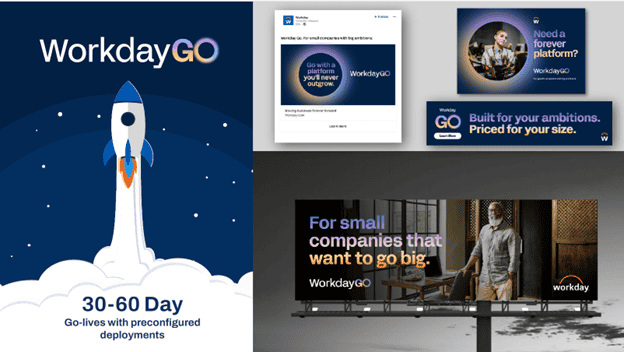
Expanding to the mid-market is another tenant of Workday’s growth plan. With WorkdayGo, the company is adapting its enterprise playbook to leverage partners. With players like UKG, Rippling, ADP, Dayforce, and HiBob providing tailored, right-sized solutions designed for this segment, Workday will find lots of resistance in this market. (SAP tried this years ago.)
Comment from Josh: This is a push for me, I’m skeptical. I love Workday as a product but it’s very complex and needs major administrative support. I doubt Workday can effectively compete with HiBob, UKG, and the others Kathi mentions without building or buying a new product. Years ago Taleo (pioneer in ATS) acquired a separate company to launch Taleo Business Edition and that product sold like hotcakes. I have a hard time seeing how pre-configured Workday SKUs make it that much easier to administer. But who knows, maybe an AI-powered “configurator” could fix that up.
Customer-Centric Innovation
The 2025 Spring Release delivered over 350 new features, shaped by customer feedback. AI-powered talent rediscovery, simplified workflows, and industry-specific enhancements are all on the list. Customers are reportedly happy and shaping the roadmap. This pace of innovation requires companies to keep up with Workday, often not an easy feat, especially in the AI areas, where adoption still lags the many capabilities Workday offers. A focus on supporting AI transformation will be key to drive real value.
Josh’s Perspectives
Workday is an ambitious, well run, culture-driven company. These announcements signal a major shift from “technology-based” to “market-based” growth. There’s no question in my mind that thousands of ISVs and integrators would love to build businesses around Workday. The only question is how quickly Workday can make this easy and profitable (for them).
As far as AI goes, the market is very competitive. SAP’s AI strategy quite far along (Joule is more extensible than the Workday Assistant), and many AI startups are reinventing the HCM market from scratch. So while the Workday Agent System of Record makes sense, many new “Agent-core” or “AI-native” HCM apps will chip away at Workday’s footprint.
That all said, this is an exceptionally well run, strong, “Irresistible Organization”. With a new CTO and strong focus on global growth, I see no reason Workday can’t achieve its $10 Billion target in the next 3-4 years.
global expansion
2025年06月12日
global expansion
滴滴出行选用NICE,以提供基于实时 AI 的个性化服务NICE has partnered with DiDi Global to enhance customer and employee experiences through its cloud-based Workforce Management (WFM) and Employee Engagement Manager (EEM) solutions. This collaboration aims to streamline DiDi's global contact center operations, improving operational efficiency and customer satisfaction with AI-driven forecasting and scheduling. The implementation of NICE's solutions facilitates real-time management and self-scheduling for agents, boosting employee engagement and operational efficiency. DiDi's choice of NICE highlights the importance of advanced, flexible technology in supporting the dynamic needs of modern, app-based transportation services.
领先的移动出行平台通过利用 NICE 的客户体验 AI 技术,使其员工能够提供轻松且高效的客户服务体验
新泽西州霍博肯-NICE (纳斯达克: NICE) 今日宣布,滴滴出行已经选用了 NICE 劳动力管理 (WFM) 和员工参与管理 (EEM) 作为其云端创新技术的一部分。滴滴现在可以全面预测、规划和管理其全球客户联系中心的运作;同时提升运营效率和员工的参与度,并确保客服代表能够在首次通话中解决问题。Betta作为全球最大的 WFM 客户群之一的支持者,在实施过程中与 NICE 价值实现服务携手合作,负责执行集成,并在多国提供咨询、培训和支持服务。
滴滴出行寻求一种能够满足其核心业务、功能及技术需求,并能够随公司成长而扩展的劳动力管理解决方案。NICE WFM 结合了 AI 技术与灵活性,能够满足跨多个大洲、具有特定区域特色的运营需求,这不仅成本效益高,而且精确度高,确保维持最佳的服务水平。通过精准预测,确保在合适的时间有合适技能的代理人,从而大幅提升客户满意度。
通过引入 NICE EEM,可以实时解决人员配置需求,使得客服代理能够自我调节工作时间表,从而增强员工参与度和工作满意度。此外,利用智能日内自动调整功能,能够主动地进行调整,预防问题的发生。
滴滴出行国际客户体验执行总监 Caio Poli 表示:“基于多个考量因素,NICE 显然是我们的首选。我们寻找的是一个顶尖的云端劳动力管理解决方案,能够使我们的全球运营在保证运营效率和员工参与度的同时,提供卓越的客户体验。NICE 的智能日内自动化功能给我们留下了深刻印象,我们的选择是基于 AI 驱动的策略以及云技术的速度和灵活性。”
NICE 美洲总裁 Yaron Hertz 表示:“随着滴滴持续全球扩张,NICE 很高兴有机会为这家数字时代最具创新和活力的应用型运输公司之一提供服务。我们相信,通过采用 NICE 的 AI 驱动预测和机器学习来进行最适合的调度安排,对于联系中心和员工而言,这将有助于推动滴滴的未来发展。”
关于滴滴出行公司
滴滴出行公司是一个领先的移动技术平台,它在亚太地区、拉丁美洲及其他全球市场提供一系列基于应用的服务,包括网约车、叫车服务、代驾以及其他共享出行方式,还涵盖某些能源和车辆服务、食品配送和城市内部货运服务。滴滴为车主、司机和配送伙伴提供灵活的工作和收入机会,致力于与政策制定者、出租车行业、汽车行业及社区合作,利用 AI 技术和本地化智能交通创新解决全球的交通、环境和就业挑战。滴滴力图为未来城市构建一个安全、包容和可持续的交通与本地服务生态系统,以创造更好的生活体验和更大的社会价值。更多信息,请访问:www.didiglobal.com
关于 NICE
借助 NICE (纳斯达克: NICE),全球各地不同规模的组织现在可以更容易地创造卓越的客户体验,同时满足关键的业务指标。作为世界领先的云原生客户体验平台 CXone 的提供者,NICE 是 AI 驱动自助服务和代理辅助客户体验软件领域的全球领导者,服务范围超出了传统的联系中心。超过 25,000 个组织在超过 150 个国家,包括 85 家以上的财富 100 强公司,都选择与 NICE 合作,以改造并提升每一次客户互动。www.nice.com
商标说明:NICE 和 NICE 标志是 NICE Ltd. 的商标或注册商标。所有其他标志属于它们各自的所有者。NICE 商标的完整列表,请访问:www.nice.com/nice-trademarks。

 global expansion
 global expansion
 global expansion
 global expansion





 扫一扫
添加客服
扫一扫
添加客服


