聚合AI时代的华人HR力量 ——2025 NACSHR北美华人人力资源年度论坛在硅谷圆满落幕
Redefining HR in the Age of AI: NACSHR 2025 Annual Conference Concludes Successfully in Silicon Valley
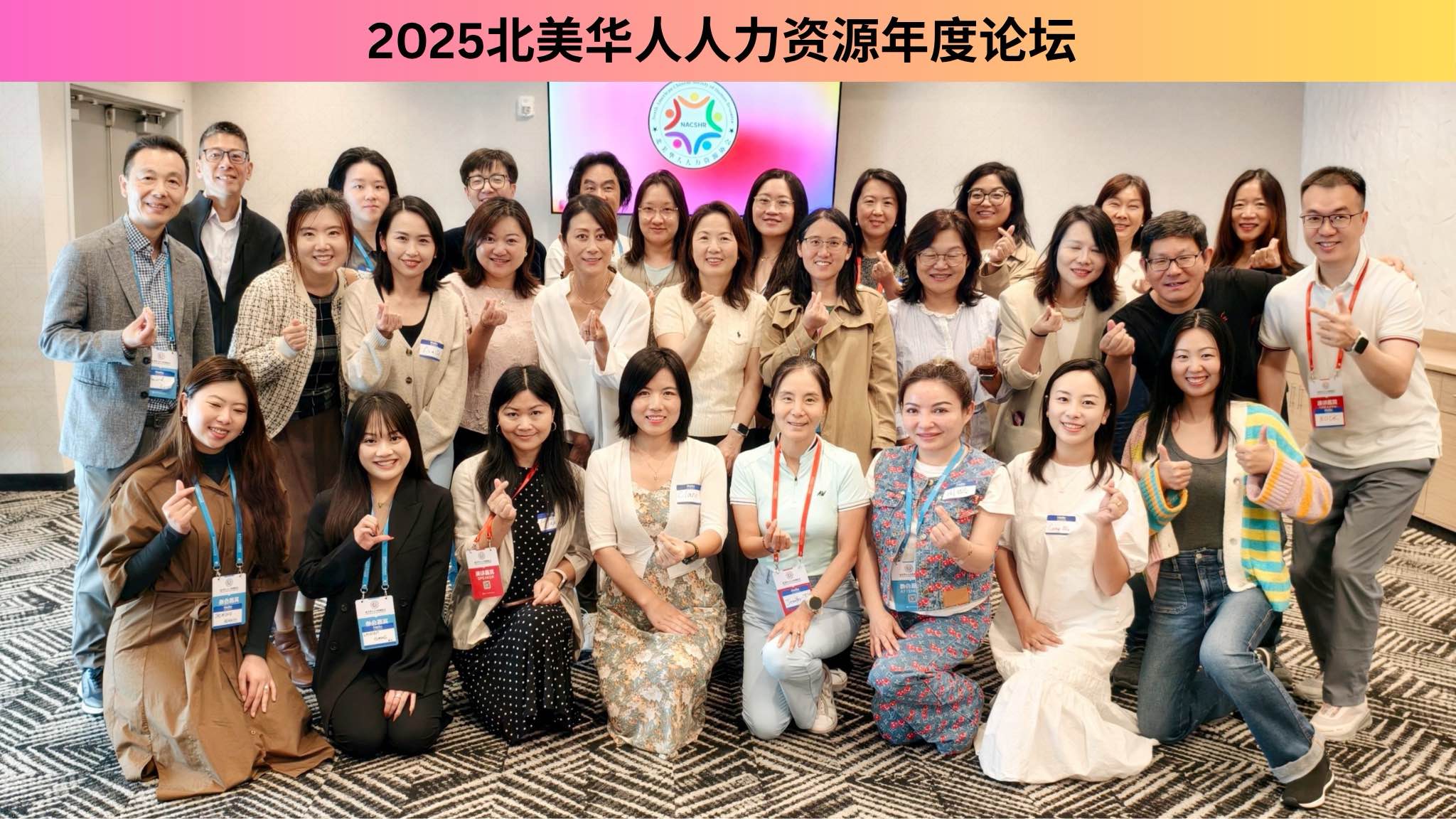
2025年10月4日至5日,NACSHR 2025 北美华人人力资源年度论坛在硅谷成功举办。这场由北美华人人力资源协会(NACSHR)主办的行业盛会,以“AI时代的人力资源变革与未来领导力”为主题,汇聚了来自旧金山湾区、洛杉矶、休斯顿、纽约、西雅图、温哥华及墨西哥等地的六十多位华人HR嘉宾与行业领袖,共同探讨AI技术、人本文化与组织创新的未来方向。在这场为期两天的深度交流中,参会者既是学习者,也是分享者;既是倾听者,更是共创者。正如NACSHR 发起人 Gawain在开幕致辞中所言:
“NACSHR不仅仅是华人HR的在北美的互动交流平台,更是一种连接的力量。我们在这里相互启发、相互成就,在AI的时代共同成长。”
本次论坛延续了NACSHR一贯的宗旨——以专业连接华人HR的全球力量,在AI与全球化浪潮下,汇聚思想、凝聚行动,为北美华人职场社群注入了新的信任与信心。
第一日 · 从AI到组织——重塑战略与协作的力量
10月4日的主题围绕“组织、AI与领导力”展开。多位嘉宾以不同视角深入剖析了AI如何重塑组织设计、决策逻辑与人才价值。
How to Design Your Organization to Support Global Business — Bijun Zhang
大会首日由本次论坛的主席 Bijun Zhang 开场。她以《How to Design Your Organization to Support Global Business》为主题,从组织设计与全球战略协同的角度,分享了跨地域团队在AI时代的成长之道。
她指出,组织设计的核心,不仅是结构,更是信任机制的建立。
“在跨时区、跨文化的团队中,真正的竞争力来自于‘清晰的边界’与‘有效的连接’。”
Bijun结合多地实践案例,提出通过“授权矩阵 + 沟通链路 + 文化共识”三要素,让全球团队在敏捷环境中高效协作。她总结道:“组织的韧性,不在规模,而在结构设计的智慧。”
The Art of Business Partnering in the Age of AI — Angela Rui
来自Canadian Solar 的 Global HR Director Angela Rui 带来了关于“AI时代的业务伙伴艺术”的分享。她认为,AI已成为HRBP最具影响力的“共驾工具”,帮助HR从事务性支持者成长为决策共创者。
Angela以实战案例讲述,如何通过AI工具洞察员工行为模式、优化绩效反馈、支持战略决策。
“AI让数据更透明,但真正的价值在于HR如何提出更好的问题。”
她强调,在AI与业务共驾的过程中,人性洞察将是HR无法被取代的核心竞争力。
川普2.0签证移民新政解读与HR应对之道 — Jiaqi (Jacky) Ji 律师
来自 Reid & Wise律所 的律师 Jiaqi (Jacky) Ji 带来了一场兼具专业性与现实指导意义的主题演讲。他从“政策误读”切入,详细剖析了近期引发热议的“10万美元入境费”事件,指出在社交媒体与碎片化信息环境下,HR应如何保持政策判断力与合规决策力。
“这是一场现实版的‘烽火戏诸侯’——政策还未实施,恐慌已先传播。”
Jacky系统解析了薪酬加权抽签机制、LCA提前布局策略及应对H-1B改革的关键要点。他提醒企业HR:
“在全球化与政治风险并存的时代,合规不仅是防御,更是战略能力。”
Panel:Organization Efficiency & AI Implementation
由 硅谷人才专家Tom Zhang 博士 主持的圆桌论坛聚焦“组织效率与AI实施”。与会嘉宾包括 Linda Lee(AI Fund Talent Partner)、Linsha Yao 与 Yalan Tan 等来自科技与生物医药行业的HR专家。
嘉宾们围绕“AI工具落地的关键障碍”展开深入探讨。讨论达成共识:
“AI能带来工具效率,但真正决定成败的,是文化的开放度与管理层的信任度。”
论坛现场氛围热烈,案例交流兼具前瞻性与实操性。
会议间隙,不分嘉宾还参与了会议合影的拍摄。
Thought Leadership Session:AI & HR Leadership — Tina Weinberger
来自 Cisco/Splunk 的高级HR业务伙伴 Tina Weinberger 以《Beyond the Hype: AI + HR Leadership》为题,带来极具洞察力的分享。她指出,AI对HR最大的改变,并非工作流程,而是“对工作的感受”。
“AI not only changes how we work — it changes how we feel about work.”
Tina提出“AI Confidence Framework”,包括四个核心要素:透明沟通、持续赋能、伦理治理、人机闭环。她强调,AI领导力的真正挑战不是工具选择,而是信任的建立。
“作为HR领袖,我们的使命不是管理变革,而是引导人走过变革。”
HR’s Next Evolution: How to Co-Pilot with AI Agents — Dr. Tom Q. Zhang
硅谷人才专家 Tom 博士在演讲中提出“共驾思维(Co-pilot Mindset)”,他指出:
“AI不会取代HR,但懂AI的HR,会取代不懂AI的HR。”
他展示了AI在招聘筛选、绩效预测、员工发展分析中的创新应用,并通过案例说明HR如何以AI为“副驾驶”,实现数据决策与人文洞察的融合。并强调未来的HR必须是会使用AI工具的人,同时在现场他还发布了一个正在招聘的HR主管岗位,其中之一的要求就是必须熟悉AI工具使用!这一要求引发全场同仁的思考和共鸣,也象征AI时代HR的新技能门槛
Solving HR Compliance and Payroll Challenges in North America with PEO — Joeyee Choon (ADP)
作为NACSHR战略合作伙伴代表,来自 ADP 的 Joeyee Choon 分享了PEO模式在北美合规与薪资管理中的创新实践。她指出:“在美国这样一个多州、多税制的环境中,共雇(Co-employment) 已成为企业提高合规与效率的关键机制。”
她以真实客户案例展示,企业通过PEO可平均节约20%的成本,并将HR从事务性流程解放出来。
“合规不是负担,而是组织持续成长的护栏。”
Redefining HR: Finding Your Unique Advantage in the Age of AI — Sandy Qian
来自 TransGlobal Insurance Agency 的 Sandy Qian 带来题为《Redefining HR: Finding Your Unique Advantage in the Age of AI》的主题演讲。她以IKIGAI模型为框架,引导HR思考个人使命与组织目标的契合点。
“AI可以自动化你的任务,但IKIGAI定义了你无法被取代的价值。”
Sandy提出,未来的HR应成为“技术的拥抱者、人性的守护者、组织文化的建设者”。
Panel:Building Leaders and Organizations in a Global Context
当天最后一个论坛由 Joki Jin 主持,嘉宾包括 Jane Xu、Carrie Peng、Cindy Fan、Grace Zhao等来自跨国科技与咨询领域的HR领导者。大家共同探讨了“全球背景下的组织领导力与人才流动趋势”,分享了多元文化团队中的实践心得。
“领导力的未来,不在权力,而在连接。”
她们从华人HR的视角出发,讨论如何在跨文化语境中平衡本地合规与全球战略,实现组织一致性与文化多样性共存。
Special Guest & VIP Dinner
夜幕降临,NACSHR特设的VIP Dinner 成为大会的温情收尾。在轻松的氛围中,嘉宾们围绕“AI与组织共生”“职业成长的长期主义”展开自由交流。这一环节不仅是社交聚会,更是一次深度链接与合作关系的延伸。许多嘉宾在会后已开启跨城市项目合作,成为未来持续共创的开端。
第二日 · 从组织到人本——在AI时代重新发现热爱与使命
10月5日的议程从技术与组织的视角,逐步走向“人性与热爱”的话题。AI不再是冷冰冰的系统,而成为激发创造力的伙伴。
From Business Leader to HR Head — Annie Jie Xu
开场分享嘉宾 Annie Jie Xu 分享了自己从20多年的商业领导者到HR负责人的转型之路。她以阿里巴巴二十年的成长经历为例,讲述如何从商业运营思维过渡到以人为本的组织建设!她谈到:最差的领导是很忙,最好的领导是会往后退。别人不帮你,是正常的,但是把事情做到极致,影响力就够了,别人也会来帮你。同时谈到阿里CPO童文红的职业经历启发了在场的每一位HR同仁。
“HR是企业灵魂的建构者。”
Annie以她的经历呼应了AI时代的人本管理主题——技术永远重要,但理解“人”的能力更不可或缺。
AI驱动的组织文化变革:如何让人机协作成为竞争优势 — Austin (Bo) Sun
Clausey AI 创始人 Austin Sun 带来对AI文化转型的系统思考。他以WM(Waste Management)的实践为例,指出:
“AI项目失败的90%原因不是技术,而是文化。”
Austin分享了如何通过内部AI培训、开放讨论与文化引导,让员工从焦虑到信任,最终实现AI共创。
“Don’t sell AI tools — build cultural momentum.”他的分享让“AI文化”从抽象概念变为可操作实践。
预见AI领导力进化 — Zhibin Liu
来自香港金融管理学院的 Zhibin Liu 客座教授,心理学家,以组织心理学视角探讨“高绩效与低焦虑的AI组织”。他通过实证研究与心理模型,说明AI领导力需要情绪智能(EQ)与适应智能(AQ)的双轮驱动。
“未来的领导者,既懂技术逻辑,也懂人心温度。”
Performance and Rewards Redesign in a Changing Workforce
由 Gabby Zhao 主持的圆桌论坛邀请 Cathy Wu、Freya Wang、Eva Meng 等HR专家,从多行业角度探讨绩效与激励机制的再设计。在AI与远程工作并行的环境下,如何用数据衡量绩效、用文化驱动动力,成为共识焦点。
如何找到自己的热爱,并把它创造到工作中 — 张岩
国际认证教练、团队领导力导师 张岩 带来最具情感共鸣的演讲。
“热爱,不是找到的,而是被创造的。”
她提出“四步法”:探索纯愿、广而告之、聆听回响、循响而行。
“幸福不是找到理想的工作,而是让当下的工作变得理想。”她的演讲以温暖和力量为论坛注入人文收尾,成为两天会议的情感高点。
HR in Startups: Building HR Functions from Zero to One
由 Libby Sun 主持,嘉宾包括 Lisa Qi、Yuqing Zhang、Ethan Zheng。他们从初创企业的角度探讨HR体系建设与快速成长的平衡。
“在初创企业,HR不是后台,而是生存引擎。”几位嘉宾以实战案例分享如何在资源有限的环境中搭建HR制度与文化支撑。
Thriving as Chinese HR Professionals in the North American Workplace
由 Mindy Gao、Jane Liang、William Chin参与的最后一场论坛,以“华人HR的职业成长与文化认同”为核心。他们探讨了如何在北美职场中建立影响力、获得认可,并以社群的方式彼此赋能。
“我们不仅在职场中工作,更在用行动定义‘华人HR’的力量。”
论坛在热烈掌声中落幕。两天16个环节的思想碰撞,带来了丰富的启发与情感共鸣。NACSHR以实际行动践行着“连接、学习与成长”的理念,为北美华人HR群体构建了一个持续交流、相互成就的专业共同体。
“当技术重塑世界,我们用热爱与连接重塑HR的未来。”
Stay Together, Stay Powerful.
workplace transformation
2025年10月06日
workplace transformation
麦肯锡:AI赋能职场,企业如何跨越管理障碍,实现智能化未来?员工对 AI 的适应速度远超领导层的预期
AI 如何重塑职场?
人工智能(AI)正在以惊人的速度重塑职场生态,许多企业正试图利用 AI 提高生产力、优化决策流程并增强市场竞争力。然而,AI 技术的广泛应用远非一蹴而就,企业的 AI 部署不仅涉及技术升级,更考验管理者的战略眼光和执行力。
麦肯锡的《Superagency in the Workplace》 这份报告深入研究了 AI 在职场中的应用现状,基于对 3,613 名员工和 238 名 C 级高管 的调查,揭示了企业在 AI 落地过程中的机遇与挑战。报告认为,AI 在职场的变革潜力堪比蒸汽机之于工业革命,但当前的最大障碍并非技术问题,而是领导层的行动力不足。
尽管 92% 的企业计划在未来三年增加 AI 投资,但只有 1% 认为自己 AI 发展成熟,表明大多数企业仍停留在 AI 试点阶段,尚未实现全面部署。更值得注意的是,报告发现员工对 AI 的接受度远超管理层的预期,但企业的 AI 发展速度依然滞后。领导者的犹豫和执行力缺失,正成为 AI 规模化应用的最大瓶颈。
本文将从员工接受度、领导层挑战、组织架构变革、AI 治理、商业价值实现等多个维度,介绍报告的核心观点,并补充对 AI 发展的进一步思考。
一、员工比领导更快接受 AI,企业行动缓慢
报告的核心发现之一是:员工已经在积极使用 AI,而领导者仍然低估了 AI 的普及度。
数据显示:
员工使用 AI 的频率比领导层预期高出 3 倍,但许多企业尚未提供系统性培训;
70% 以上的员工认为 AI 在未来两年内将改变至少 30% 的工作内容;
94% 的员工和 99% 的高管都表示对 AI 工具有一定熟悉度,但只有 1% 的企业认为 AI 应用已成熟。
这一现象表明,AI 在企业中的主要障碍并非员工适应能力,而是管理层的滞后决策。许多企业高管仍然停留在探索 AI 价值的阶段,而员工已经在日常工作中广泛使用 AI 工具,如自动生成文档、数据分析、代码编写等。员工在推动 AI 发展方面的主动性,远远超出管理层的认知。
然而,企业未能为员工提供足够的 AI 培训和资源,导致 AI 的应用仍然停留在浅层次,难以转化为真正的生产力提升。例如,48% 的员工认为 AI 培训是 AI 规模化应用的关键,但许多公司仍未建立 AI 学习机制。企业如果不采取措施缩小这一认知鸿沟,可能会错失 AI 带来的长期竞争优势。
二、AI 领导力挑战:速度焦虑与执行落差
尽管 AI 的发展潜力巨大,但报告指出,47% 的企业高管认为公司 AI 发展过于缓慢,主要原因包括:
AI 技术成本的不确定性:短期 ROI(投资回报率)难以量化,导致企业不敢大规模投资;
AI 人才短缺:AI 相关技术人才供不应求,企业缺乏相应的招聘和培养体系;
监管与安全问题:企业在数据隐私、算法透明度等方面的担忧阻碍了 AI 落地。
这种“速度焦虑”让企业在 AI 发展过程中陷入试点—停滞—观望的循环:
试点阶段:部分企业已启动 AI 试点项目,如客服自动化、数据分析等;
停滞阶段:由于短期收益不确定,试点项目难以规模化推广;
观望阶段:企业倾向于等待行业先行者经验,而非主动探索 AI 的商业价值。
报告强调,AI 的落地不仅是技术问题,更是企业管理问题。领导者需要具备更强的战略决心,加快 AI 投资,并明确 AI 在企业中的角色,才能真正推动 AI 规模化应用。
三、如何实现 AI 规模化落地?
1. AI 人才培养
AI 的大规模应用依赖于系统性的 AI 人才培训。然而,报告发现,近一半的员工认为企业提供的 AI 支持有限。企业需要采取措施:
建立 AI 培训体系,涵盖 AI 基础知识、业务应用和 AI 伦理等内容;
推广 AI 试点项目,让员工亲身参与 AI 工具的开发和使用;
设立 AI 激励机制,鼓励员工利用 AI 提升工作效率。
2. 组织架构调整
AI 不能仅仅作为 IT 部门的创新项目,而应当成为企业整体战略的一部分。报告建议:
设立 AI 战略委员会,确保 AI 发展与企业长期战略保持一致;
推动 AI 在各业务部门落地,提升 AI 在实际业务流程中的应用深度;
强化 AI 风险管理,确保 AI 应用在数据安全和监管方面的合规性。
3. AI 治理:平衡速度与安全
虽然 AI 带来了极大的商业价值,但报告指出,企业在 AI 治理方面仍存在诸多挑战:
51% 的员工担心 AI 可能带来的网络安全风险;
43% 的员工关注 AI 可能导致的数据泄露;
企业需要建立 AI 伦理标准,确保 AI 透明、公正、合规。
四、AI 时代的商业价值:企业如何真正实现 ROI?
尽管企业对 AI 充满期待,但报告显示,目前仅 19% 的企业 AI 投资带来了 5% 以上的收入增长,表明大多数企业的 AI 应用尚未转化为可观的商业回报。为了提升 AI 价值,企业需要:
从“技术驱动”转向“业务驱动”,确保 AI 应用直接创造商业价值;
优化 AI 目标设定,明确 AI 在核心业务中的定位;
加强 AI 应用场景探索,特别是在客户服务、供应链管理等高回报领域进行深入部署。
AI 成败的关键在于管理层
AI 的成功不仅依赖技术本身,更取决于企业领导者的执行力和战略眼光。企业若要真正迈向 AI 时代,需要:
加速 AI 战略落地,推动组织变革;
加强 AI 人才培养,提高员工 AI 适应能力;
建立 AI 治理体系,确保 AI 安全合规发展。
在 AI 时代,最危险的不是迈得太快,而是思考得太小、行动得太慢。
附录:《Superagency in the Workplace》 下载
workplace transformation
2025年03月14日
workplace transformation
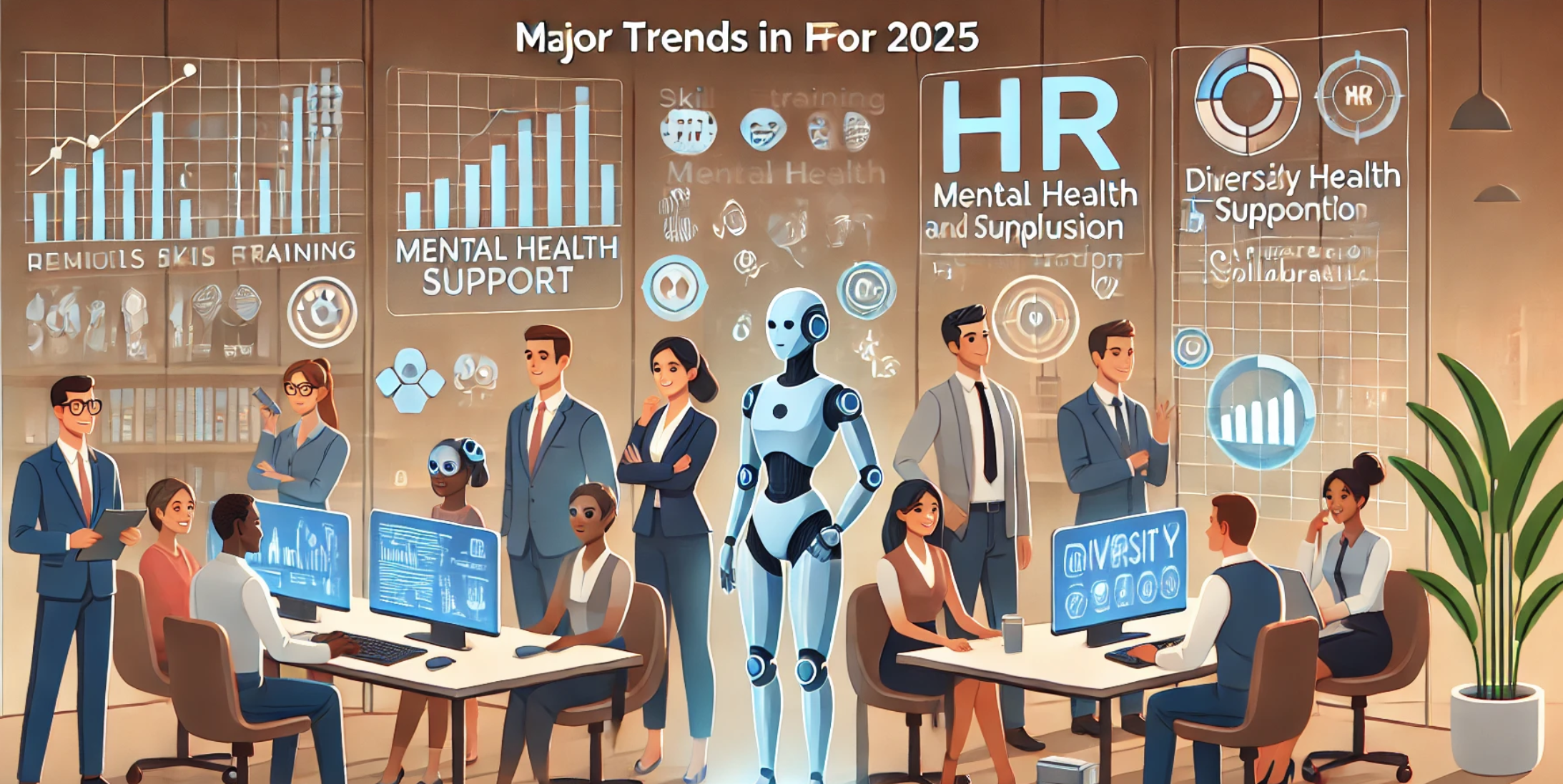
Josh Bersin:Digital Twins, Digital Employees, And Agents Everywhere2025 年,数字员工和人工智能助理的崛起将彻底改变人力资源运营,改变招聘、数据分析和员工管理等任务。 这些技术包括数字双胞胎和智能代理,它们将与人类专业人员一起工作,以提高生产力和优化工作流程。 随着人工智能工具成为日常业务不可或缺的一部分,人力资源领导者必须拥抱这些创新,同时继续关注技能培训、心理健康和包容性工作环境。 向人工智能的转变还将重塑团队动态,这对人力资源部门重新设计角色和流程以保持竞争力提出了挑战。
I recently heard Elon Musk predict that every citizen would have multiple Optimus robots in their homes within five years. And while I often ignore his predictions because they’re exaggerated, I think he’s on to something. We are about to witness an explosion of Digital Employees in our companies, and these may be the “robots” we’ve heard about for years.
Let me explain. This week I talked with dozens of vendors and clients at Unleash and then visited our development partner Sana Labs in Stockholm. It’s now clear that we’re going to be working with multitudes of “digital employees” in the year ahead.
(And as Dario Amodei, the founder of Anthropic explains, AI can do many more positive things in business, science, and health than we ever imagined.)
By “digital employee” I mean a software powered agent that can talk with us, answer detailed questions, solve complex analytic problems, and navigate a multitude of systems. ChatGPT and its peers, which introduced the idea of an agent, has now spawned dozens of “agentic” use cases, which I’d be willing to refer to as personalities.
Let me start with a “Digital Twin.” Imagine you have a superb customer service agent with years of experience helping your most demanding clients. If you load the last five years of their emails, coupled with all their internal documentation, and a log history of their last two years of service calls, you can essentially “create him or her” digitally with all the knowledge, style, and internal contacts this person has developed. This twin, which may look initially like an AI assistant, could then carry on this employee’s work when the real life worker is on vacation.
One of our clients, a large insurance company, has already built “digital twins” for claims processing. If you think about the complexity and workflow of processing a claim, much of it could be learned by an agent, making the “claims robot” an expert on this important process. And as you change claims rules and limits, the agent will learn new guidelines in only seconds.
Our AI assistant Galileo, a trained expert on HR (Galileo is trained on 25 years of research and thousands of conversations with clients and vendors), is essentially a “digital twin” of me and the other analysts in our firm. I’m not saying Galileo is as fun to talk with as we are, but I can assure you that he (or she) is as knowledgeable and supportive. And Galileo is even smarter than I am: he has instant knowledge of skills models, compensation benchmarks, turnover statistics, and other data bases which I can only access by looking them up on demand.
And using the Sana platform we can configure Galileo to have multiple personalities. Galileo the “Recruitment Agent” might have in-depth knowledge of screening, interviewing, and candidate skills assessment and he may have direct linkage to SeekOut, Eightfold, or any other sourcing applications. In his candidate facing personality he may be able to answer candidate questions, explain shift schedules, and “sell” the company to top job candidates. (This is what Paradox has done for years and vendors like Eightfold and LinkedIn are launching now.)
But there’s more. Imagine that this “digital twin” or “digital employee” has intimate knowledge of Workday, SuccessFactors, or a variety of other systems. Now the assistant can not only answer questions and help solve problems, he can also process transactions, look things up, and run reports against multiple system. The digital employee has turned into a “digital analyst,” who can find things and do work for you, saving you hours of effort in your daily life. (Vee from Visier is designed for this.)
Suppose you ask your digital friend to attend meetings for you, participate in conversations on certain topics, and alert you in real time when urgent issues come up for discussion. He could help you scale your time, keep you informed about decisions you need to know about, and help you manage your action items. And the list goes on and on and on.
Best of all, what if your digital twin can talk to you. Suppose he “checks in” with you about the project you asked for help with last week, so you inform him how things are going and he gets “smarter” about what you may need next. Galileo does this today, prompting you to dig into a problem and explore areas you may not have considered. And if you ask him about management or people issues, he could give you advice and coaching, based on the leadership models or even CEO interviews in your own company. (BetterUp, Valence and others are working on this.)
This is not science fiction, my friends. All this is becoming reality and will certainly be common next year.
Every vendor has a slightly different focus. The Microsoft Copilot specializes in MS Office-related activities, ServiceNow’s focuses on internal service and support, Galileo is focused on the needs of HR, and Joule is an expert on all the functions of SAP. Each of these “digital employees” needs training, feedback, and connections to stay current and relevant. So it’s doubtful that one digital employee will do everything. (Training a digital employee means managing his or her corpus of information, which will be a major new role in HR.)
One thing is very clear: we are going to be living and working with these guys. And as we use them and see what they’re capable of, we’re going to redesign work. Little by little we’ll offload tasks, projects, and workflows. And as we do, we’ll get smarter and smarter about redesigning our teams.
I liken the process to that of a carpenter who gets a new multi-function power drill. Before the drill he may have manually drilled holes, carefully selecting the drill bit and the level of pressure based on wood density. Now he drills holes faster, more accurately, and with more precision. Soon he just speeds through the process, spending more time on cabinet fit, finish, or design.
The same thing will happen to our HR tasks, projects, and designs. And these new digital employees are programmable! So once we figure out what they’re capable of we can adjust them, customize them, and connect them together. Eventually we’ll have intelligent assistants that operate as entire applications. And that’s the threat to incumbent software companies – the agents hollow out many of our existing applications.
How Do Our Digital Employees Impact Our Own Work?
One more observation. Many a few of the clients I talked with kept asking “what about our softskills?” What work is truly human?
I think that’s the wrong question. Rather we should ask the opposite: how much can I delegate to my new friends as fast as possible!
Have you been upset that your vacuum cleaner took away the rewarding human work of sweeping a floor? How much joy do you get from washing dishes? Did your dishwasher make you feel deflated when you stopped splashing around in the soapy water?
Of course not – these tools eliminated tasks we considered to be “drudgery.”
Well today, thanks to digital assistants, creating a pivot table to do cross-tab analysis has become drudgery. You can stop getting your hands wet with that task – ask Galileo or Copilot to analyze the data, and then ask him to chart it, add more data, and try new assumptions. The more we learn to use these new digital employees the more “drudgery” we can stop doing.
And consider complex “human-centered” activities like “change management.” A client asked me “how could Galileo help me with change management for our new HCM system?”
I answered her with dozens of ideas: ask Galileo for case studies of other companies and have it build a checklist to consider based on what other companies did. Then ask Galileo to build a training plan; ask it to read the user documentation and create a table of what features are new; then ask Galileo to rewrite that change plan by role. And finally ask Galileo to write a press release about success, craft some compelling communications to employees, and ask it to compute the ROI of all the steps eliminated.
These are all “manual” human tasks we do today and they take time and ingenuity to figure out. If you went through this process in Galileo you could ask your digital employee to save these steps and prompts in a “template,” and you have just taught your digital employee how to do change management. The next time you need him he can step you through the process.
As I started to explain this to my client I stopped and said: wait a minute. I can’t possibly show you everything Galileo can do. You have to try it for yourself.
And that’s my big message. Don’t wait for a vendor to drop a finished solution in your lap. These are intelligent, trainable, digital experts. You have to get to know them so you can figure out where they fit in your job, your projects, and your company. Just like you do with any new hire.
I say it’s time to get started. No more sweeping floors or washing dishes by hand. Let’s meet our digital employees, tell them about our projects, and ask for their help. Step by step, day by day, we can redesign our jobs to be more more productive, liberating us to do greater things.

 workplace transformation
 workplace transformation
 workplace transformation


 扫一扫
添加客服
扫一扫
添加客服


