LinkedIn推出AI招聘助手:重新定义未来招聘流程LinkedIn Enters AI Agent Race With LinkedIn Hiring Assistant
LinkedIn推出了首个AI Agent : Hiring Assistant,旨在帮助招聘人员重新成为招聘人员。
LinkedIn于本周推出了全新的AI招聘助手,这款工具旨在自动化招聘过程中高达80%的工作,特别是候选人筛选和招聘前的步骤。通过与LinkedIn平台的无缝集成,这款助手不仅提高了招聘人员的工作效率,也显著提升了候选人的质量。该工具的“体验记忆”和“项目记忆”功能,可以记录招聘人员的搜索和操作习惯,并将所有与招聘项目相关的信息进行整合,从而智能化地优化招聘流程。
这款助手已经在西门子、Canva等公司的招聘流程中得到了应用,这些公司报告称,通过LinkedIn招聘助手,招聘人员的生产力显著提升,候选人质量也得到了极大的改善。招聘前的AI辅助搜索仅需30秒即可完成,而传统的搜索通常需要15分钟。
LinkedIn招聘助手还通过AI驱动的沟通功能改善了候选人的体验。数据显示,使用AI辅助发送的招聘信息的接受率提高了44%,接受速度也加快了11%。此外,AI搜索的候选人接受率高出18%。
随着越来越多的公司采用AI技术,招聘与候选人之间的竞争日益加剧。求职者也在利用AI工具优化简历,甚至在面试中使用AI辅助表现,从而使HR在筛选候选人时面临更多挑战。因此,LinkedIn招聘助手等工具正成为招聘人员不可或缺的助手。
LinkedIn招聘助手不仅仅是提高效率的工具,它真正的价值在于解放招聘人员,使他们能够专注于与候选人和招聘经理的对话,改善雇主品牌,并更好地了解就业市场。这种转变反映了人才获取的战略性转变——从执行角色转变为人才顾问,帮助公司更好地实现增长。
详细请看Josh Bersin 写的这篇介绍
As I discussed in the article Digital Twins, Digital Employees, Agents Everywhere, tech vendors are creating AI-powered Agents as fast as they can. And in HR, where we deal with hundreds of mundane checklist-types of processes, the opportunity for automation is everywhere.
This week, just as Microsoft launched a tools to help companies build Agents in Copilot, LinkedIn announced its Hiring Assistant. And this is a pretty amazing product.
The Hiring Assistant is the first highly-integrated agent I’ve seen that fits right into the LinkedIn workflow. And the companies using it now (Siemens, Canva, AMS) are seeing recruiter productivity and candidate quality skyrocket.
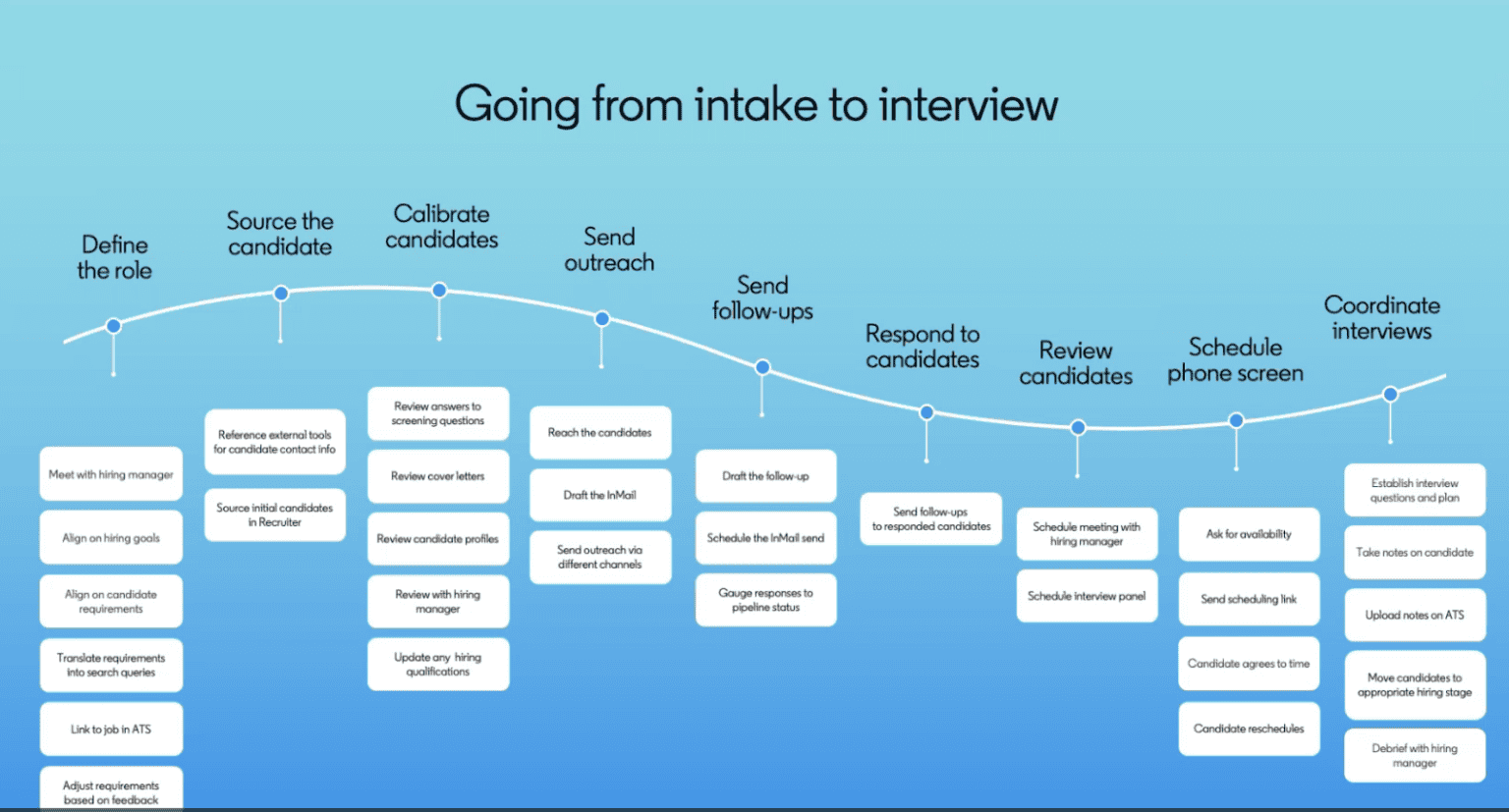
Here’s how to think about it: consider a schematic of the recruitment workflow.
As you can see, there are more than 30 steps to complete, and this doesn’t even include background checking, offer-letter generation, benefits discussions, pre-boarding, and onboarding.
With this brand new Assistant LinkedIn believes they can automate almost 80% of this pre-offer workflow. And the LinkedIn Hiring Assistant is just getting started.
Here are some screenshots of the workflow:
As you can see, the agent prompts the recruiter with intelligent responses and questions along the way. And throughout the process it stores more and more information to get smarter and smarter.
This Is A Sophisticated Product
This is a well-engineered product. Not only does it include many subtle features (ie. “find me a candidate like Joe,” which brings in Joe’s profile and analyzes Joe’s role, skills, and experience), it includes several platform innovations.
The first is something LinkedIn calls “Experiential Memory,” storing the recruiter’s search and activity history for future work. The Hiring Assistant learns what this recruiter is doing, how they communicate, and how they operate, to tune its results to each recruiter’s needs (ie. a tech recruiter vs. an executive recruiter).
Second is a feature called “Project Memory,” which brings together all the information about a single search project. This means the candidate selection criteria, emails, and input from hiring managers are stored in the project, enabling the assistant to see the whole experience of selection. Recruiters understand this challenge: every hire and every hiring manager is different, and each project has unique and sometimes new requirements which have nothing to do with the job description.
Other Agents Will Have To Take Notice
LinkedIn is not the first mover in this space, but the company’s credibility will accelerate the market. Paradox, the current leader in recruitment automation, has been automating high-volume recruiting for almost a decade and offers an agent that not only helps recruiters but also supports job seekers. It isn’t focused on sourcing liked LinkedIn, but it automates the rest of the process (candidate inquiries, interview scheduling, assessment, onboarding).
And it really works: this week Chipotle announced that Paradox’s solution reduces time to hire by 75%, making it a central part of the company’s growth strategy.
LinkedIn Hiring Assistant is receiving similar accolades.
“Doing a normal search before AI took upwards of 15 minutes. Now, with AI-Assisted Search, it takes about 30 seconds to get results. The time saved is tremendous. It is so much more convenient and easier doing it this way,” said Victoria Östryd Söderlind, Senior Recruitment Specialist, Toyota Material Handling Europe.
“The AI features on LinkedIn have allowed our recruiters to do more, to be better and to grow faster in all of our activities. It’s about spending time in the right places where our time is more valuable and LinkedIn’s AI features have enabled us to do that. What it’s not doing is removing great conversations with candidates, stopping our ability to ask them questions or getting to know candidates as people and humans,” said Olivia Brown, Head of Talent Acquisition, Octopus Energy.
Improving Candidate Experience
While LinkedIn talks about the value to HR, the bigger value may be for candidates. The company found that AI-Assisted outreach messages generate a 44% higher acceptance rate and are accepted 11% faster by job seekers. And AI-based searches produce 18% higher candidate acceptance. As Paradox has discovered, candidates don’t like to waste time scheduling calls with recruiters if they can avoid it.
And that leads to another important issue. There is now a growing AI battle between recruiter and candidates. AS AI helps recruiters source and screen candidates, the candidates are using AI to “power-up” their resumes. One of our clients told me that almost all their job applicants now submit resumes that look eerily similar to job descriptions. Why? Job candidates are using AI also!
This means is that tools like LinkedIn Hiring Assistant are more essential than ever. As job seekers tweak their identity and even use AI interview assessments to game interviews, HR has to beef up its tools to better differentiate candidates.
Liberating Recruiters To Recruit And Advise
The big story is actually this: while Hiring Assistant is an efficiency tool, what it really does is free up recruiters to talk to candidates. Recruiters who are bogged down with drudgery can talk with hiring managers, improve employment brand, and get to know candidates and the job market better. This is part of what we call Systemic HR: moving talent acquisition away from the “fulfillment center” role to that of a talent advisor, helping the company think about its best ways to grow.
As you look at these tools and think about automation, I encourage you to read our new research on the strategic shift in talent acquisition. Automation is not just about productivity and cost savings: it’s really about liberating our minds to think and add value in new and exciting ways.
Paradox
2024年10月29日
Paradox
Josh Bersin: When Will The Trillions Invested In AI Pay Off? Sooner Than You Think.近年来,生成式人工智能(GenAI)的投资已达数万亿美元,但围绕其回报问题的争论不断升级。一些分析师,如麻省理工学院教授达隆·阿西莫格鲁(Daron Acemoglu)和纽约大学心理学与神经科学教授加里·马库斯(Gary Marcus),对AI的经济影响持悲观态度,认为其对美国生产力和GDP增长的推动作用有限,甚至可能导致市场崩溃。相反,另一派如高盛的全球经济学家则乐观地认为,AI有望在未来十年内大幅提高生产力。然而,文章指出,生成式AI的真正价值在于其特定领域的应用。例如,Paradox和Galileo等HR技术平台通过高度专业化的解决方案,显著提升了招聘和人才管理的效率。最终,文章强调,AI行业仍处于早期阶段,成功的关键在于找到具有专注性和精确性的创新解决方案。
In the last few weeks there has been a lot of concern that Gen AI is a “bubble” and companies may never see the return on the $Trillion being spent on infrastructure. Let me cite four analyst’s opinions.
Will Today’s Massive AI Investments Pay Off?
MIT professor Daron Acemoglu estimates that over the next ten years AI will impact less than 5% of all tasks, concluding that AI will only increase US productivity by .5% and GDP growth by .9% over the next decade. As he puts it, the impact of AI is not “a law of nature.”
On a similar vein, Gary Marcus, professor emeritus of psychology and neural science at New York University, believes Gen AI is soon to collapse, and the trillions spent will largely result in a loss of privacy, increase in cyber terror, and a lack of differentiation between providers. The result: a market with low profits and big losses.
Goldman Sachs Head of Equity Research Jim Covello is similarly pessimistic, arguing simply that the $1 Trillion spent on AI is focused on tech that cannot truly automate complex tasks, and that vendors’ over-focus on “human-like features” will miss the boat in delivering business productivity. (He studies stocks, not the economy.)
And Goldman Sachs Global Economist, who is a fan, estimates that AI could automate 25% of work tasks and raise US productivity by 9T and GDP by 6.1% over the next decade. He follows the traditional business meme that “AI changes everything” for the better.
What’s going on? Quite simply this new technology is very expensive to build, so we’re all unsure where the payoffs will be.
Buyers Are Looking For A Return Soon
If we discount the work going on at Google, Meta, Perplexity, and Microsoft to build AI-based search businesses, which make money on advertising (Zuckerberg essentially just said that in a few years AI will guarantee your ad spend pays off), corporate IT managers are asking questions.
An article in Business Insider pointed to a large Pharma company that cancelled their Microsoft Copilot licenses because the tool was not adding any significant value (Chevron’s CIO was quoted similarly in The Information).
Another quoted a Chief Marketing Officer who stated Google Gemini’s email marketing tool and the new AI-powered ad-buying tool performed worse than the human workers it was intended to replace (or support).
Given that these tools almost double the “price per user” for the productivity suites, I think it’s fair that CIOs, CMOs, to expect them to pay for themselves fairly quickly.
What’s Going On? The Big Wins Will Be Domain Specific
As with all new technologies that enter the market quickly, “the blush on the rose” is over. We’ve been dazzled by the power of ChatGPT and now we’re searching for real solutions to problems. And unlike the internet, where research was funded by the government, there’s going to be a lag (and some risk) between the trillions we spend and the trillions we save.
Given that ChatGPT is less than two years old and OpenAI has morphed from a research company into a product company, it’s easy to see what’s happening. Every vendor and tool provider is narrowing its AI “strategy” and not just pasting little AI “stars” on their websites, looking for useful things to do. And this process may take a few years.
In the world of HR, I think we can all agree that a “push the button job description generator” is a bit of a commodity. However if the AI analyzes the job title, identifies the skills needed through a large skills engine, and tunes the job description by company size, industry, and role, then it’s a fantastic solution. (Galileo does this, as does SeekOut, SAP, and some other vendors.)
The more “specific” and “narrow” the AI is, the more useful it becomes. Generic LLMs that aren’t highly trained, optimized, and tuned to your company, business, and job are simply not going to command high prices. So while we all thought ChatGPT was Nirvana, we’re now figuring out that highly specialized solutions are the answer.
Let me give you some examples.
The first is the platform built by Paradox, a pioneering company that started work on AI-based recruiting agents in 2016. Paradox, now valued at around $2 Billion, delivers an end-to-end recruitment platform that automates the entire process of candidate marketing, candidate experience, assessment, selection, interview scheduling, hiring, and onboarding. Most people believe its a “Chatbot” but in reality it’s an AI-powered end-to-end system that radically simplifies and speeds the recruitment process in a groundbreaking way. Companies like 7-11, FedEx, GM, and others see massive improvements in operational efficiency and both candidates, managers, and recruiter adore it. It took Paradox eight years to build this level of integrated solution.
The second is our platform Galileo. Galileo, which is now licensed by more than 10,000 HR professionals, is a highly tuned AI agent specifically designed to help HR professionals (leaders, business partners, consultants, recruiters, and other roles) do the “complex work” HR professionals do. It’s not a generic LLM: it’s a highly specialized solution designed specifically for HR professionals, and we’ve added specialized content partners and are building special integrations with other HR platforms. Our clients tell us it’s saving them 1-2 hours a day.
The third is the platform HiredScore, that was recently acquired by Workday. Founded in 2012, the HiredScore team built tools to help identify “fit” between individuals and jobs, and tuned its AI to be highly explainable, unbiased, and very easy to use. It took Athena Karp and the team a few years to nail down the use-cases and user interface but now HiredScore is considered one of the most powerful recruitment “orchestration” tools in the market, and is also used for internal hiring and many other applications. Every customer I talk with tells me it’s essential and saves them months of manual, error-prone effort.
The fourth is the platform Eightfold, which was invented in 2016 as a way to build “Google-scale” matching between job seekers and jobs. Through many years of engineering, product management, and ongoing sales process the company has become the leader in a new space called “Talent Intelligence,” now a billion dollar rapid-growing category. The company is about ten years old and now has some of the world’s largest companies building their hiring, career management, and talent management processes using AI. Companies like EY, Bayer, and Chevron now use it for all their strategic talent programs.
Each of these vendors, including others like Gloat, Sana, Arist, Lightcast, Draup, Uplimit, Firstup, and hundreds of others have patiently taken the power of Generative AI and applied it with laser precision to their solutions. Each of these companies is different, and as we work with them we see lightning bolts of innovation: not in AI itself, but in finding new ways to solve problems and do what I call “crawling up the value curve.”
This is the path for AI in the coming years. As with all new technologies, the “trough of disappointment” is always followed by the “bowling pin” of hitting the nail on the head. Innovators, entrepreneurs, and startup founders are the ones who will take GenAI and apply it in unique ways to solve problems. And soon enough, “AI-powered” will be a phrase we barely even need to say.
The Best Solutions Will Be Narrow Not Wide
GenAI solutions require a large “platform” of data, infrastructure, and software. That alone is not where the value resides. Rather, the big productivity advantages come after years of effort, focusing the data sets and working with customers to find the features, UI designs, and data sets that add enormous value. And we are still in the early stages.
If you want to learn more about HR Technology and AI, join me at the HR Technology Conference on September 24-25 in Vegas, or at Unleash in Paris in October 16-17. While I can’t predict who will win the core AI platform game (Microsoft, OpenAI, Google, Meta, Amazon will fight it out), I can predicts this: Generative AI will deliver massive improvements in business productivity. You just have to shop around a bit and wait for just the right solutions to arrive.

 Paradox
 Paradox
 Paradox
 Paradox



 扫一扫
添加客服
扫一扫
添加客服


