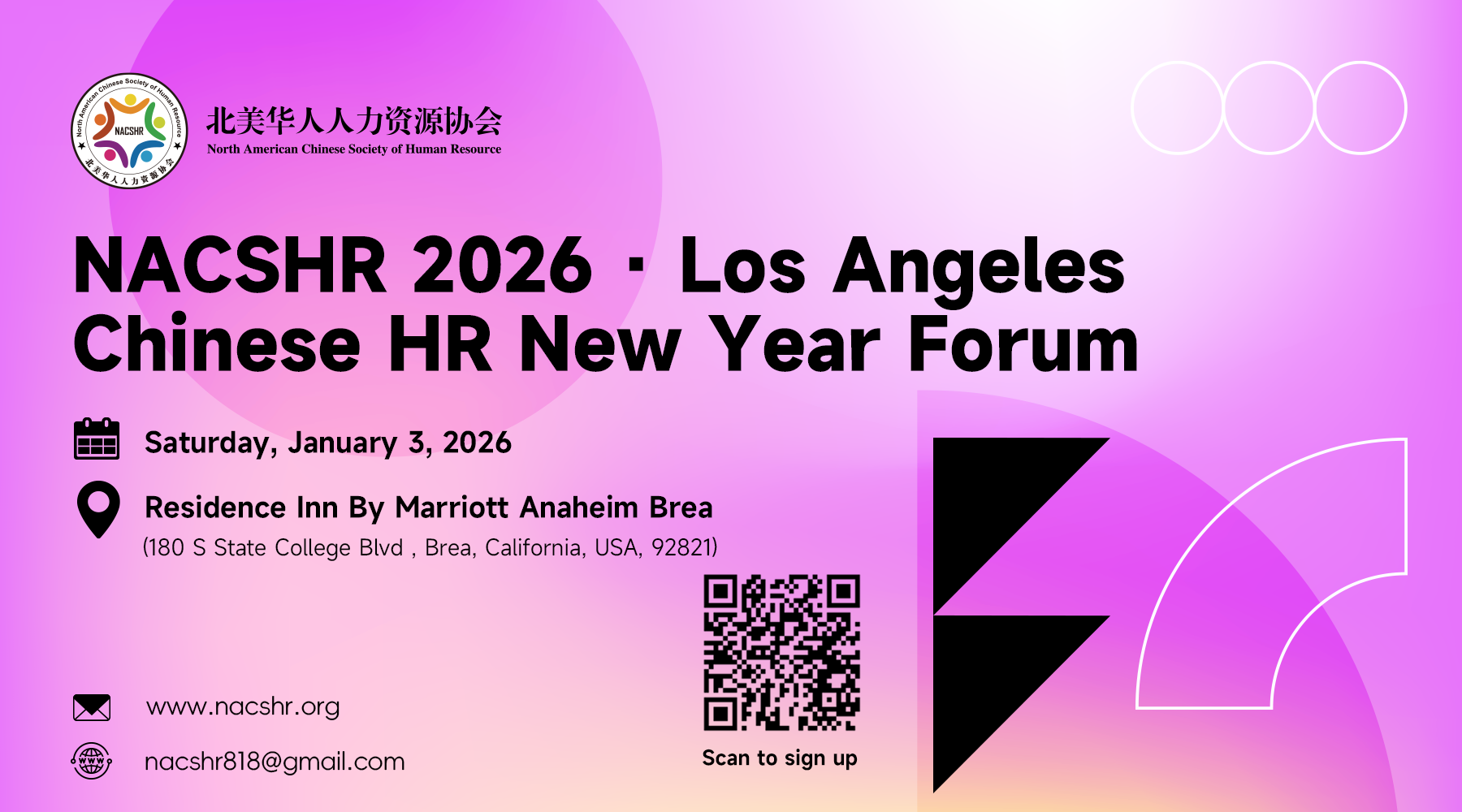
北美华人HR新年论坛 · NACSHR 2026洛杉矶 | 全球视野 × 本地实践 · 1月3日盛大举办!NACSHR 2026 · 洛杉矶 NACSHR 2026 · Los Angeles
北美华人HR新年论坛 Chinese HR New Year Forum
时间:2026年1月3日(周六) 9:00-17:00 Saturday, January 3, 2026
地点: Residence Inn By Marriott Anaheim Brea (180 S State College Blvd , Brea, California, USA, 92821)
报名:https://www.nacshr.org/Survey/0A2575B1-DABC-432A-BF2F-7EF6E8898D1A
在全球人才格局加速重塑、AI技术深度渗透职场、合规与监管持续升级的背景下,出海企业亟需精准落地本地HR策略,而北美华人职场专业人士也在不断寻找走向更广阔舞台的路径。NACSHR 2026 · 洛杉矶华人HR新年论坛,正是在这样的时代需求与群体共鸣中诞生。
这不仅是一场人力资源行业的专业论坛,更是一场专属于北美华人HR与企业高管的年度盛会。我们关心的不是空洞的愿景,而是切中当下的关键议题:
如何在北美市场 招到人、留住人、管好人?
如何在 AI加速变革 的趋势中找到个人与组织的定位?
如何更好地链接 服务机构、工具平台与优秀人才,实现企业与个人的共赢?
在这里,你将收获:
高密度信息沉浸:一线实践者的经验框架与最新行业打法(AI、薪酬、合规、招聘);
多元互动场景:岗位机会对接、午餐社交、会员交流、快速展示秀,让你不仅仅是听众;
可信赖的人脉网络:结识值得深交的同行、未来的合作伙伴,甚至下一份工作的雇主;
持续延展的社群价值:论坛只是起点,你将融入 NACSHR 的长期社群,获得持续资源共享与影响力拓展。
这是一场属于你我共同塑造的盛会。对于HR,这是认清趋势、校准方向的机会;对于服务机构,这是展示专业、赢得客户的舞台;对于出海企业,这是重建组织能力、抓住人力关键的节点。
我们用心准备的不只是内容,而是一段值得你出发的旅程。
Stay Together. Stay Powerful.
NACSHR 2026 · 洛杉矶 华人HR新年论坛
时间:2026年1月3日(周六) 9:00-17:00
地点: Residence Inn By Marriott Anaheim Brea (180 S State College Blvd , Brea, California, USA, 92821)
报名:https://www.nacshr.org/Survey/0A2575B1-DABC-432A-BF2F-7EF6E8898D1A
门票类型:提前报名获得早鸟门票(无忧退票:会前两周可退、可保留名额至下次)
HR Leader Pass:仅限InhouseHR和学生及企业内部HR相关职能
General Pass:适用于HR服务机构、顾问、猎头人才服务等非InhouseHR相关
——————
· HR Pass优惠票: 198美元/人 12月15日前 (原价300美元)
· General Pass优惠票:300美元/人 12月15日前(原价600美元)名额按比例分配,额满为止
· HR Pass优惠票: 250美元/人 12月31日前 (原价300美元)
· General Pass优惠票:450美元/人 12月31日前(原价600美元)名额按比例分配,额满为止
· 展览展示门票:资料现场发放和5分钟展示机会,含门票一张:2000美元 仅剩一个名额
· 三人同行,享受8折优惠
· 赞助合作模式,具体请联系工作人员,多种模式对论坛支持!
因酒店费用过高,会议不提供午餐,但提供咖啡茶、软饮和小零食等
为了确保所有参会者的最佳体验,NACSHR论坛管理团队将定期审核注册名单,并可能根据需要调整注册类别。如果您的注册类型被调整,您需补缴相应的费用差额。本政策旨在维护公平性,并提升所有与会者的参会体验。
付费指南:https://www.nacshr.org/3016/
更多会议相关内容,我们会不断更新,并通过NACSHR官网和社交媒体发布。
会议参展及赞助演讲合作
联系人:Annie(nacshr818@gmail.com)或 点击申请 : https://www.nacshr.org/Survey/CDBE9324-6291-EB0E-3E50-91532A2A70BB
媒体合作: nacshr818@gmail.com(备注媒体合作)
你为什么不能错过NACSHR峰会:
聆听行业大咖的精心分享:演讲嘉宾包括成功的企业家、重量级的行业内大咖、优秀的人才战略专家,精通中国以及北美的人力资源市场。
学习新知识,掌握新动态:不论您是职场老将还是新兵,更新知识库是一个永恒的课题,峰会设置了多种会议形式,帮助您打开新视野。
职业发展新机遇,更广泛的选择:NACSHR设置了北美地区HR岗位需求,提供面对面沟通交流机会。
北美地区最大的华人HR行业盛会:汇聚北美职场华人力量,打造北美唯一、最大的华人HR盛会。
交流新资讯,结交新伙伴:探讨行业热点话题,激发创新思维,共同推动HR行业的发展。
启发职场新思维,实现职业新突破:探讨华人管理者如何实现职场发展目标,与嘉宾和行业专家共同探讨如何在美国职场实现自我价值。
谁应该参加 NACSHR 洛杉矶新年论坛?
无论你正处于职场探索、企业拓展,还是希望建立行业影响力的阶段——这场论坛都为你准备了专属的参与价值:
· 华人HR从业者如果你正在美国从事招聘、HRBP、薪酬福利、HRIS或劳资合规工作,这里将为你带来最前沿的工具方法、最佳实践案例、招聘与职业发展机会,以及一群志同道合、可信赖的专业伙伴。
· 出海企业的人力负责人、总经理、创始人如果你是正在北美拓展的中资企业管理者,这场论坛将帮你快速掌握本地人力合规策略、人才招聘路径、激励制度与管理模式,同时链接有执行力的HR顾问、法律与运营资源。
· 想进入HR领域的在美新移民与学生群体如果你对HR感兴趣、正在寻找转型路径,这里能让你迅速理解真实市场需求、建立人脉基础、并找到前辈指引。
· 希望触达中资企业的HR服务机构与个人顾问如果你提供薪酬、保险、移民、福利、培训、工具或法律等服务,这场论坛将让你直接接触高意向的HR决策者与出海企业客户,为品牌建设、客户合作和市场推广提供精准舞台。
HR服务机构为什么要积极参与?
在北美市场,中资企业与华人HR决策者对本地服务资源的信任与合作机制尚在建设中。作为HR服务机构,这是一次进入高质量圈层、建立品牌心智、拓展真实客户的黄金机会。
· 精准触达:来自中资企业、HR团队的决策者直接面对面接触,远高于线上广告转化效率
· 主动参与:不仅限于展示位,你还可参与5分钟展示秀、圆桌讨论、联合活动策划等环节,展现专业能力
· 品牌曝光:通过资料包、海报、主持口播、社群渠道等形式,实现论坛前中后全周期品牌露出
· 内容共创:有机会与NACSHR联合发布报告、访谈、白皮书,共建行业影响力
· 进入长期社群体系:不仅是一次参会,更是成为NACSHR生态服务网络的一员,持续获取线索与合作
这不是一次参展,而是一次可信、可持续的市场进入。
NACSHR 2026 · Los Angeles
Chinese HR New Year Forum
Date & Time | Saturday, January 3, 2026 · 9:00 AM – 5:00 PMLocation | Greater Los Angeles Area (convenient access)
Registration | https://www.nacshr.org/Survey/0A2575B1-DABC-432A-BF2F-7EF6E8898D1A
As the global talent landscape rapidly reshapes, AI penetrates deeply into the workplace, and compliance and regulation continue to evolve, outbound enterprises urgently need to localize their HR strategies with precision. At the same time, Chinese professionals in North America are constantly seeking pathways to broader opportunities. The NACSHR 2026 · Los Angeles Chinese HR New Year Forum was born out of this shared demand and resonance.
This is not just a professional HR forum—it is an annual gathering dedicated to Chinese HR professionals and business executives across North America. The forum focuses on pressing, practical issues rather than abstract visions:
How to hire, retain, and manage talent in the North American market?
How to position both organizations and individuals in an era of accelerated AI transformation?
How to better connect with service providers, platforms, and outstanding professionals to achieve win-win outcomes?
What You Will Gain
High-density insights: First-hand frameworks and cutting-edge practices in AI, compensation, compliance, and recruiting.
Diverse participation formats: Job-matching, networking lunch, member exchanges, and lightning showcases—making you more than just an audience.
A trusted professional network: Build meaningful connections with peers, potential partners, and even future employers.
Sustained community value: The forum is just the beginning—you will be integrated into NACSHR’s ongoing HR community for continued collaboration and growth.
Ticket Categories & Pricing
HR PassExclusively for In-house HR professionals, internal HR functions, and students
Early Bird (before Dec 1: 150/person (Regular $300, limited availability)
Discounted (before Dec 31): $250/person (Regular $300)
General PassFor HR service providers, consultants, headhunters, and other non In-house HR professionals
Early Bird (before Dec 1): $350/person (Regular $600, limited availability)
Discounted (before Dec 31): $450/person (Regular $600)
Exhibition Pass
$2,000 limited availability)
Includes brochure distribution, 5-minute presentation slot, and 1 entry ticket
Additional Information
Group Discount: 20% off for three attendees together (not applicable to Early Bird tickets)
Lunch will not be provided due to high hotel catering costs, but coffee, tea, soft drinks, and light snacks will be available
NACSHR reserves the right to review and adjust registration categories; if a registration type is updated, the difference in ticket fees must be paid. This policy ensures fairness and an optimal experience for all attendees.
Payment Guide: https://www.nacshr.org/3016/
Why You Can’t Miss the NACSHR Forum
Hear from industry leaders: Featured speakers include successful entrepreneurs, senior industry experts, and talent strategists with deep knowledge of both the Chinese and North American HR markets.
Learn and stay updated: Whether a seasoned professional or a newcomer, continuous learning is essential. The forum offers multiple formats to broaden your HR perspective.
New career opportunities: NACSHR highlights HR job openings across North America and facilitates in-person networking.
The largest Chinese HR event in North America: Bringing together Chinese HR professionals and executives, creating the only and largest gathering of its kind.
Expand your network and insights: Explore hot topics, spark new ideas, and collaborate to advance the HR profession.
Inspire new thinking: Learn how Chinese professionals can achieve their career goals and personal growth in the U.S. workplace.
Who Should Attend the NACSHR Los Angeles Forum?
This forum is designed for you—whether you are exploring your career, expanding your business, or building professional influence:
Chinese HR professionalsIf you are working in the U.S. in recruitment, HRBP, compensation & benefits, HRIS, or labor compliance, you’ll gain access to cutting-edge tools, best practice case studies, career opportunities, and a trusted peer community.
HR leaders, GMs, and founders of outbound enterprisesIf you are managing Chinese enterprises expanding in North America, this forum will help you quickly master local compliance strategies, recruitment pathways, incentive systems, and management models, while connecting with experienced HR consultants, legal advisors, and operational resources.
New immigrants and students in North AmericaIf you are interested in HR or looking to transition into the field, this forum will help you understand real market demands, build a network, and find mentors to guide your path.
HR service providers and independent consultantsIf you provide payroll, insurance, immigration, benefits, training, tools, or legal services, this forum will connect you directly with decision-makers and outbound enterprise clients, offering a highly targeted stage for branding and client acquisition.
Why HR Service Providers Should Participate
In the North American market, trust and collaboration between Chinese enterprises and local HR service resources are still being established. For HR service providers, this forum is a golden opportunity to access a high-quality network, build brand recognition, and secure real clients.
Targeted access: Direct interaction with decision-makers from Chinese enterprises and HR teams—far more effective than online ads.
Active participation: Beyond booths, you can join the 5-minute showcase, panel discussions, and co-hosted activities to demonstrate expertise.
Brand exposure: Gain visibility before, during, and after the event through brochures, posters, host mentions, and community channels.
Content co-creation: Collaborate with NACSHR on reports, white papers, and interviews to build long-term influence.
Integration into the NACSHR ecosystem: Participation is not a one-time event but an entry into NACSHR’s service network for continuous leads and collaboration.
This is not just an exhibition—it is a credible, sustainable entry into the market.
Sponsorship & Media Partnerships
Exhibition & Sponsorship OpportunitiesContact: Annie (nacshr818@gmail.com)Apply here: https://www.nacshr.org/Survey/CDBE9324-6291-EB0E-3E50-91532A2A70BB
Media PartnershipsEmail: nacshr818@gmail.com (Please indicate "Media Partnership")
Stay Together. Stay Powerful.The annual flagship gathering for Chinese HR professionals in North America—see you in Los Angeles!
Why AI is now HR’s businessCould the AI revolution also herald a revolution in HR?
Generative AI is leaving many businesses in a fix.
On the one hand, the potential of the technology is strikingly obvious. Since ChatGPT debuted to the public in late 2022, AI has made extraordinary advances. Coding tools can spin up micro apps from a simple prompt. Chatbots can produce instantaneous research. Video models can create studio-grade clips. Tools like these can supercharge all kinds of work, whether it’s helping create a whole marketing campaign or simply assisting an individual reason through a thorny problem. One estimate sizes the corporate opportunity at $4.4 trillion globally.
Yet it can be bewilderingly hard for enterprises to realize those gains. Studies show that generative AI is having limited impact on productivity. Many organizations find themselves either stuck in pilot purgatory, or rolling out initiatives that fail to deliver ROI. Others don't even know where to start.
This issue is especially pronounced for smaller enterprises. In fact, research suggests that AI is seen as the number-one challenge by four out of five small business leaders in the UK. Small firms are half as likely to have implemented it compared to larger companies. And within the small companies that have adopted AI, usage is often uneven. Seventy three percent of senior managers use it at least once a month, compared with only 32 percent of entry-level employees. This creates what Kevin Fitzgerald, UK Managing Director of the all-in-one employment platform Employment Hero, calls the “AI advantage gap.”
“AI is only delivering productivity gains for some, and that’s a huge problem,” he says. “For technology to drive meaningful change, it needs to be in the hands of everyone.”
Human resources (HR) departments are uniquely positioned to help manage some of the challenges around AI adoption. That’s because taking full advantage of the new AI tools available to organizations is more than just an IT project. “AI is all about job redesign, new skills, new organization structures, and new roles for leaders,” says Josh Bersin, a respected HR industry analyst and CEO of HR consultancy The Josh Bersin Company. “HR people are essential as part of companies’ AI transformations.” In practice, this kind of project tends to be easier for smaller businesses, which have fewer employees and less organizational complexity to disrupt.
Bersin says that Chief Human Resources Officers (CHROs) now frequently lead AI-based organizational redesigns. Going further, almost two thirds of IT decision-makers expect their HR and IT teams to merge in the next five years, according to a recent survey. This is already happening at companies such as Moderna, the biotech firm with more than 5,000 employees, which now has a single leader covering both.
“HR has a once-in-a-generation opportunity to reshape the future of work,” says Fitzgerald. “And it’s important to get this right. Bad AI rollouts can slash personal productivity in half.”
So what does HR-led transformation look like in practice? Here we spotlight three ways HR leaders can set their organization up for AI success…
1. HR as pioneers
Leading on AI transformation means deeply understanding training needs, integration challenges, employee resistance and—fundamentally—how and where AI offers value. This means HR professionals need real experience of those things themselves.
There are many HR tasks to which both traditional machine learning and generative AI is well suited. Much of the press buzz is around recruitment—using AI to source candidates, screen CVs, and automate parts of the application process—but its impact can be much broader. The creative and communication side of the job is a natural fit for the capabilities of large language models (LLMs), which excel both in summarizing and expressing information. Whether it’s drafting job descriptions, communicating complicated policies in plain language, or managing the team’s internal knowledge, there’s plenty that an LLM can help with (so long as it offers appropriate privacy assurances). There are a range of options for deployment, from buying tools that package up an LLM for delivering on a specific use case—such as offering AI training programs or building FAQ chatbots—to simply subscribing to a frontier AI assistant like ChatGPT.
The most immediate benefit is the potential gains for the HR team itself. Handing off repetitive tasks to AI can free up time. But it’s also the baseline for any HR team that is planning on leading the way in a business’ AI transformation, because credibility will be vital.
That’s not to say that it should only be HR leading the charge on AI—Bersin says that more often than not having a dedicated committee with representatives from HR, legal, and IT is most effective—but it’s a necessary criterion for playing a central role. “It’s about leading by example,” says Fitzgerald. “People don’t want technology forced on them—they want to see its benefits, and be given the freedom and encouragement to explore it.”
Of course, much of HR’s AI usage will be internally facing, so there’s a comms job to be done. “My advice to the HR leader would therefore be: share,” says Fitzgerald. “Share the wins that you've had, and actually put them out there to the broader business.”
2. HR as culture definers
Establishing the right culture around AI is vital. “It’s the missing link in AI adoption,” says Deepali Vyas, Global Head of Data & AI at global talent advisory firm ZRG.
There are two crucial reasons for this.
The first is that when a company chooses to roll out AI, it can create ill feelings. People can fear it’s a prelude to cost cutting and job losses. Of course, an organization may be planning to downsize—but equally it could be planning to do more with the same number of people. Whatever the plan, be transparent. If nobody needs to worry about their jobs, tell them. If a restructure is likely, fair dealing and honesty can go a long way to attenuating resentment. HR has the authority and the skills to lead on conveying this information in the most effective and appropriate way.
The second reason concerns “shadow AI.” This is where employees use AI tools of their own without telling management, either because they fear for their jobs or because they view AI as a shortcut and don’t want to pull back the curtain on how they get things done. Shadow AI is already widespread; the security firm Varonis estimates that up to 98 percent of employees use shadow AI or shadow IT in some capacity, with employees hiding their AI use out of fear of their employer's reaction.
While the primary risks of shadow AI are to do with security and privacy, there is also a more systemic drawback. Top-down AI tool implementation can be important, but companies that don’t also tap into the wisdom of the crowd will miss out on AI opportunities. Generative chatbots are general-purpose tools with the most open-ended interface possible: there are countless different ways to use them, and the people best placed to figure out how this kind of AI can help your business are the people who work there. But you can’t enjoy the fruits of their experiments if they are unwilling to share how they’re using it and what they’re discovering as a result.
“You really need to bring shadow AI use to the surface,” Vyas says. “In any case, banning or ignoring shadow AI is not going to make it disappear. It's only going to drive it further underground.” Bringing it out into the light is, again, a question of culture. If IT owns guardrails and platforms, and the C-suite owns vision and accountability, HR owns the people and behaviors piece. In addition to quelling fears that revealing AI usage will jeopardize jobs, HR needs to create forums to encourage sharing across all teams. This could take the form of workshops and hackathons or simply dedicated channels on Slack. There should also be incentives, so that individuals who come up with approaches that create meaningful value are well remunerated for their contributions.
“There's a lot of fear versus empowerment,” says Vyas. “HR’s cultural mandate is building a culture of AI fluency, normalizing AI as a partner in work and to build trust around its use.”
3. HR as organization designers
AI transformation is not just about rolling out the tools. You need teams with AI literacy, skills and mindsets—teams that are open to new ways of working and to reimagining workflows that have perhaps remained unchanged for decades. You may also need to create new roles like a Chief AI Officer, or hire specialist software developers.
“It's about building that future-ready workforce,” says Vyas. HR’s expertise in recruitment and training will be crucial in this effort—only half of employees in SMEs believe their company has done a good job instilling technological know-how—and AI itself can play a powerful role in making a success of it. Forward-thinking organizations weave AI into workforce management, from how workers move internally to how they train and learn, Vyas says. “There’s personalized learning journeys, there's internal mobility recommendations, there's workforce planning tied to all of these business scenarios.”
As they scale, companies may wish to rethink their org charts in light of AI. The traditional triangular org chart has been a mainstay since Brigadier General Daniel McCallum unveiled the first example in 1855. But many commentators believe that new architectures will coalesce to reflect how people work best with AI. Microsoft’s Work Trend Index Annual Report 2025 argues that the org chart will be replaced with a “Work Chart,” which it describes as “a dynamic, outcome-driven model where teams form around goals, not functions, powered by [AI] agents that expand employee scope and enable faster, more impactful ways of working.” In practice this means a flatter, more flexible operating model. Firms that have harnessed AI in this way report having more satisfied, more optimistic employees.
HR will need to play a pivotal role in managing any such transformation. “That’s not only because most savvy HR leaders are also very good at change enablement,” says Bersin, “but also because this clearly would have implications for pay models, reward systems, and leadership pipeline.” What’s more, Microsoft argues that in a Work Chart world, orchestrating the interplay between humans and AI agents—and getting the balance right—is going to be an emerging area of responsibility for HR. In discharging this duty, they will need to collaborate more closely than ever with technical teams.
This shift may seem radical. But, as the aphorism has it, it's easy to underestimate the long-term effects of new technologies. Vyas believes this kind of business architecture will just be “the new normal—and sooner than we might think”.
原文:https://www.wired.com/sponsored/story/employment-hero-why-ai-is-now-hrs-business/
头条
2025年11月28日
头条
加州雇主血泪教训:HR 必看 2025 最新 Meal & Rest Break 合规指南加州的餐休法律极为严格,一次违规可能触发三重惩罚:罚金工资、工资单违规与等待时间罚金。根据第226.7条,只要未能提供合规的餐休或休息,雇主就必须支付一小时罚金工资。而法院已明确此类罚金属于工资,因此若工资单未列出,将触发第226条的工资单责任;若员工离职未结清,则触发第203条的等待时间罚金。Ferra 案裁定,罚金工资的“常规薪酬率”必须依照加班费标准计算,包括奖金、佣金与差额补贴,并具有追溯效力。
一个价值1.72亿美元的教训
在*Savaglio v. Wal-Mart Stores, Inc.*案中,沃尔玛因餐休违规问题面临了高达1.72亿美元的惊人判决,该案影响了近116,000名员工。这并非个案。许多用心良苦的雇主,由于对加州复杂且严格的餐休和休息法律存在误解,常常在不知不觉中陷入代价高昂的法律陷阱。一次看似微不足道的时间记录错误,可能会像滚雪球一样,演变成一场财务灾难。本文旨在揭示加州餐休法律中最具冲击力且最易被误解的关键点,帮助每一位人力资源专业人士避免类似的灾难性后果。
1. 陷阱一:一次违规,连锁反应引发三重惩罚
在加州,一次未提供的餐休不仅仅是一次性的罚金问题,它会像多米诺骨牌一样,引发一系列连锁的法律责任。
初始罚金 (Initial Penalty): 根据《加州劳动法》第226.7条,最基本的处罚是罚金工资 (premium pay)。如果雇主未能提供合规的餐休,则必须为该工作日支付员工额外一小时的工资。同样,如果未能提供合规的工间休息,也需支付额外一小时的工资。每天的罚金工资上限为两小时。
工资定性引发的连锁诉讼 (Chain Litigation Triggered by Wage Classification): 加州法院明确裁定,这种罚金工资被视为工资 (wages),而非罚款 (penalty)。这一法律定性是关键,因为它会触发至少另外两项重大的法律风险:
工资单违规 (Inaccurate Wage Statements): 由于罚金工资是工资的一部分,若未能将其清晰地列在员工的工资单上,就构成了对《劳动法》第226条的违反,这将导致另一套独立的罚款。
等待时间罚金 (Waiting Time Penalties): 如果员工离职,任何未支付的罚金工资都将被视为未结清的工资。根据《劳动法》第203条,雇主若故意不在员工离职时结清所有应付工资,将面临最高长达30天工资的“等待时间罚金”。
PAGA诉讼的“核”威胁 (The "Nuclear" Threat of PAGA Lawsuits): 《私人总检察长法案》(PAGA)允许任何一名“受害”员工代表州政府,为所有其他受影响的员工提起诉讼。由于餐休违规问题往往是系统性的,而非孤立事件,它们成为了PAGA诉讼的重灾区。这意味着,一个原本看似微小的问题,可能会迅速演变成一场波及全公司、索赔金额高达数百万美元的集体诉讼。
2. 陷阱二:“加班费率”才是罚金的真正计算标准
许多雇主在计算餐休罚金工资时会犯一个常见且代价高昂的错误:他们错误地认为罚金工资仅按员工的基本时薪计算。
加州最高法院在Ferra v. Loews Hollywood Hotel, LLC一案中的裁决彻底颠覆了这一观念。法院明确指出,用于计算罚金工资的“常规薪酬率”(regular rate of compensation)与用于计算加班费的“常规薪酬率”(regular rate of pay)是同义的。
这意味着,在计算罚金时,必须包含以下所有非酌情性报酬:
基本时薪 (Hourly wages)
非酌情奖金 (Non-discretionary bonuses)
佣金 (Commissions)
计件工资 (Piece-rate pay)
轮班补助 (Shift differential pay)
最关键的一点是,正如 Ferra 案裁决所强调的,这一规定具有追溯效力:
It is important for employers to note that this definition of “regular rate of compensation” and this decision apply retroactively.
这意味着,所有HR专业人士必须立即采取行动:审查公司过去支付的所有餐休罚金,并调整薪酬系统,确保未来的计算完全符合Ferra案的规定,以避免进一步的法律风险。
3. 陷阱三:仅仅“提供”休息是不够的
在Brinker Restaurant Corp. v. Superior Court一案中,加州最高法院澄清,雇主的责任不是强迫员工去休息。然而,这绝不意味着雇主可以采取消极被动的态度。雇主必须主动创造一个让员工能够不受打扰地享受休息的条件。
雇主的法律义务包括:
必须完全解除员工的所有工作职责 (Must relieve employees of all duty)。
必须放弃对员工活动的控制 (Must relinquish control over their activities)。
必须允许员工有合理的机会享受不受打扰的30分钟休息时间 (Must permit them a reasonable opportunity to take an uninterrupted 30-minute break)。
不得以任何方式阻碍或不鼓励员工休息 (Must not impede or discourage employees from taking their meal period)。
以下是一些雇主可能非法“阻碍或不鼓励”员工休息的具体例子:
人员配备不足 (Understaffing): 导致员工实际上无法离开自己的岗位。
工作量过大 (Excessive Workload): 安排的工作任务过多,使得员工没有时间休息。
企业文化压力 (Cultural Pressure): 营造一种“拼命三郎”的文化氛围,将不休息视为对公司的奉献,从而给选择休息的员工施加无形压力。
4. 陷阱四:休息豁免协议并非“万能挡箭牌”
虽然法律允许员工在特定情况下放弃餐休,但这些豁免协议的适用范围非常狭窄,且常常被误用。
只有在以下两种情况下,雇主和员工才能通过双方自愿同意,合法地豁免餐休:
如果每日总工时不超过6小时,可以豁免第一次餐休。
如果每日总工时不超过12小时,且第一次餐休没有被豁免,可以豁免第二次餐休。
雇主必须确保这些豁免协议是员工在没有任何压力的情况下自愿签署的。
对于“在岗”餐休(on-duty meal periods)的要求则更为严格,必须同时满足两个条件:
工作的性质确实使员工无法完全脱离所有职责。这是一个客观标准,不能由雇主主观决定。
雇主和雇员之间必须有书面协议,并且协议中必须声明雇员可以随时以书面形式撤销该协议。
在现实中,我们看到一些行业(如医院)形成了放弃第二次餐休的“文化惯例”,以便员工能早些下班。然而,当这种做法演变成一种默认的期望或事实上的要求时,就产生了巨大的法律风险。这种无形的文化压力可能导致豁免协议的“自愿”性质受到质疑,从而使整个豁免安排变得非法。
化被动为主动,拆除合规“定时炸弹”
如我们所见,一个简单的时间记录失误完全有可能演变成一场涉及多重罚款和PAGA集体诉讼的重大财务危机。与其被动地等待诉讼上门,不如主动采取措施,建立一个坚不可摧的合规体系。
以下是HR专业人士应立即采取的主动合规策略:
制定清晰的书面政策: 明确规定公司的餐休和休息政策,确保所有员工和管理人员都理解其内容。
采用精准的计时系统: 使用自动化工具准确记录休息时间的开始和结束。禁止四舍五入或自动扣除休息时间等不准确的做法。
强化经理责任: 培训管理人员,让他们明白其职责不仅是安排休息,更是要确保员工能够不受阻碍地享受合规的休息。
定期进行内部审计: 定期审查休息记录和罚金支付计算,特别要确保罚金工资的计算方法符合Ferra案规定的“常规薪酬率”标准。
请记住,当诉讼发生时,您的计时记录会是您最有力的辩护,还是最致命的负债?
----
本文内容基于公开资料、加州劳动法(California Labor Code)、IWC Wage Orders 与 DLSE 指南进行整理,仅供一般性信息参考,不构成法律建议。具体用工情形因职位、行业、合同条款与实际操作差异而不同。如您的企业面临潜在餐休违规风险、用工纠纷、PAGA 暴露或其他劳动法相关问题,建议咨询具有加州劳动法执照的专业律师,以获取针对性的法律意见与最新适用法规。
CHRO 的新战略机遇:生成式 AI 如何重塑组织的未来概要:74% 的 CEO 认为团队已准备好迎接 AI,但只有 29% 的 C-suite 同意。这一巨大认知差距既是风险,也是 CHRO 最关键的机会窗口。预计到 2025 年,77% 的初级岗位与超过 25% 的高管岗位都将因 AI 发生改变。未来三年,CHRO 必须从支持角色转变为组织未来的设计者,围绕三项任务展开:构建 AI 人才战略、重塑组织运营模式、建立 AI 治理框架。AI 时代的核心竞争力不再是技术本身,而是 CHRO 如何重塑组织能力与文化。抓住这个窗口期,组织才能真正迈向未来。
引言:迎接组织变革的“AI 时刻”
生成式 AI 与以往任何技术都截然不同,它正以前所未有的速度颠覆商业与社会,迫使领导者实时反思并重塑其核心战略。这场变革的核心并非技术本身,而是它对“人”与“工作方式”的根本性重塑。正如深度研究所指出的,“生成式 AI 的一切都与人有关——关乎工作如何完成”。
懂得如何用生成式 AI 赋能人才的领导者,将对业务产生“倍增效应”。在未来三年,首席人力资源官(CHRO)将迎来一个决定性的转折点,从传统的支持角色转变为驱动这一倍增效应的核心战略制定者。然而,当前仍有高达 60% 的高管将人力资源视为纯粹的行政职能,这一认知错位不仅是巨大的风险,更预示着一个前所未有的战略机遇。CHRO 必须抓住此刻,引领组织迎接未来。
--------------------------------------------------------------------------------
一、趋势洞察:生成式 AI 正在重塑工作的本质
1. AI 放大人类能力,而非取代人类
生成式 AI 的核心价值在于放大人类的专业能力。它通过自动化市场研究、内容创建、数据分析和代码开发等重复性任务,让员工得以专注于更高价值的创造性工作。例如,客服人员可以将常规问答交给 AI,从而专注于销售赋能;程序员可以摆脱繁琐的编程,聚焦于提升代码质量与安全性;HR 专家则能从日常流程中解放出来,全力投入于真正重要的人才发展。
企业的竞争优势不再仅仅来源于技术本身,而是来源于规模化员工的专业知识和扩展组织的能力。这催生了“AI 增强型劳动力”的概念。一个清晰的现实是:生成式 AI 不会取代人类,但使用生成式 AI 的人将会取代不使用它的人。
2. CEO 与组织间存在显著的“AI 准备度差距”
高管层对组织 AI 准备度的认知存在显著脱节,这种乐观情绪背后潜藏着巨大风险。数据显示:
74% 的 CEO 认为他们的团队已经为生成式 AI做好了技能准备。
然而,仅有 29% 的 C-suite 高管 同意这一观点。
这一巨大的认知鸿沟,代表了 CHRO 最为紧迫的行动指令。更值得警惕的是,AI 的影响是普遍的:到 2025 年,77% 的初级员工的岗位将发生转变,同时超过四分之一的高管也无法幸免。这使得 CEO 的盲目乐观尤为危险。CHRO 的核心机会在于,识别并弥合组织内部的人才与能力错配,确保组织具备驾驭变革的真实能力。
3. 未来关键能力:创造力与协作力超越技术力
在一个看似由技术驱动的变革时代,一个反直觉的真相浮出水面:人类独有的软性能力正变得空前重要。一项核心洞察指出:
高管们认为,到 2025 年,对组织最有价值的技能将是创造力。
当技术性工作可以被 AI 高效辅助时,企业的核心竞争力将从技术熟练度转向那些机器无法复制的能力。高管们认为,团队建设和协作能力与软件开发和编码同等重要,甚至领先于分析和数据科学。创造力,将成为引领未来的关键。
--------------------------------------------------------------------------------
二、CHRO 的三大新使命:未来 36 个月的行动框架
为应对挑战,CHRO 需要一个清晰、可执行的战略框架,围绕以下三大新使命展开行动。
1. AI 人才战略 (Talent Strategy for AI)
目标:重新设计人才的“选、育、用、留”体系,构建一支 AI 增强型团队。
行动建议:
重塑岗位与技能图谱:推动对现有岗位职责的重新定义,将工作重心从执行重复性任务,转向利用 AI 进行分析、创造和战略决策。
推动全员技能再培训:将 AI 技能提升视为员工重大的职业发展机遇。尤其要重点投资于高绩效员工,因为 AI 无法放大平庸的绩效,它带来的是一场革命而非演进,其真正价值在于将优秀人才的能力提升到全新高度。
将人力资源部作为战略试点:要让全员拥抱 AI,首先要从人力资源部开始。CHRO 应将 HR 部门打造为组织内 AI 转型的战略试点项目,率先对 HR 专业人员进行再培训,使其成为组织内 AI 应用的实践者、引领者和赋能者。
2. 组织运营模式重构 (Operating Model Redesign)
目标:打造更敏捷、更智能、更具创造力的组织模式,以释放 AI 的全部潜力。
行动建议:
聚焦高价值应用场景:避免被海量的可能性分散精力。集中资源投资于三到五个最具商业影响力的 AI 应用场景(“Focus on the top five. Or three.”),以点带面,实现价值最大化。
建立快速迭代与试错文化:鼓励团队以“快速失败”(fail fast)的方式进行小范围实验。建立跨部门的反馈循环机制,系统性地分享成功案例、失败教训和实践经验。
利用 AI 优化工作流程:应用 AI 增强的流程挖掘技术,深入分析现有工作流程,精准识别瓶颈与低效环节,并通过智能化改造加速决策效率。
3. AI 治理与伦理 (AI Governance)
目标:建立负责任的 AI 使用框架,确保技术向善,规避潜在风险。
行动建议:
建立明确的道德准则:制定并推行一套清晰的 AI 道德使用框架,其中包含明确的标准、指南和行为期望。
保障数据安全与隐私:在鼓励全员实验的同时,必须围绕数据保护和道德规范设立明确的护栏,确保创新在安全可控的范围内进行。
确保透明与公平:在招聘、绩效评估等关键人力资源环节应用 AI 时,必须建立有效的机制来管理算法偏见,确保决策过程的透明度与公平性。
--------------------------------------------------------------------------------
三、从战略伙伴到未来设计师:CHRO 的新定位
生成式 AI 正在推动 CHRO 的角色发生根本性演进。CHRO 必须从被 60% 高管视为被动的行政支持者,进化为主动的战略引擎,成为组织未来工作模式的总设计师和 AI 时代人力资本的管理者。CHRO 的新角色是通过前瞻性地引导 AI 在人才与组织层面的落地,主动重塑组织文化、决策模式和业务节奏。
在最高管理层中,CHRO 的新定位是连接技术、人才与业务战略的关键枢纽。AI 的成功绝非单一部门的责任,而需要建立一个由业务、IT 和人力资源负责人共同负责的问责模式。在这个领导力“三驾马车”中,CHRO 作为平等的战略伙伴,确保技术投资能够真正转化为组织能力和商业价值。
--------------------------------------------------------------------------------
决胜未来,重在组织能力的设计
生成式 AI 时代已经到来,领先的企业正在迅速采取行动。最终的成功者,将是那些能够围绕人才与技能建立灵活、深思熟虑的战略,并积极克服组织焦虑、奖励热情、拥抱包容与乐观的组织。
在生成式 AI 时代,决定企业未来竞争力的不是技术本身,而是 CHRO 对组织与人才能力的重新设计能力。

 头条
头条
 头条
头条
 头条
头条
 头条
头条
 头条
头条

 头条
头条
 头条
头条
 头条
头条
 头条
头条
 头条
头条

 扫一扫
添加客服
扫一扫
添加客服


